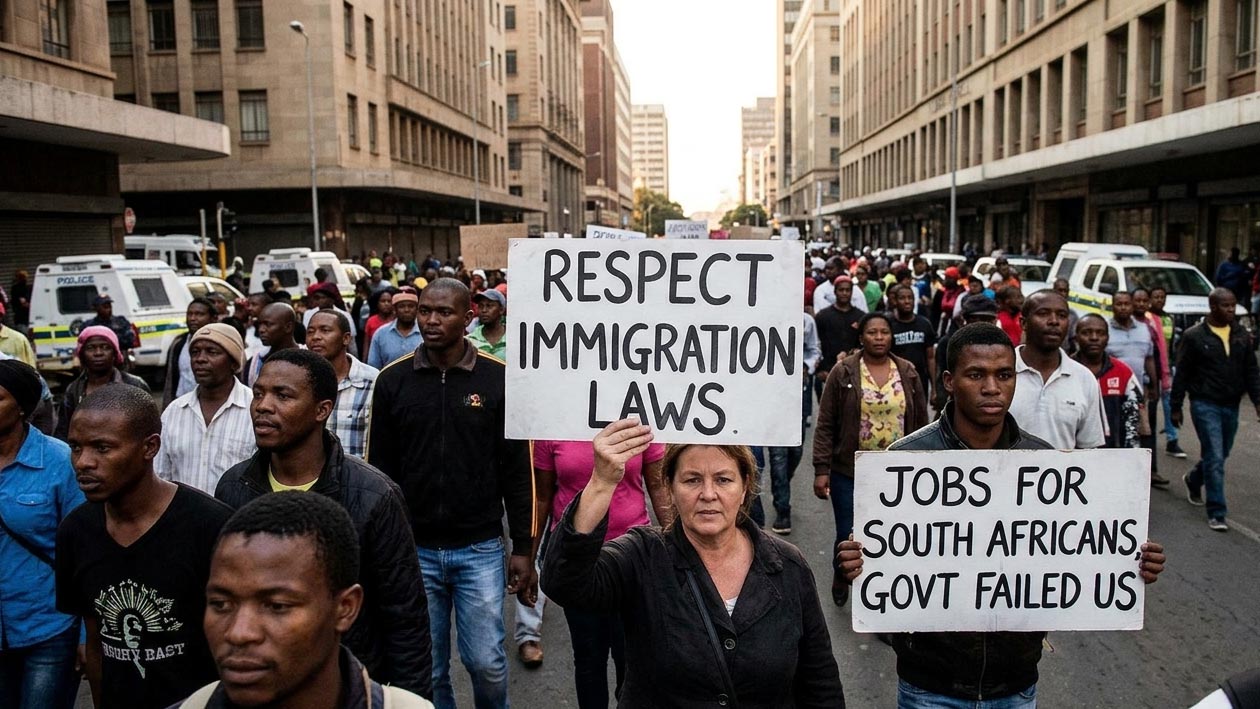
The debate around illegal immigration in South Africa is one that cannot simply be dismissed as xenophobia. It is a real issue that touches on law enforcement, border security, crime, economic participation and access to opportunities. The emergence of the March and March movement reflects growing frustration among many South Africans who believe their government has failed to adequately address illegal immigration. Yet, the movement risks becoming misdirected if its campaign does not ultimately improve the lives of ordinary South Africans.
Recent demonstrations by March and March have drawn thousands of supporters across cities such as Durban, Pretoria and Johannesburg. The movement argues that undocumented immigrants contribute to crime, unemployment and pressure on public services, while calling for stricter border control and mass deportations.
At face value, there is nothing unreasonable about demanding that immigration laws be respected. Every sovereign nation has the right to know who enters its borders and to take action against those who violate immigration regulations. Illegal immigration is not unique to South Africa. Countries across the world invest billions into border management because uncontrolled migration can create social and economic challenges.
However, the true measure of this campaign will not be how many people are removed from the country. Its success should be judged by whether South Africans experience tangible improvements in their daily lives afterwards.
If undocumented immigrants are being blamed for unemployment, then unemployment should decrease after decisive action is taken. If foreign nationals are accused of dominating certain sectors of the economy, then South Africans should visibly benefit through increased business ownership and job opportunities. If crime is one of the movement’s major concerns, then communities should become safer. Otherwise, the movement risks creating an illusion of progress while the deeper problems remain untouched.
South Africa’s unemployment crisis is one of the worst in the world, sitting above 30 per cent. It would be intellectually dishonest to suggest that illegal immigrants alone created this crisis. Years of corruption, weak economic growth, poor governance, electricity shortages, failing municipalities and declining investor confidence have all contributed to the current situation.
Removing undocumented immigrants may address part of the problem, but it cannot replace economic reform. It cannot fix failing infrastructure. It cannot solve corruption. It cannot automatically create millions of jobs. This is where the danger lies. If citizens are led to believe that deportations alone will transform the economy, disappointment will inevitably follow when the structural problems remain. There is also a diplomatic cost to consider. Reports have already emerged of foreign nationals voluntarily returning to their home countries amid growing hostility and fears for their safety. Nearly 300 Ghanaians were recently repatriated following anti-immigrant protests. Such developments can strain relations between South Africa and fellow African nations that have historically maintained strong political and economic ties. South Africa must be careful not to send the message that all foreigners are unwelcome. There is a significant difference between opposing illegal immigration and targeting every foreign national.
Legal immigrants play an important role in many economies. They establish businesses, create employment, pay taxes and contribute skills that strengthen various industries. South Africa itself has benefitted enormously from foreign investment and entrepreneurship over the years. Many businesses operating in townships and city centres have created economic activity where opportunities were previously limited. The same reality applies in Eswatini.
A South African-style anti-foreigner campaign would make little sense in Eswatini because foreign investors contribute significantly to economic activity. They bring capital, create jobs and stimulate commerce. A developing economy cannot afford to isolate people who are investing money and creating opportunities simply because they come from another country. In fact, many of the businesses that support local economies across Southern Africa exist because investors were welcomed rather than rejected. This is why balance is essential.
A country has every right to remove individuals who entered illegally and violated immigration laws. That principle should be respected. Yet people who have followed legal processes, acquired the correct documentation and contribute positively to society should not become targets of suspicion, harassment or exclusion. South Africa’s immigration debate must remain focused on legality, not nationality. The frustration driving the March and March movement is understandable. Many South Africans feel abandoned by a government that has struggled to deliver jobs, security and economic growth. Yet, if the movement wants lasting credibility, it must prove that its proposed solutions will improve the lives of citizens rather than merely provide a convenient scapegoat.
If unemployment remains high, crime remains rampant and poverty remains widespread after the deportations, then South Africans will eventually discover that the country’s challenges run far deeper than the presence of undocumented immigrants. The real victory will not be counted in the number of people removed from the country. It will be measured by whether ordinary South Africans finally see meaningful improvements in their livelihoods.
The debate around illegal immigration in South Africa is one that cannot simply be dismissed as xenophobia.