LOBAMBA – The continued underfunding of the Eswatini Posts and Telecommunications Corporation (EPTC) pension fund is placing a significant financial burden on the parastatal, which is now spending approximately E2 million every month to meet pension obligations.
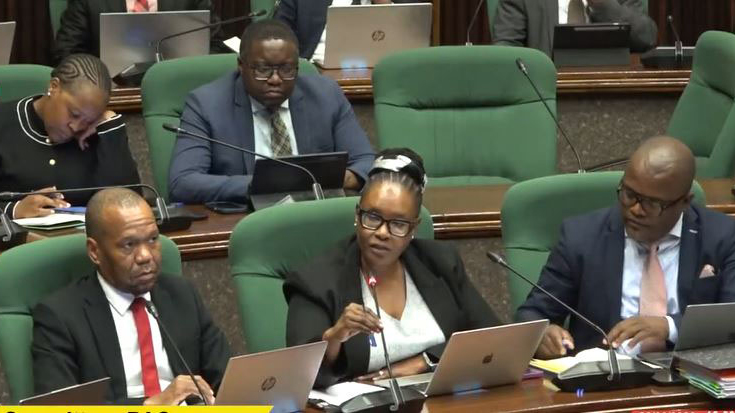
The matter was revealed during EPTC’s appearance before Parliament’s Public Accounts Committee (PAC) yesterday.
Members of Parliament (MPs) heard that the pension fund has effectively been depleted, forcing EPTC to make monthly contributions from its operational budget to ensure pensioners continue receiving their benefits and retiring employees are paid.
It was shared that for the fund to be fully funded, it needs around E400 million.
Acting Chief Executive Officer Fulatsa Sibanyoni acknowledged that the corporation remained under severe financial pressure and that efforts to implement a turnaround strategy were progressing slowly due to funding constraints.
She explained that although Cabinet had approved the turnaround strategy, no financial resources had been made available to support its implementation.
“Unfortunately, the picture is not a good one. The turnaround strategy was approved by Cabinet, but there was no funding to support it,” said Sibanyoni.
Chief Financial Officer Lungile Nxumalo informed the committee that EPTC’s 2025 financial performance had benefited from a debt write-off arrangement with the Eswatini Revenue Service (ERS), which helped reduce the corporation’s reported losses.
Despite this temporary relief, the corporation continues to struggle with mounting liabilities.
The CFO told MPs that EPTC’s operating expenses remain significantly higher than its income, resulting in debts accumulating on a monthly basis.
She said the organisation was continuing to engage creditors and negotiate payment arrangements while seeking a long-term solution to its financial challenges.
The pension fund emerged as one of the major concerns during the committee proceedings.
Responding to questions from MPs, Nxumalo confirmed that the underfunding problem remained unresolved, although efforts were under way to address it.
She revealed that the pension fund currently has no resources of its own and relies entirely on monthly injections from EPTC to meet its obligations.
“Currently, the situation is such that the pension fund has no funds at all. Every month EPTC funds the scheme to ensure pensioners and retiring employees receive their benefits. It has now become part of EPTC’s monthly operational costs,” she said.
PAC Chairperson Madala Mhlanga questioned how a pension fund that should have been protected had reached such a state.
In response, Nxumalo explained that the deficit predated the establishment of EPTC as a standalone entity and was inherited when the corporation was separated from government operations.
She further explained that the scheme was a defined benefit pension fund, which guarantees specific retirement benefits regardless of the fund’s performance.
According to the CFO, the situation worsened in the early 2000s when new employees stopped joining the scheme and were instead enrolled in alternative retirement arrangements.
As membership declined, fewer contributions flowed into the fund while pension obligations continued to increase.
Nxumalo told MPs that EPTC currently supports three retirement arrangements: a defined benefit pension fund, a defined contribution fund and a provident fund.
She explained that unlike the defined benefit scheme, the defined contribution and provident funds are fully funded because benefits are directly linked to employee contributions and investment returns.
The defined benefit pension fund, however, guarantees a predetermined benefit upon retirement, making it vulnerable when contributions and investment returns are insufficient to meet future obligations.
The committee heard that EPTC currently has approximately 570 pensioners drawing benefits from the scheme, compared to only 150 active contributing members.
Nxumalo said this imbalance had significantly contributed to the deficit.
She explained that, in addition to inheriting an existing funding gap, the scheme had experienced contribution shortfalls over many years.
Matsanjeni South Member of Parliament Sicelo Ndlangamandla sought clarity on the extent to which EPTC’s monthly support for the fund was affecting operations.
The CFO confirmed that the corporation injects approximately E2 million into the pension fund every month and acknowledged that the payments were placing additional strain on already stretched finances.
She said the corporation had been actively searching for a sustainable solution because the monthly obligation was worsening its financial challenges.
The discussion also turned to EPTC’s engagements with the World Bank regarding possible financial assistance.
Khubuta MP Masiphula Mamba questioned officials about the nature of the support being sought and whether it would take the form of a loan.
Initially reluctant to provide details while negotiations remained ongoing, EPTC officials were reminded by PAC members that Parliament required full disclosure on matters involving public entities.
Nxumalo subsequently explained that discussions with the World Bank had commenced early last year and were being coordinated through the responsible ministry.
She said the international lender had outlined a number of conditions that needed to be met before any funding could be approved.
Among these requirements, she said, was proof that EPTC would be capable of repaying any financial assistance received and that its turnaround strategy would place the organisation on a sustainable footing.
Principal Secretary Mshishimba Dlamini also addressed the committee and indicated that government would return to Parliament before the end of the year to seek support regarding the matter.
MP Ndlangamandla further pressed officials on when the pension fund could be fully restored, given the substantial monthly contributions being made by the corporation.
In response, Nxumalo explained that restoration would only be possible through a significant capital injection that would eliminate the deficit and fully fund the scheme.
She added that if the required funding were secured, EPTC’s preferred option would be to liquidate the defined benefit pension fund altogether.
According to the CFO, closing the fund would eliminate the risk of future deficits and prevent the corporation from facing similar financial pressures in years to come.
“The fund can only be restored through a substantial lump-sum injection. If funding is secured, the plan is to liquidate the fund and ensure that this type of deficit does not arise again in future,” she said.
… AG condemns EPTC for writing off Sun International, Calabash debts
LOBAMBA-The Auditor General, Timothy Matsebula has condemned the management of EPTC for writing some debts it is owed by some companies.
The issue emanates from a finding Matsebula made to the effect that the ccorporation had included in its trade receivables listing, a total amount of E1 041 026.78 relating to two customers that have been liquidated, hence there are no prospects of recovery of the amounts due.
In his report, Matsebula said he was concerned that the deficit reported in the statement of comprehensive income may be understated as a result of omission of these irrecoverable debts, and trade and other receivables may be overstated.
He said when he queried the management, he was informed that the entire amount had already been fully provided for under the allowance for expected credit losses.
He said the management said that as part of the winding down process for Sun International, EPTC successfully recovered E393 473.01 with the remaining balance deemed irrecoverable.
Management further stated that they will seek Board approval at the next meeting to formally write off the residual amount and emphasized that this write-off will not impact the income statement as the full provision had already been accounted for in prior periods.
During the PAC sitting yesterday, the AG made it known that he was not impressed with the decision to write off the debts.
He said the money owed is a lot.
“Writing off does not mean you should stop chasing the debt. You should recover the money,” the AG said.
He mentioned that EPTC has a legal team that he believes is capable to recovering monies owed.
He said the two companies owing EPTC probably have new owners who must be engaged.
He said Sun International is on the verge of being bought by a major fund.
In response, EPTC Chief Financial Officer Lungile Nxumalo said they are aware that Calabash has started operating again but under a new management.
“Regarding Su International, it will depend on whether the new management does open the doors to engaging with companies the previous owners owed,” she said.
Acting Chief Executive of the Eswatini Communications Commission Fikile Gama responding to queries raised by the PAC and the AG.