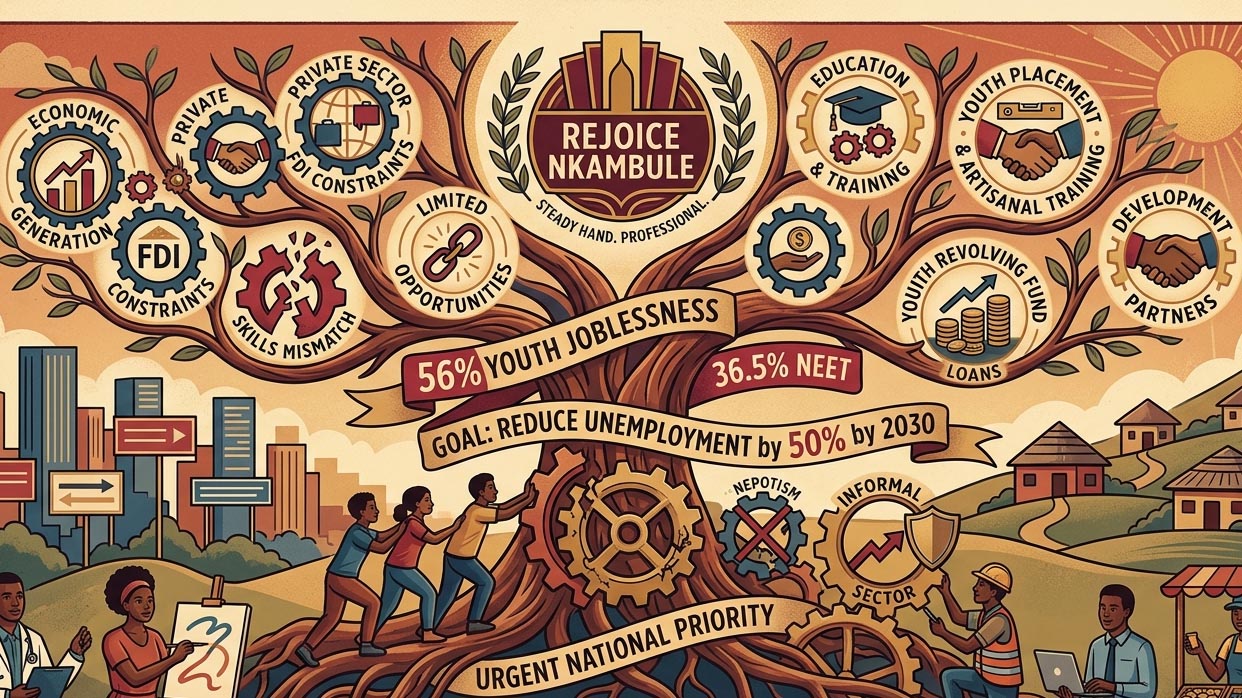
Before I address the issue, I would like us to think aloud. I would like to express my shock at the passing of Mrs Rejoice Nkambule, Deputy Director of Health Services under the Ministry of Health. I agreed with someone who was sharing his grief that she was professional, a steady hand, a leader who was welcoming and always had a smile as she welcomed all who engaged her.
Condolences to all her colleagues in the Ministry of Health, as well as the entire health sector fraternity, who have lost an experienced and hard-working leader who always sought solutions to intractable challenges. Condolences to the Nkambule family for losing a wife, mother and aunt, to mention a few.
We also pass our condolences to her Church for losing a member who dedicated her life serving God in the midst of heavy work responsibilities.
We can only draw strength from the infallible Word of God in Rev 14:14: “Then I heard a voice from heaven say write this: ‘ Blessed are the dead who die in the Lord from now on’, says the Spirit. “They will rest from their labour, for their deeds will follow them”. Rest in eternal peace, Msutfu!
Coming to today’s matter, unemployment in Eswatini is well documented. The Afrobarometer report states: “In Eswatini, where more than half (56 per cent) of youth aged 15-35 struggle with joblessness (Ministry of Labour and Social Security, 2023), government and development partners have established a range of initiatives to facilitate youth participation in the labour market. This is aimed at reducing youth unemployment by 50 per cent by 2030. One of Eswatini’s most well-regarded programmes is the Eswatini Youth Development Programme, whose two-pronged approach to the youth unemployment crisis focuses on both graduate placement and artisanal training (Mlangeni, 2022).
For aspiring entrepreneurs, the Youth Enterprise Revolving Fund provides collateral-free loans of up to E200 000 to assist young people in their entrepreneurial pursuits.
Despite these efforts, limited job opportunities and a sluggish economy threaten Eswatini’s ability to keep its young and energetic human resources at home.
While 25 000 young people enter the labour market each year, only 1 000 new jobs are created annually (World Bank, 2025a). More than one in three young EmaSwati – 36.5 per cent in 2023 – are not in education, employment or training (World Bank, 2025b).”
Why does youth unemployment persist?
The Eswatini economy struggles to generate enough formal jobs to keep pace with the growing number of young people entering the labour market. The private sector is small, and foreign direct investment (FDI) is constrained; thus, fewer new companies are hiring entry-level workers. The national education system has been widely criticised by institutions such as the World Bank for producing graduates whose skills do not match the needs of the modern job market.
Young emaSwati face a harsh cycle where entry-level positions and internships often require prior work experience. This leaves recent school and university leavers struggling to break into the formal workforce.
Because formal jobs are so scarce, about 40 per cent of the employed workforce operates in the informal sector, which lacks job security, health insurance and social benefits. Young people often face systemic challenges such as nepotism, corruption and favouritism, making it even harder to secure a fair shot at entry-level openings.
It is indeed commendable that the government has identified youth unemployment as a national priority. The 2020 Youth Policy, the State of Young People Report 2025, Youth Coordination Framework, Youth Fund and some critical initiatives by government, with assistance of development partners, point to government’s realisation that youth unemployment must be addressed urgently. However, the reality on the ground is that the problem is worsening. With Eswatini’s economic prospects already threatened by the war in Iran, which has resulted in the oil crisis, the youth unemployment crisis will persist into the foreseeable future.
It is unfortunate that young people trapped in unemployment and poverty are losing hope as the systems favour the well-connected. Sadly, some have lost their lives by committing suicide. This situation cannot be allowed to continue because the very future of Eswatini is at stake, as we all know that young people are the future. Hence, the need to continue to search for lasting solutions.
What needs to be done?
Youth unemployment is a national crisis that the government alone cannot effectively address. Hence, addressing youth unemployment requires a multifaceted approach that tackles economic factors, skills gap, education and training, as well as systemic issues such as unfair employment practices.
It is not just a development issue; it is the root cause of inequality, disillusionment and division in our society. Hence, the need to address nepotism and corruption that have become a norm in our country.
Youth must also not give up but should explore opportunities from government and partners.
Before I address the issue, I would like us to think aloud. I would like to express my shock at the passing of Mrs Rejoice Nkambule, Deputy Director of Health Services under the Ministry of Health.