A landmark report by Oxfam, titled “A Tale of Two Continents,” recently exposed the extreme wealth gap and systemic inequality gripping Africa. The report contrasts an Africa ‘tailored for the super-rich’ with the harsh reality of hundreds of millions of citizens trapped in entrenched poverty. Crucially, the authors note that despite pockets of robust economic growth, the continent remains deeply afflicted by poverty. The gap between the rich and the poor across Africa is now greater than in any other region of the world, except for Latin America. Consequently, the promise of achieving the United Nations Sustainable Development Goals and the African Union’s Agenda 2063 remains a distant dream for millions, particularly the youth.
According to Oxfam, many African nations are currently wrestling with the poisonous legacy of historic slavery and colonialism, exacerbated by failed macroeconomic policies historically imposed by the IMF and the World Bank.
We must draw inspiration from this report to look honestly at our own kingdom. We must examine how inequality is actively destroying the social foundation of Eswatini, a nation that routinely wears the mask of a developing, lower-middle-income country.
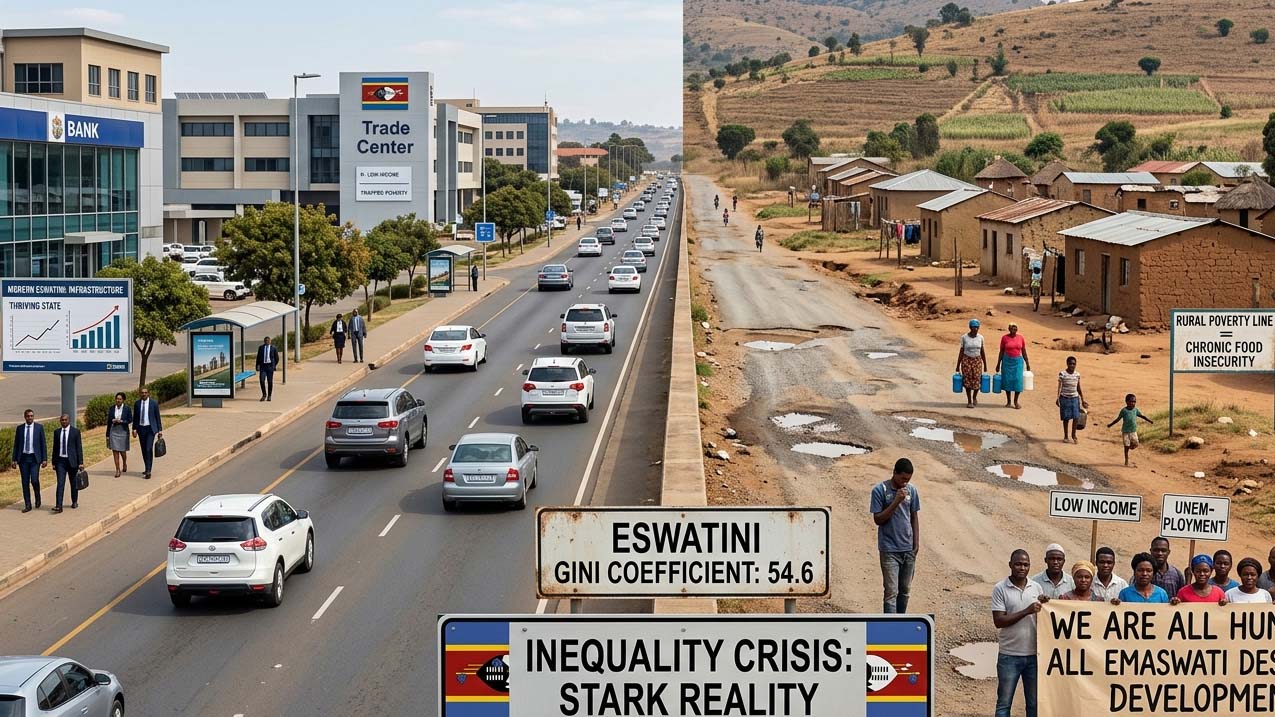
The structural developments showcased during the celebration of His Majesty’s 40 years of reign paint a picture of a modern, thriving state. We see sweeping highways, urban skylines marked by high-rising buildings, bustling trade networks and modern cars congesting the Mbabane-Manzini corridor during the day.
However, the moment one leaves these urban hubs and ventures into peri-urban and rural areas, a starkly different reality emerges. Mud houses and poorly maintained gravel roads. This duality reflects the grim fact that Eswatini remains one of the most unequal countries on Earth, carrying a staggering Gini coefficient of 54.6. This structural chasm does more than just separate the rich from the poor, it actively forces the majority of emaSwati into a desperate, daily struggle for survival.
Data from domestic agencies, the World Bank and the United Nations highlight this profound paradox: While national GDP figures suggest a modest level of national wealth, the dividends are heavily concentrated at the top. Over 54 per cent of the population lives below the lower-middle-income poverty line of US$4.20 per day. These are emaSwati who lack sufficient food, struggle to send their children to school and are left highly vulnerable to human rights violations without any institutional recourse.
This economic stagnation is further compounded by unprecedented youth unemployment, which currently stands at a staggering 56 per cent among young emaSwati aged 15–24. In an environment where employment is too often treated as a commodity for sale, dependent entirely on ‘who you know’, qualified young people from impoverished backgrounds face a near-impossible barrier to entry.
This stark reality is mirrored in the 2025 Afrobarometer report. The survey indicated that a vast majority of emaSwati went without a cash income (75 per cent), medical care (75 per cent), food (68 per cent), and cooking fuel (53 per cent) at least once over the past year, while nearly half (47 per cent) lacked access to clean water.
The situation is even more difficult for women living within our patriarchal social structures. Gender disparity remains one of the most defining and damaging features of Eswatini society. Women underrepresented in critical positions in public and private sectors.
Furthermore, inequality is physically manifested in the empty shelves of our local health facilities. While the elite echelons of society access world-class, private healthcare or travel abroad for medical treatment, the impoverished majority must rely on a severely underfunded public healthcare system.
Education offers little escape. While primary school access is near-universal, climbing the ladder to secondary or tertiary education requires capital that rural families simply do not possess. As a result, national statistics point to a sharp decline in enrolment at secondary and high school levels. Rural schools are systematically underfunded and face chronic teacher shortages. To make matters worse, accessing State scholarships requires specific credits that structurally disadvantage learners coming from poorly funded, rural backgrounds.
Compounding these issues, Eswatini’s rural poor depend almost entirely on rain-fed, subsistence agriculture. Driven by persistent droughts and unpredictable weather patterns linked to climate change, crop yields continue to decline, leaving one-fifth of the entire population chronically food insecure.
Inequality demands urgent, aggressive action. It is time for government to confront this crisis by first acknowledging that systemic disparity is a destabilising reality that must be met with political force.
It is time to acknowledge that all emaSwati deserve to enjoy national development dividends, especially those who have been systematically left behind.
Those on the fringes of our society must be given a structural ladder to climb out of the cycle of poverty and helplessness. Social safety net programmes must be treated as a fundamental human right, not a political privilege.
The poor must oppose being treated as second-class citizens. We are all human!
A landmark report by Oxfam, titled “A Tale of Two Continents,” recently exposed the extreme wealth gap and systemic inequality gripping Africa.