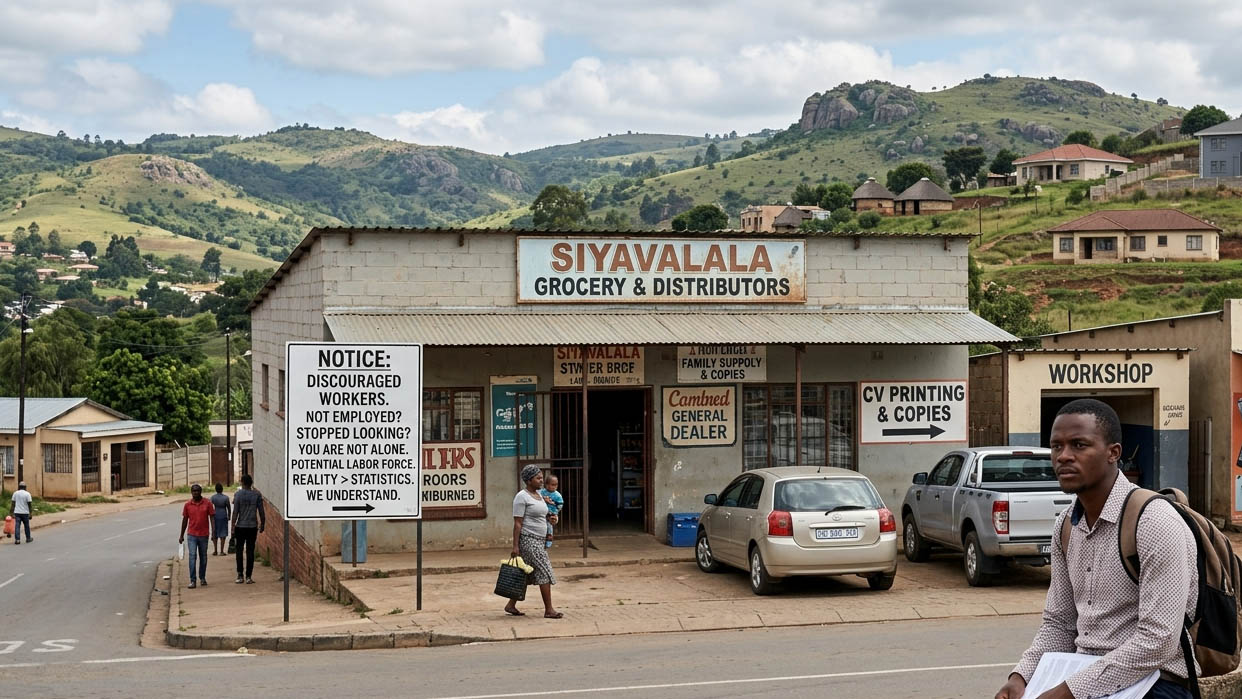
The 2025 Integrated Labour Force Survey says Eswatini created 10 871 jobs in the past two years. Excellent. Somebody should immediately inform the 136 487 unemployed people because they appear not to have noticed.
While we are at it, perhaps somebody should also notify the 91 323 emaSwati who have stopped looking for work altogether. The survey calls them the ‘potential labour force’. Ordinary people call them discouraged.
Together, that is 227 810 people facing labour market difficulties. That is not a statistic. That is a population. Yet somehow, we are expected to celebrate. Now, before anyone accuses this column of being negative, let us acknowledge the progress. The unemployment rate fell from 35.4 per cent to 33.5 per cent. That is good.
The problem is that for many families, unemployment statistics are like weather forecasts. They sound encouraging on the radio, but bear little resemblance to what is happening outside. The survey says jobs increased. The graduate sitting at home says otherwise. The mother paying transport money for her unemployed son says otherwise. The father who proudly attended graduation four years ago and is now financing another round of CV printing says otherwise. And that brings us to the questions nobody seems eager to answer. The country produces an estimated 3 500 graduates every year. How many of them have been absorbed into active employment? How many government-sponsored graduates have found jobs substantial enough to begin repaying their scholarship loans? How many are working in positions related to the qualifications taxpayers funded? Most importantly, where is the national scorecard?
If we are serious about employment, we should not merely count graduates crossing the stage in gowns. We should count how many eventually cross into workplaces. Otherwise, we are celebrating production while ignoring outcomes. The survey offers another fascinating discovery. Employment increased. Underemployment also increased. In other words, more people have jobs, but more people also want additional working hours because the jobs they have are not enough.
Now that takes talent. Imagine a football team announcing that it scored more goals while simultaneously conceding more goals. You would have questions. Yet in our labour market, employment rises and labour distress rises at the same time.
The official explanation is that jobs are being created. The lived reality is that many of those jobs are not creating livelihoods. That distinction matters. A seasonal job is not the same as a career. A few hours of work a week is not the same as economic security. Being counted in a survey is not the same as being able to pay school fees. Then there is youth unemployment.
Fifty-two per cent. More than half of economically active young people aged between 15 and 24 cannot find work. At this point, unemployment among the youth is no longer a challenge. It is a national institution.
It has survived policy announcements, economic recovery strategies, conferences, workshops, consultations and stakeholder engagements. If unemployment were a civil servant, it would already qualify for a long-service award. The survey further tells us that nearly 200 000 young people are neither employed, in education, nor in training. Two hundred thousand. That number should terrify every policymaker.
Instead, we seem content to discuss percentages while an entire generation waits for opportunity to arrive. Which brings us to the biggest question raised by this survey. Where are the jobs we keep hearing about?
Every year, there are announcements. Investments are announced. Factories are announced. Projects are announced. Empowerment programmes are announced. Tenders are announced. Jobs are announced. The jobs themselves remain remarkably shy. And nowhere is this contradiction more glaring than in the debate around the more than E17 billion worth of major projects awarded in recent years. We were told these projects would stimulate economic activity.
We were told they would create jobs. We were told they would drive growth. Fair enough. Where is the evidence? Not in speeches, but in the labour market. The labour survey has arrived carrying a calculator and asking uncomfortable questions. The contracts certainly exist and the unemployment crisis also exists.
If billions upon billions of Emalangeni have flowed into projects supposedly creating opportunities, why does Eswatini remain one of the worst-performing labour markets in SADC?
Why does youth unemployment remain above 50 per cent? Why are nearly 100 000 people too discouraged to continue looking for work? Why is manufacturing still stuck at 7.3 per cent of employment? Why are women losing jobs while men gain them?
The numbers simply refuse to cooperate with the narrative. Perhaps that is because we are measuring the wrong thing. Maybe the question is no longer whether jobs are being created. Maybe the question is what kind of jobs are being created. If a low-paying, insecure job shifts a percentage point on a statistical table but does not change a household’s circumstances, has the economy really progressed? If employment grows while underemployment grows too, who exactly is benefitting? These are not academic questions. They determine whether families eat, whether graduates stay and whether taxpayers receive a return on the investments made in education and infrastructure. The irony becomes even sharper when one considers the concerns raised by business organisations. Local companies buy locally, employ locally, pay taxes locally, purchase fuel, materials and services locally. The money circulates. The multiplier effect works. Yet, many local firms argue they continue to watch major opportunities pass them by. And guess who keeps paying taxes while struggling to access major contracts, meaningful subcontracting opportunities and genuine empowerment? The local entrepreneur. The local contractor. The local business owner. The very people expected to expand the tax base and support economic growth. Imagine contributing to the feast, helping pay for the food and setting up the tables, only to discover you are not on the guest list. That is how economic empowerment begins to sound when measured against the labour statistics.
The point is not to oppose foreign investment. Every serious economy needs investment. The point is to ask whether public spending is generating public benefit on the scale promised. That is the conversation the labour survey has forced upon us. Yes, 10 871 jobs were created. That is progress, but 136 487 people remain unemployed. More than 91 000 have stopped looking. Nearly 200 000 young people are disconnected from employment, education or training.
The 2025 Integrated Labour Force Survey says Eswatini created 10 871 jobs in the past two years. Excellent. Somebody should immediately inform the 136 487 unemployed people because they appear not to have noticed.