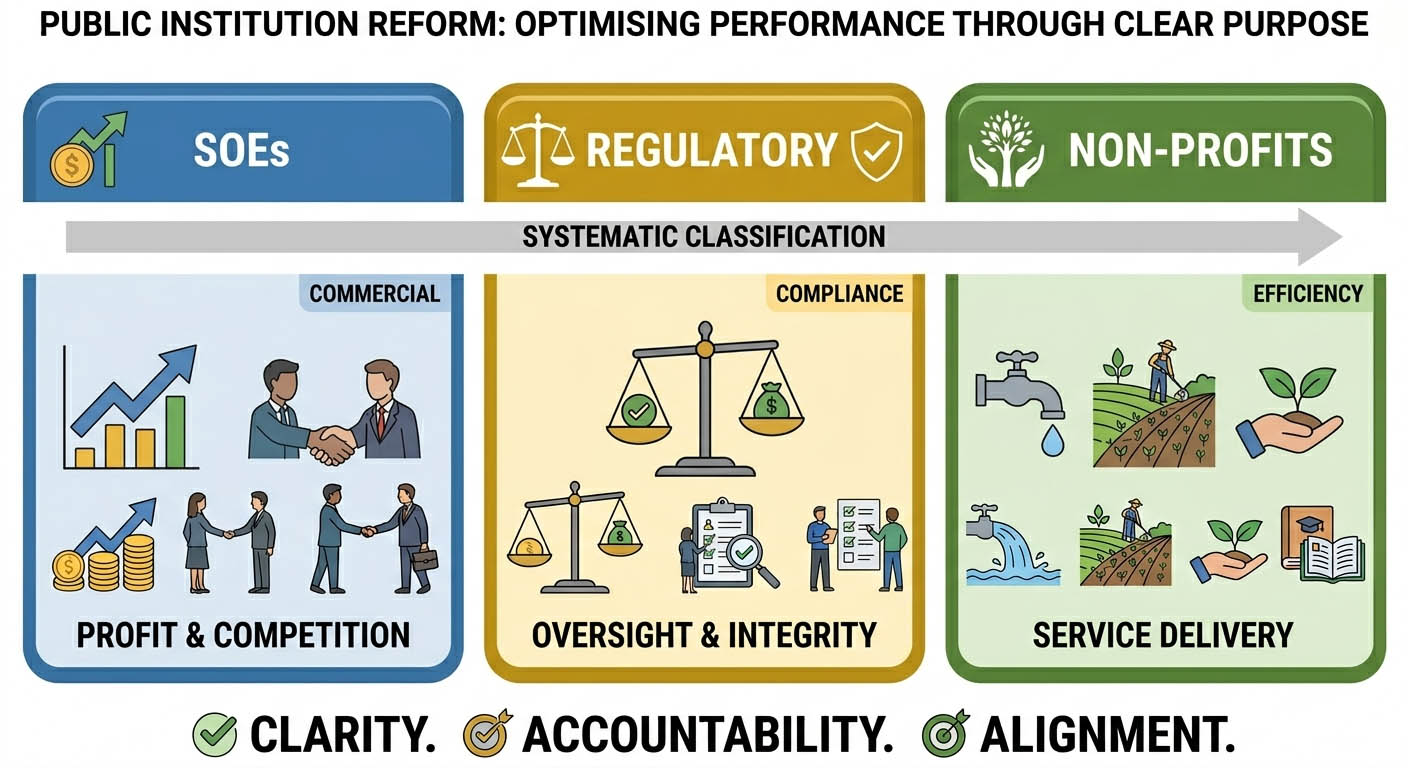
The kingdom’s economic landscape is shaped by a diverse array of public institutions, i.e., State-owned enterprises (SOEs), regulatory bodies, and non-profit parastatals. Each plays a distinct role in national development, yet the lack of a clear methodology for separating and classifying them has often blurred their mandates. This lack of clarity risks inefficiency, duplication of functions and misaligned expectations. To strengthen governance and optimise performance, it is imperative that the country adopt a systematic framework that distinguishes these entities by purpose: Profitability, regulation or service delivery.
The case for a methodology
Public institutions are often grouped under the broad term ‘parastatals,’ yet this generalisation obscures their distinct roles. A clear methodology is needed to separate them into three categories: State-Owned Enterprises, Regulatory Bodies, and Non-Profit Parastatals. This separation would align expectations, strengthen accountability and ensure each institution contributes appropriately to national development.
Profitability and competition
SOEs in Eswatini include entities such as the Eswatini Electricity Company, Eswatini Posts and Telecommunications Corporation, etc. These enterprises operate in sectors where commercial viability is possible and necessary. Their mandate should be clear: Strive for profitability in a competitive environment. Profitability ensures sustainability, reduces reliance on government subventions and contributes to national revenue. However, profitability must not come at the expense of stifling competition. SOEs should compete fairly with private firms, avoiding monopolistic practices that hinder innovation. For example, telecommunications and energy markets benefit from competition, which drives down costs and improves service quality. A methodology that enforces competitive neutrality, where SOEs and private firms operate under the same rules, would prevent unfair advantages and foster a dynamic economy.
Oversight and market integrity
Regulatory institutions such as the Eswatini Competition Commission, the Eswatini Energy Regulatory Authority and the Eswatini Public Procurement Regulatory Agency are not designed to generate profit. Their role is to safeguard market integrity, enforce standards and protect consumers. Expecting them to operate as commercial entities distorts their mission.
Instead, regulatory bodies should be evaluated based on their effectiveness in ensuring compliance, transparency and accountability. For example, the Competition Commission’s success lies in preventing anti-competitive practices, not in generating revenue. Similarly, the Energy Regulatory Authority’s mandate is to balance consumer protection with investor confidence in the energy sector. A methodology that clearly separates regulators from SOEs would prevent confusion and strengthen governance.
Efficiency in service delivery
Non-profit parastatals such as the University of Eswatini, EWADE and the National Agricultural Marketing Board exist to deliver public goods. Their mandate is not profitability but operational efficiency. They mobilise communities, support smallholder farmers and enhance food security. Their success should be measured by service coverage, cost-effectiveness and impact on livelihoods.
For instance, ESWADE’s irrigation projects have transformed rural agriculture, integrating smallholders into commercial value chains. NAMBoard ensures stable markets for farmers, protecting them from volatility. UNESWA trains the critical mass of human capital required for developing the nation. These institutions thrive when they minimise waste, maximise outreach and deliver services equitably. A methodology that emphasises efficiency benchmarks, such as cost per beneficiary or service delivery timelines, would sharpen their accountability.
Why separate
The absence of a clear methodology on assessment of SOEs has led to overlapping mandates and blurred accountability among public institutions. Some SOEs operate with regulatory powers, creating conflicts of interest, while others rely heavily on government subsidies despite being commercial in nature, undermining fiscal discipline. At the same time, non-profit parastatals are often judged by profitability metrics, which misrepresent their true purpose. Establishing a separation between these entities would bring significant benefits. It would provide clarity of mandate, ensuring each institution is evaluated according to its rightful role: Profitability for SOEs, regulation for oversight bodies and service delivery for non-profits. Accountability would improve, as performance indicators could be tailored to each category, preventing unfair comparisons. Fiscal discipline would be strengthened, with SOEs expected to generate revenue while non-profits justify subventions through efficiency. Competition would be enhanced, as regulators ensure a level playing field and SOEs compete fairly with private firms. Finally, policy alignment would be improved, allowing government strategies to target each category appropriately rather than applying a one-size-fits-all approach.
Implementation
Developing a clear methodology for classifying Eswatini’s public institutions requires collaboration among policymakers, economists and civil society, and should follow a structured process. The first step is mapping all institutions to create a comprehensive inventory of parastatals, SOEs and regulatory bodies. Next, clear criteria must be defined to distinguish them according to profit motive, regulatory mandate or service delivery.
Once classified, performance indicators should be tailored to each category: Profitability ratios for SOEs, compliance rates for regulators and efficiency metrics for non-profits. Legislative reform would then be necessary to update laws and make these mandates legally binding. Finally, public communication is essential to educate citizens on the distinctions, fostering transparency, accountability and trust in the system.
In conclusion, the country urgently needs a clear methodology to distinguish State-owned enterprises, regulatory bodies and non-profit parastatals. Such separation will sharpen mandates, strengthen accountability and align performance with purpose. By clarifying roles, the nation can build a more efficient, competitive and sustainable economy.
The kingdom’s economic landscape is shaped by a diverse array of public institutions, i.e., State-owned enterprises (SOEs), regulatory bodies, and non-profit parastatals.