Eswatini has taken a significant step towards building a sustainable, resilient and competitive agriculture sector with the official launch of the GEF8 Food Systems Transformation Project.
The initiative, valued at US$3.8 million (equivalent to E61.38 million), was unveiled at Royal Villas on Thursday March 19, 2026, by the Ministry of Agriculture in partnership with the Ministry of Tourism and Environmental Affairs and Eswatini Water and Agricultural Development Enterprise (EWADE), with support from the Food and Agriculture Organization of the United Nations (FAO).
The project forms part of the Global Environment Facility’s Food Systems Integrated Programme and reflects Eswatini’s commitment to transforming its agrifood systems while strengthening food security, climate resilience and inclusive economic growth.
In his keynote address, the Minister for Agriculture, Mandla Tshawuka, described the project as a ‘major stride’ in advancing national development priorities. He emphasised that the initiative aligns closely with Eswatini’s strategic frameworks, including efforts to achieve food sovereignty, improve productivity and reduce post-harvest losses.
Through targeted interventions, the project aims to restore degraded landscapes, strengthen agricultural value chains and build resilience among communities.
A key highlight of the programme is its strong focus on three priority landscapes, Ngwempisi, Malolotja, and Lubombo, where livelihoods are deeply tied to agriculture and natural resources.
Key focus areas and targets
The minister outlined the following interventions and targets, which will guide implementation:
- Rangeland rehabilitation
- Water and soil conservation
- Diversification of crops
- Improved access to markets
- Reduction of invasive species
- Community-driven solutions for sustainable landscape governance
The project will specifically target:
- 25 000 direct beneficiaries (50 per cent women, 30 per cent youth)
- 3 000 farmers adopting climate-smart technologies
- 1 800 households diversifying production
- 15 000 hectares under sustainable land management
- 6 500 hectares of degraded land restored
- Improved water security for 10 000 people
- Conservation of biodiversity corridors
- An estimated 350 000 tonnes of CO₂ equivalent in carbon benefits.
The minister stressed that these interventions are critical to ensuring long-term sustainability, improved livelihoods and environmental protection.
The project also underscores the importance of partnerships. Government acknowledged that challenges such as climate change, land degradation, water scarcity and rising input costs cannot be addressed in isolation. Collaboration with development partners, financial institutions, private sector players and communities is central to success.
Special recognition was given to the FAO for its technical support and continued partnership with Eswatini. Through the GEF8 facility, the country has been able to unlock vital resources to accelerate transformation in the agriculture sector.
FAO representative Patrice Talla described the project as a milestone that will influence Eswatini’s food systems for generations. He highlighted that agriculture supports nearly 80 per cent of rural livelihoods, yet faces mounting pressures from climate shocks, biodiversity loss and limited participation of women and youth.
The project responds directly to these challenges by promoting climate-smart agriculture, strengthening governance and financing systems, improving production landscapes and fostering innovation. It also builds on existing initiatives, with co-financing exceeding US$32 million, further amplifying its impact.
Implementation will be led by EWADE, working closely with the Eswatini Agricultural Development Fund (EADF), ensuring strong national ownership and accountability.
Meanwhile, the Ministry of Tourism and Environmental Affairs reaffirmed the importance of climate finance and coordinated action in driving sustainable development. The project is expected to enhance ecosystem services, protect biodiversity and support inclusive value chains that empower farmers, women and youth.
In closing, the minister called for collective action from all stakeholders, including government entities, traditional authorities, the private sector and development partners. He reaffirmed government’s commitment to transforming Eswatini’s agrifood systems into a foundation for economic growth, resilience and shared prosperity.
The launch marks the beginning of what stakeholders describe as not just a project, but a long-term movement towards a more sustainable and food-secure Eswatini.
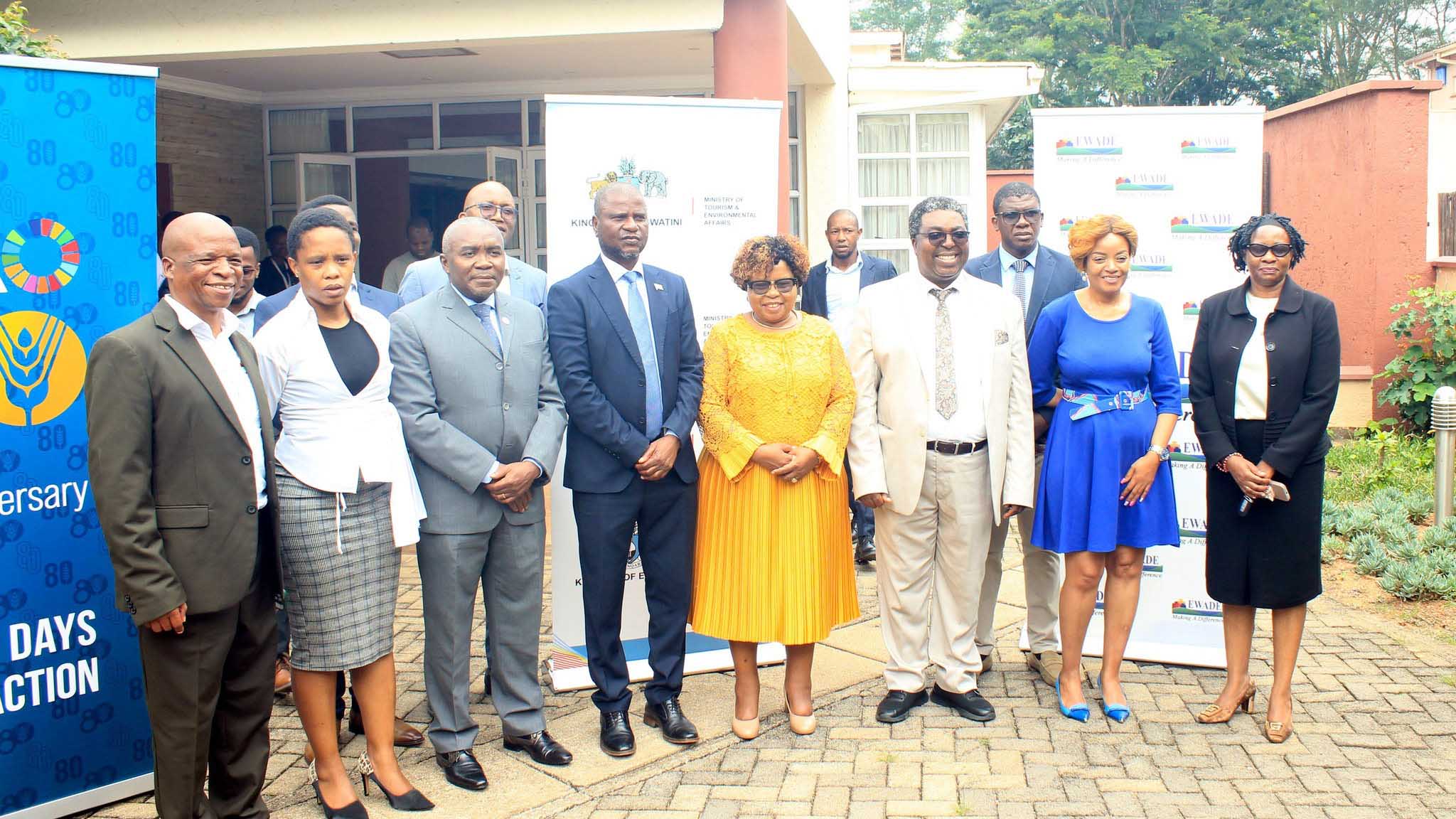
Minister for Agriculture Mandla Tshawuka (4th L) and Minister for Tourism and Environmental Affairs Jane Simelane (4th R) with dignitaries from the different organisations in partnership with the Ministry of Agriculture. (Pics: FAO)