MAPHALALENI – Imagine a school having three head teachers posted to it within the space of a single year.
For the community surrounding Maphalaleni High School, this has not been a hypothetical scenario, but a lived reality, one that has raised concerns about the stability of the institution and its declining academic performance.
The school, located under the Maphalaleni Inkhundla in the Hhohho Region, has for decades served as the main high school for several surrounding rural communities. For many families, it remains the closest and most accessible option for secondary education.
Learners typically arrive from nearby primary schools such as Mcengeni, Meleti, Mabheleni, Lubhaceni and Malandzela. For years, the school has been the natural progression point for pupils completing their primary education in the area.
In recent times, the institution has found itself battling a crisis of discipline and leadership instability. According to some community members, these challenges are reportedly tied to the growing influence of the illegal dagga trade among local youth.
Maphalaleni Inkhundla is represented in Parliament by Mabulala Maseko, who also serves as Minister for Public Service.
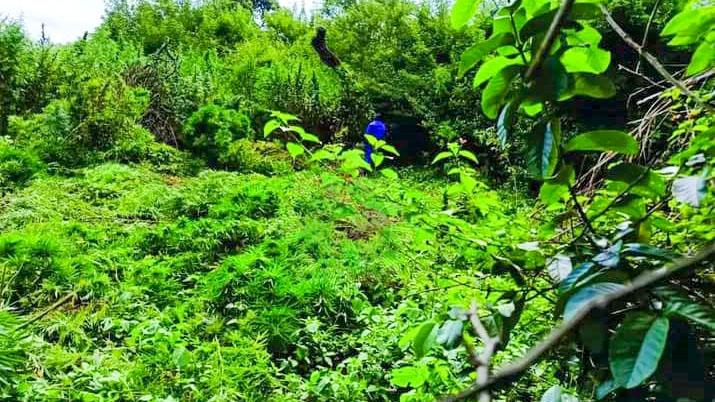
While the constituency is widely regarded as one of the country’s maize-producing areas, it is also a fact that a number of families across the communities also cultivate dagga, an illegal crop that nonetheless remains a source of income for several households.
According to a parent who spoke on condition of anonymity, the school has struggled to retain head teachers over the past two years. “Last year alone, we had three headteachers posted here,” said the parent, who confirmed having a child enrolled at the school.
The current head teacher, Vusi- muzi Dlamini, was posted to the school in December last year following the departure of the second head teacher just last year alone.
The issue of leadership instability surfaced prominently during a meeting held last week between the school administration, parents and local traditional leaders.
During the meeting, it has been reliable gathered that several parents blamed the situation on unruly behaviour by certain pupils, who they said have increasingly turned the school into what one parent described as ‘their own playground’.
Indvuna YeMcuba Alpheus Mhlanga was initially reluctant to comment when contacted on Thursday. However, he did explain that as the inner council, their responsibility was simply to welcome any head teacher posted to the school. He further confirmed that the institution had indeed experienced frequent leadership changes.
Going forward, Mhlanga said the community had committed itself to supporting the current head teacher in efforts to restore stability and improve academic results. While cautious about discussing the matter publicly, Mhlanga acknowledged that the involvement of some pupils in dagga cultivation had complicated efforts to enforce discipline.
He noted that some learners involved in the trade had effectively become breadwinners in their households; a situation he said has made it difficult for parents to reprimand them. “They have become belungu,” said Mhlanga, using a local term often used to describe someone with money.
*Full article available on Pressreader*
Though Maphalaleni Inkhundla is known largely as a maize crop baskets, it is also an open secret that several homesteads cultivate dagga for income purposes. (Pic: Internet)