MBABANE – In a rare case of a security breach, while Cabinet was deliberating on national issues, an uninvited intruder was reportedly listening in and following the meetings.
So serious was the security breach that on many occasions, important content from the meetings made its way to external entities and the media, who allegedly used it for their own benefit.
This breach was confirmed by the Prime Minister (PM), Russell Dlamini, in an exclusive interview.
The breach was so serious that there were even attempts to bug the PM’s mobile communication devices.
These moves were thwarted as well. However, the PM’s Office disclosed that it was yet to thoroughly sweep Cabinet offices for any listening devices or listening bugs that may still be hidden at Hospital Hill.
“What remains now is a holistic sweep of both the Cabinet offices and official office,” he said.
He, however, stated that most threats had been neutralised.
This was after the PM’s Office engaged experts to remove the threats.
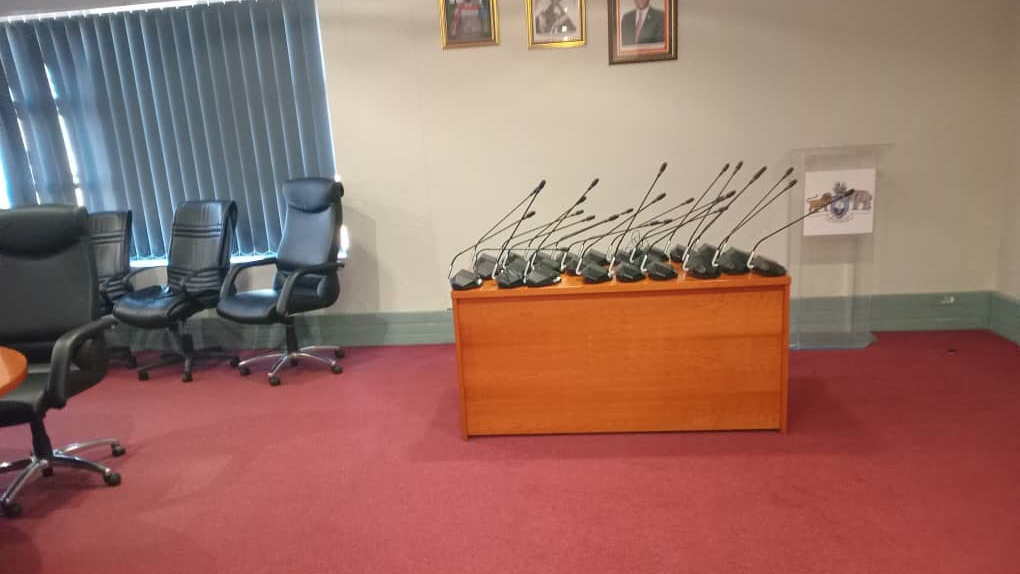
The Times Sunday visited the PM’s Office, whereby boardrooms which had wireless communication systems used by ministers had been removed.
These were removed as part of efforts to eliminate all listening devices or secret transmission microphones, which could potentially be used by malicious actors to eavesdrop on meetings involving ministers and officials.
According to sources, this is the very system that had been manipulated externally to transmit whatever was communicated in the boardrooms.
Meanwhile, the PM’s Office said since the end of February 2025, there have been no leaks of critical Cabinet meetings.
In an interview, the PM described the incident as a serious case of cybersecurity breach, which has forced his office to reassess its security protocols.
Neither the PM nor his office has disclosed the source of the spying or the individual who was secretly monitoring Cabinet meetings.
During the interview, the PM emphasised that the security breach in his office and the Cabinet has been addressed.
“We have since improved security. We have implemented several measures to ensure this does not happen again,” he said.
The PM’s Office noted that since addressing the issue of information security, there have been no further leaks from Cabinet meetings.
An officer within the PM’s security cluster said ministers are now able to discuss national matters openly and in confidence, with no fear of information leaking either from his office or the Cabinet boardrooms.
As part of the new security measures, visitors entering the PM’s Office are now required to hand over their mobile phones and electronic devices to police officers who provide security.
Meanwhile, government has allocated approximately E40 million for security upgrades at the Prime Minister’s Office at Hospital Hill and his official residence.
These funds were sourced from development partners of the kingdom and government.
It is standard practice globally for heads of government to be afforded high-level security.
As part of the security upgrades, the PM’s office seeks to procure bulletproof doors and windows, the construction of a perimeter wall and the installation of surveillance equipment all intended to safeguard the third-most important official in the country’s political hierarchy.
This expenditure comes amid heightened threats to the PM’s safety, as outlined in his office’s annual report to Parliament for the 2024/25 fiscal year.
Under the section titled Government Security Office Challenges and Mitigation, the report states that the high threat level against the prime minister’s residence posed a significant security risk.
The PM’s Office also highlighted the urgent need for advanced anti-bugging equipment. “This is a serious threat to national security and urgent action is critical. Constant security scanning and office sweeps are required to mitigate this risk,” the report reads.
This revelation comes at a time when the premier publicly revealed the existence of a cabal operating within the country.
When speaking about the cabal in Parliament, he clarified that he was not referring to a group with shared interests, but to individuals with a common purpose.
“Cabals are common in most countries because, by nature, they work against governments using underhanded tactics. By pointing out the presence of a cabal, I was not accusing all parliamentarians or media members of being part of it or being controlled by it,” he said.
Speaking about the existence of a cabal, Dlamini stressed that the information was intended as a warning to relevant stakeholders and not as a name-and-shame exercise.
Meanwhile, the E40 million mentioned includes funds already spent on security since the PM assumed office, as well as funds allocated for the 2025/26 financial year.
According to the budget estimates, the government has allocated E23.4 million in donor funds to a project titled Improvement of Security and Surveillance at the Prime Minister’s Office, covering the period from April 1, 2025 to March 31, 2028. These funds are provided by the Kingdom’s donor partners.
The prime minister’s private residence at Tubungu, Matsapha, will also be upgraded.
Sources close to his office indicated that part of the funding has been used to construct housing for police officers stationed at the PM’s residence.
According to the annual report from the PM’s Office, the ‘high threat level directed at the prime minister’s residence posed a security threat.’
Reporters who visited the residence recently observed building rubble outside the wall surrounding the double-storey house.
Not Zimbabwean, liSwati in charge of pm’s intelligence
MBABANE – Against popular belief that Zimbabweans are running the prime minister’s security intelligence, the Times SUNDAY can reveal that a liSwati is in charge of the security.
The prime minister has enlisted diplomat and security expert Mduduzi Mbingo to join his security team.
Mbingo, a decorated intelligence operative, is now officially part of Prime Minister Russell Dlamini’s security detail.
He is also a former police officer.
Mbingo has served in various diplomatic missions abroad and has been abroad serving in various assignments as assigned by government.
The respected diplomat’s most recent assignment was as Chargé d’Affaires at the Kingdom of Eswatini’s mission to the United Nations in New York.
The premier revealed that Mbingo, who was involved during a press conference held on Friday, has been specifically engaged by his office to address and neutralise security threats.
Dlamini added that he was pleased with the progress and visible results achieved so far.
The Times Sunday briefly spoke to the reserved, but widely respected officer. Mbingo expressed satisfaction with his new role within the PM’s security team but declined to disclose the specifics of his assignment.
Officers within the prime minister’s security team shared how Mbingo’s arrival has positively transformed their operations.
“He is very intelligent and a hard worker. We respect him because all his suggestions regarding the safety of the VIP have been spot on,” said one officer, who requested anonymity as he was not authorised to speak on behalf of the team.
Since his arrival, he said there has been a remarkable change in the security system in the protection of the PM and, of note, is the halt of information leaks around the PM.
Some of the gadgets that were removed in one of the offices in Cabinet. (Courtesy pic)