Madam,
Every year, on June 16, South Africa falls silent to remember the thunderous defiance of its youth. National Youth Day is more than a commemorative date on the calendar; it is a sacred invocation of the 1976 Soweto Uprising. On that day, thousands of students marched to protest the oppressive imposition of Afrikaans as a medium of instruction, a policy designed to deepen their subjugation under the Bantu Education system. When the apartheid regime responded with live ammunition, the blood of children like Hector Pieterson stained the streets, igniting a fire of resistance that would eventually consume the system of white supremacy.
However, the story of South Africa’s liberation was never confined to its borders. It was a regional struggle, sustained by the grit and solidarity of its neighbours. Among these, the Kingdom of Eswatini holds a complex and vital place in the tapestry of the anti- apartheid movement.
The relationship between Eswatini and South Africa is rooted in deep cultural, linguistic and familial ties. During the darkest decades of apartheid, Eswatini became a critical, if precarious, sanctuary.
In the wake of the 1976 uprising, as the South African police unleashed terror on the youth, a tide of political refugees streamed across the border. Many of these young activists found a temporary haven in Eswatini, where the African National Congress (ANC) began to weave its underground structures.
Eswatini served as a vital transit point for the liberation struggle. From the quiet streets of Manzini and Mbabane, ANC cadres, many of whom had been the very students forced into exile by the regime’s brutality, reorganised and plotted the path towards a free South Africa.
While the Eswatini monarchy often walked a diplomatic tightrope to preserve the kingdom’s security, the spirit of the people remained linked to the success of their brothers and sisters across the border.
The path was not without cost and Eswatini’s soil became a battleground for State-sponsored assassins.
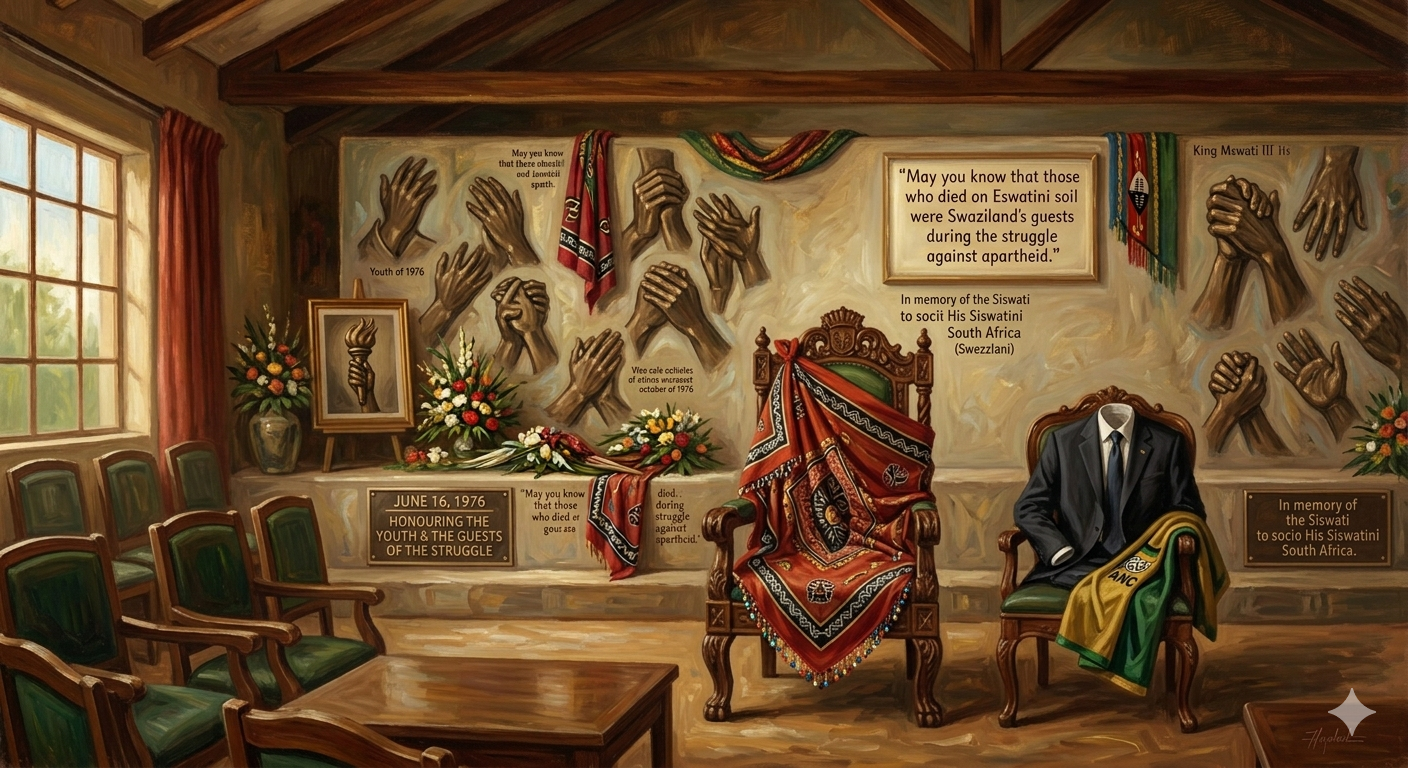
In 2004, during a poignant cleansing ceremony in Manzini to honour the fallen, the depth of this bond was reaffirmed. Professor Mongane Serote, the then-Chief Executive Officer of the Freedom Park Trust, Deputy Prime Minister Albert Shabangu offered a sentiment that captured the essence of this shared sacrifice: “May you know that those who died on Eswatini soil were Swaziland’s (Eswatini) guests during the struggle against apartheid.”
This acknowledgment serves as a reminder that South Africa’s freedom was a gift paid for in blood, both at home and in the homes of its neighbours. Central to this journey was Nelson Mandela, whose vision of a democratic, non-racial South Africa galvanised the world.
Mandela, who himself understood the necessity of regional cooperation, navigated the delicate task of balancing South Africa’s new democracy with the internal political realities of his neighbours, including his personal engagements with King Mswati III to encourage reform and stability.
As South Africa commemorated June 16 yesterday, it celebrated the courage of a generation that refused to be silenced. It is a time to reflect on the nature of solidarity, the realisation that the chains of one nation are felt by all.
The contribution of Eswatini and the steadfast leadership of figures like Mandela, remind us that the fight for human dignity is a collective endeavour. It is a testament to the fact that even when borders are enforced, the reach of human empathy knows no bounds.
In honouring the youth of 1976, we honour not just a national legacy, but the neighbours who stood in the gap, providing a lifeline when the night seemed eternal. This shared history continues to underpin the regional cooperation that sustains our pursuit of a stable, prosperous and truly liberated Southern Africa.
Every year, on June 16, South Africa falls silent to remember the thunderous defiance of its youth. National Youth Day is more than a commemorative date on the calendar; it is a sacred invocation of the 1976 Soweto Uprising.