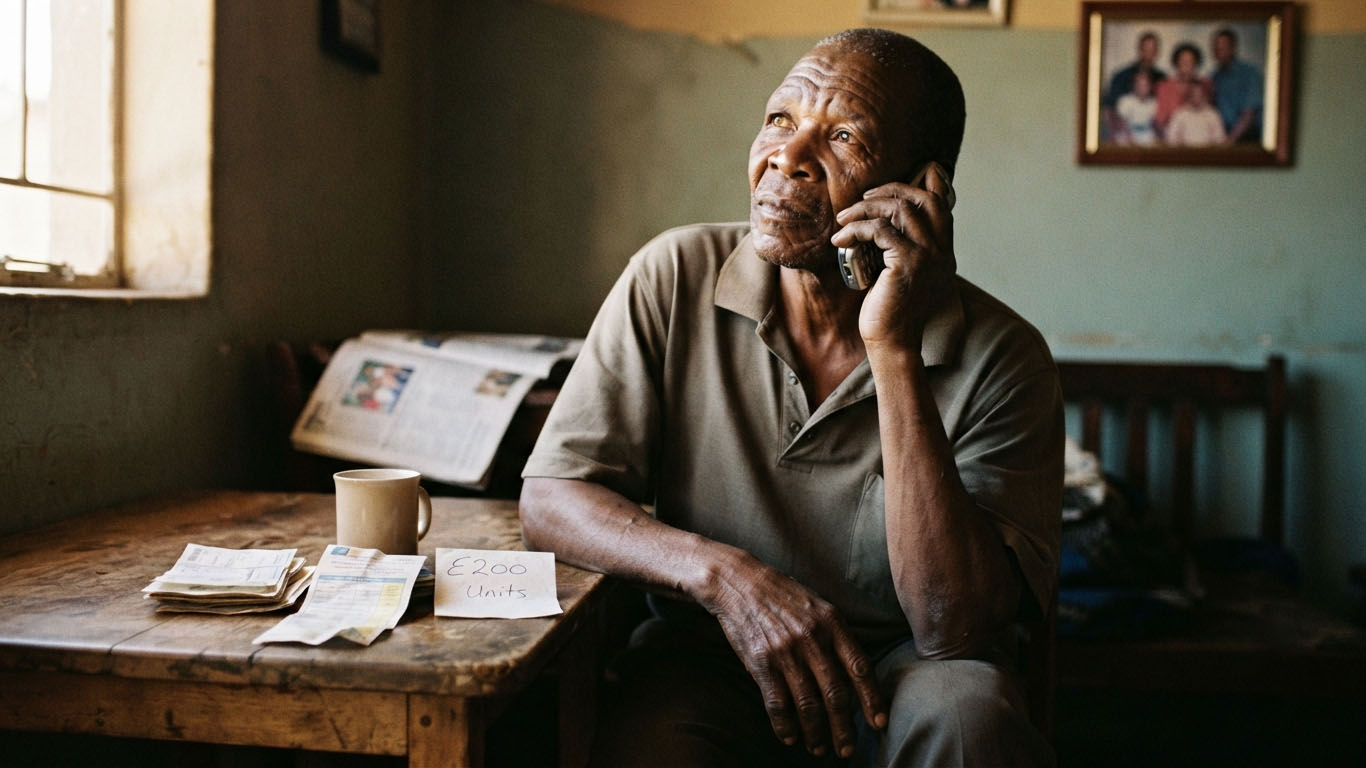
My uncle Magonso phoned me last week. Now, you and I know that when an uncle calls during working hours, there are usually only two possibilities. Either somebody has died or somebody’s electricity has.
Fortunately, it was the electricity.
“Mshana,” he said, in the tone people use when they have already decided you are helping them. “Can you send me E200 for units?” I asked him what happened to his money. He laughed like a man who has reached an age where the answer is obvious. “My pension happened to my money,” he said. That stayed with me because Malume Magonso is not a lazy man. He worked for decades. The kind of decades that leave permanent evidence in your knees. The kind where you wake up before sunrise for so many years that your body develops its own alarm clock. He did everything we are told responsible adults should do. He went to work. He paid deductions. He contributed to retirement funds. He believed the system. Then one day he retired and discovered that while he had been saving for retirement, retirement had apparently been saving everybody else.
That is why the auditor general’s report caught my attention. It revealed that E147 million deducted from workers’ salaries for pension and provident fund contributions was never remitted to the funds where it was supposed to go. Not promised. Not pledged. Not budgeted. Deducted. Already taken. Suddenly, Magonso’s request for electricity money did not sound like an old man struggling with rising costs. It sounded like an audit finding with a cellphone. “Malume,” I asked, “what if part of the reason your pension is so small is that somebody treated your future like an overdraft facility?” He asked: “What nonsense are you talking about?” So, I explained. The University of Eswatini owes E98.9 million in unremitted contributions. ESTVA owes E33.5 million. Eswatini Medical Christian University owes E7.4 million, while SANU owes E7.3 million. He paused, breathed heavily, then asked, “So they deducted the money?”
“Yes.” “And they didn’t send it?” “Yes.” “And nobody thought that was a problem?” Now we were getting to the difficult part because this did not happen once. According to the report, it happened repeatedly. Month after month. It became a business model. Magonso became eerily quiet. That worried me. Normally, when he doesn’t understand something, he explains it anyway. This time he was thinking. “So let me understand,” he said. “Every month, workers contribute to their retirement.” “Yes.” “And the money is supposed to be invested.” “Yes.” “And instead, the institution keeps it.” Like a man confessing adultery after overwhelming evidence, I answered: “Yes.” He sighed. “So, my future was helping somebody survive month-end.” I laughed.
Then I realised he was serious. The report suggests some institutions retained these funds to ease cash-flow pressures and cover operational difficulties. Workers thought they were saving for retirement. It turns out retirement was saving the institutions. Then I told malume that an economist had explained exactly why this happens. “Good,” he said. “At least somebody understands the problem.”“He lectures at UNESWA.”
“Excellent.” “The same UNESWA owing almost E99 million.” Silence and finally said: “Wait, so the man explaining the fire, works inside the burning building?” I nearly spilt my coffee, because it was true. The poor economist had spent the entire interview explaining governance failures, weak oversight and the dangers of treating pension contributions like cash-flow buffers.
Meanwhile, his own employer was sitting on enough pension arrears to start a small municipality. That is the sort of irony that should qualify for tax relief. The economist warned that delayed remittances reduce investment returns. “That part I understand,” said Magonso. “You do?” “Yes, I do. If I plant maize five months late, I harvest less maize.” Exactly. No PowerPoint presentation required. The problem with pension contributions is that they rely on time. Time is what makes money grow. When contributions are delayed, the money loses opportunities to earn returns through investments.
In simple terms, your retirement savings are supposed to be working while you are working. If the money never arrives where it is supposed to go, both of you end up unemployed. There was a long pause.
Then Magonso said: “So every month they delay, my pension becomes smaller.”“Essentially.” “And I get older at the same time.” “Yes.” He paused. “That is a race I cannot win. Imagine working for 35 years only to discover your pension has been doing piece jobs somewhere else.” A minute later, he said something that hit harder than any audit finding. “The money reached retirement age before it reached the retirement fund.” I wish I could tell you he was joking. The report raises uncomfortable questions about accountability. Pension deductions are not donations. They are not voluntary contributions. They are money already belonging to workers.
Once deducted, that money has one job: To reach the retirement fund. That is it. No detours. No side quests. No adventures. Magonso worked long enough to earn a pension.
The pension never worked long enough to earn him. The truly dangerous thing about this story is how normal it sounds. People hear E147 million and immediately move on to football results. Imagine if E147 million disappeared from Arsenal FC. Imagine if it vanished from a major road project. There would be outrage.
Yet retirement savings attract less attention because the victims are spread across thousands of payslips. One deduction here, another there. Until somebody adds everything together and discovers the future has been quietly accumulating arrears. As our conversation ended, Magonso sighed. “So, what you’re telling me is that while I was planning for retirement, somebody else was planning with my retirement.”
I couldn’t argue. Then, from somewhere in the background, I heard my aunt’s voice. “Magonso! Did you ask him for the electricity money?” Immediately, there was movement on the line. The confidence disappeared. The authority vanished. The man who had just been analysing pension governance like a parliamentary committee suddenly sounded like a witness under cross-examination. “Yebo make, I asked him. “And did he send it?” “Not yet.” “Then stop talking politics and ask properly!” I nearly dropped the phone. For a moment, I felt sorry for him. Then again, unlike E147 million in pension contributions, my aunt was demanding accountability in real time. Maybe that is the real lesson here. In my aunt’s world, when money is supposed to go somewhere, somebody follows up. Somebody asks questions. Somebody refuses to accept excuses.
Perhaps if the same energy had been applied to pension deductions, Malume Magonso would not be calling me for electricity money after a lifetime of work.
Perhaps this is the saddest punchline of all. Not that workers failed to save for retirement. But that retirement may have stopped saving for them.
My uncle Magonso phoned me last week. Now, you and I know that when an uncle calls during working hours, there are usually only two possibilities. Either somebody has died or somebody’s electricity has.