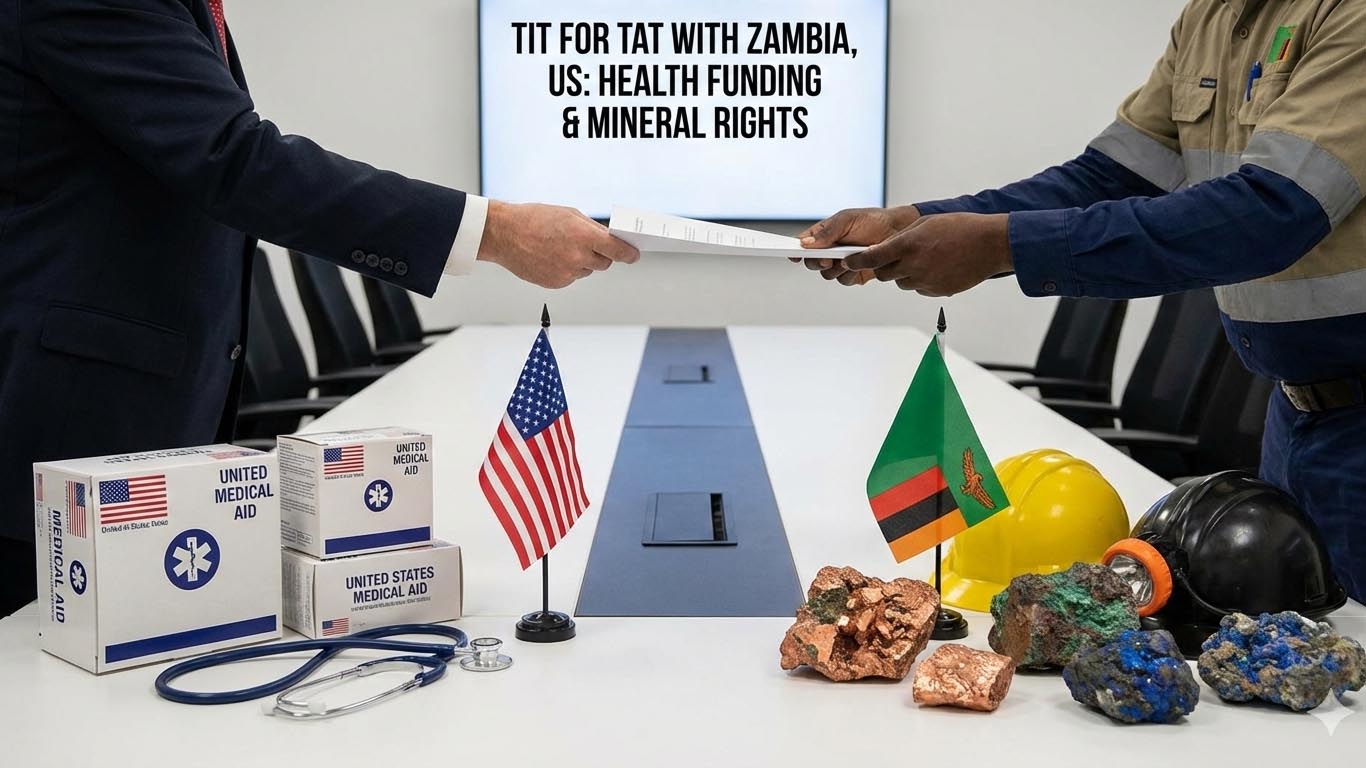
The United States’ delay of a proposed US$1.5 billion health funding package to Zambia while citing several factors that include a push for greater access to critical minerals and what Washington describes as unfair treatment of American companies operating in Zambia, is interesting. The decision sits at the intersection of public health financing and resource diplomacy and places Zambia within a global pattern where development assistance and strategic economic interests increasingly interact.
Zambia remains one of Africa’s largest recipients of external health support, particularly in programmes linked to HIV/AIDS malaria and maternal health. American funding has, for years, supported drug procurement, health worker training and disease surveillance. The delay affects planning cycles within Zambia’s health sector, even though existing programmes continue under previously approved arrangements. United States officials frame the pause as a review, rather than a cancellation; though the message conveyed links health financing to wider bilateral economic relations.
Washington states that American companies face regulatory and fiscal treatment in Zambia that it considers unfavourable. These concerns are raised alongside interest in Zambia’s copper and cobalt resources, which are integral to global energy transition supply chains. Zambia holds some of Africa’s largest copper reserves and is positioned as a key supplier, as demand for electric vehicles and renewable energy infrastructure expands. United States policy documents openly identify critical minerals as strategic assets and encourage partnerships that secure supply, while countering dominance by rival powers.
The Zambia Government publicly maintains that mineral resources are managed under domestic law and all investors operate within the same regulatory framework. Authorities also highlight sovereign rights over natural resources, which are recognised under international law. Mining taxation, licensing terms and local participation requirements are presented as tools to maximise national benefit, rather than barriers directed at specific investors. From this perspective, linking health funding to mineral access appears transactional, albeit such linkages have long featured in global development finance.
In assessing whether it is fair or realistic to expect funding without expectations, historical precedent matters. Major donors rarely provide large scale financing without conditions, whether explicit or implicit. Conditionalities have historically extended above and over fiscal management to include trade access, investment protections and policy alignment. Development assistance has often functioned as both a humanitarian instrument and a mechanism for advancing donor interests. Facts.
Examples from other countries show that mineral access has been exchanged for financing or infrastructure support. In the Democratic Republic of Congo, a long-standing ‘minerals for infrastructure’ arrangement with China grants access to copper and cobalt in return for roads hospitals and power projects. The Sicomines agreement, though renegotiated over time, shows how resource wealth is leveraged to secure development financing. In Zimbabwe, Chinese firms receive access to lithium deposits alongside commitments to processing facilities and associated infrastructure with State backing and policy support. These cases show that resource-linked financing is an established feature of international economic relations, not an exception. Again, facts.
United States engagement differs in structure, still not in principle. American policy traditionally channels funding through aid programmes, not direct resource barter. However, strategic competition and supply chain pressures blur these distinctions. Health funding becomes part of a larger diplomatic toolkit used to shape economic relationships and investment environments. Zambia faces a balancing act between maintaining diversified partnerships and protecting access to social sector financing, while preserving policy autonomy.
From a factual standpoint, it is practical to expect that large scale funding comes with expectations. Donors justify this through domestic accountability to taxpayers and strategic priorities tied to national security, economic resilience and global influence. Whether those expectations align with recipient development plans determines long-term sustainability. Zambia’s health needs are well documented with disease burdens that require predictable financing and stable procurement systems. Delays introduce uncertainty, even if framed as temporary reviews and complicate coordination with other funding partners.
At the same time, Zambia’s mineral sector already attracts interest from multiple partners, including China the European Union and private investors. Competition offers leverage yet also increases complexity in managing overlapping demands regulatory standards and geopolitical interests. Granting preferential access to one partner may affect relations with others and influence domestic considerations such as revenue mobilisation, industrial policy and employment creation.
The fairness of linking health funding to mineral access depends on interpretation. From the donor perspective aligning assistance with strategic interests follows established State practice. From the recipient perspective, health financing addresses immediate population needs that are not directly related to extractive policy. International norms do not prohibit such linkages though they generate debate within development and humanitarian circles.
Ultimately the delayed US$1.5 billion health funding is merely a depiction of changing dynamics in global aid, where health security economic interests and mineral supply chains intersect. Expecting funding without expectations is rarely realistic, given historical practice. It’s a tit for tat type situation. Zambia operates within a system where resource wealth attracts strategic attention and where development finance is negotiated rather than unconditional. The outcome of this episode will likely continueto influence how future health and economic partnerships are structured, not only for Zambia, but for other resource-rich countries managing similar pressures.
The United States’ delay of a proposed US$1.5 billion health funding package to Zambia while citing several factors that include a push for greater access to critical minerals and what Washington describes as unfair treatment of American companies operating in Zambia, is interesting.