MBABANE - Eswatini’s private sector credit has surged to a historic high of E23.2 billion, signalling growing economic activity across key industries despite persistent global and domestic pressures that continue to weigh on consumers, businesses and the country’s external reserves.
This is according to the latest Monthly Statistical Release for March/April 2026 issued by the Central Bank of Eswatini, which paints a picture of an economy experiencing stronger business borrowing, improved banking sector liquidity and rising money supply, while still facing challenges linked to declining foreign reserves and subdued household borrowing.
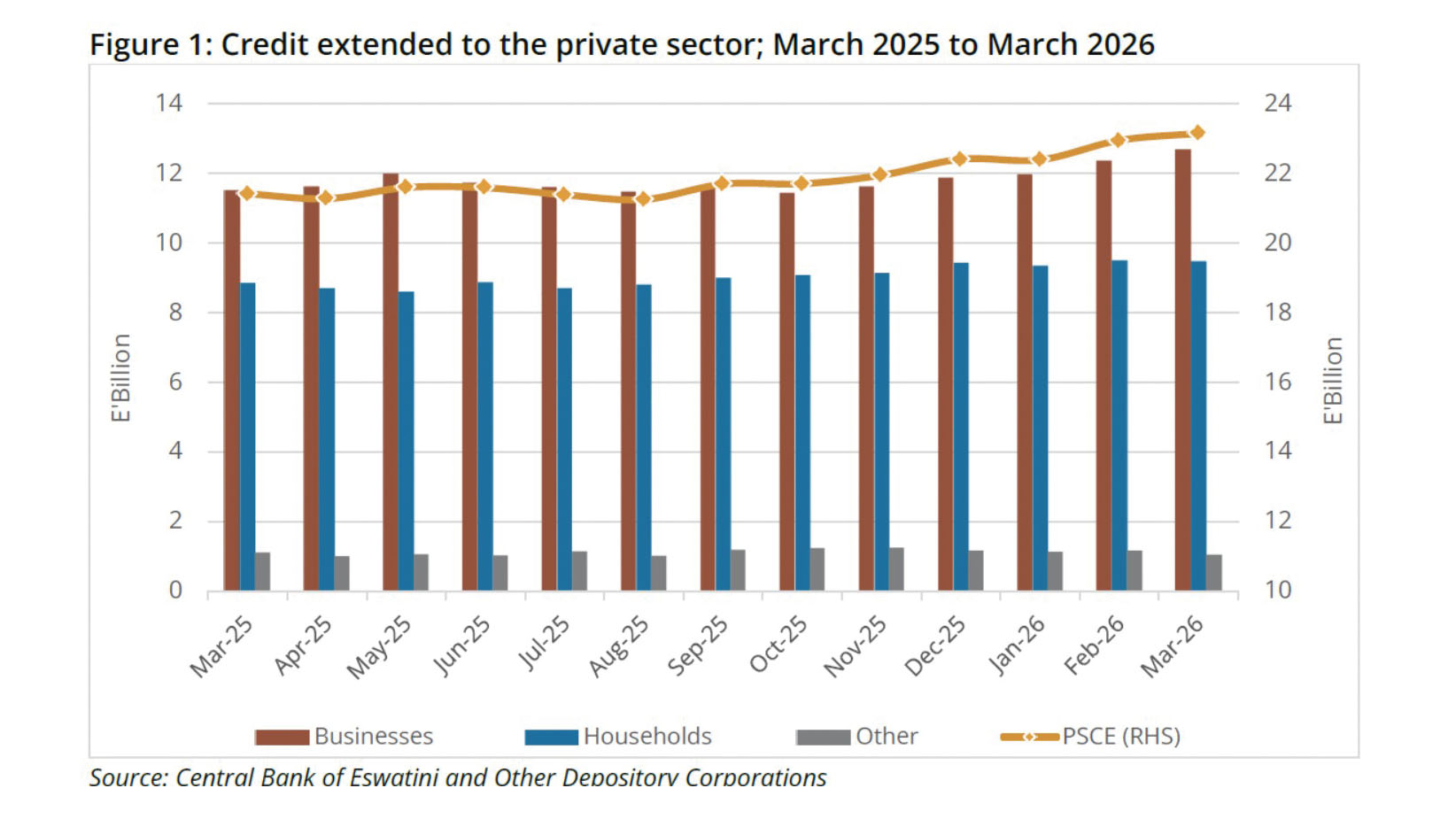
The report shows that credit extended to the private sector increased by 0.9 per cent month-on-month and 8.1 per cent year-on-year to reach a new peak of E23.2 billion at the end of March 2026.
The increase was largely driven by businesses, with firms across sectors continuing to access financing for expansion, operational costs and investment projects.
The banking sector’s willingness to lend, coupled with relatively stable interest rates, appears to have supported the upward momentum in credit growth. The central bank maintained the discount rate at 6.75 per cent in April 2026, while commercial banks’ prime lending rate remained unchanged at 10.25 per cent.
According to the release, credit to the business sector grew by 2.6 per cent month-on-month and 10.1 per cent year-on-year to reach E12.7 billion in March 2026.
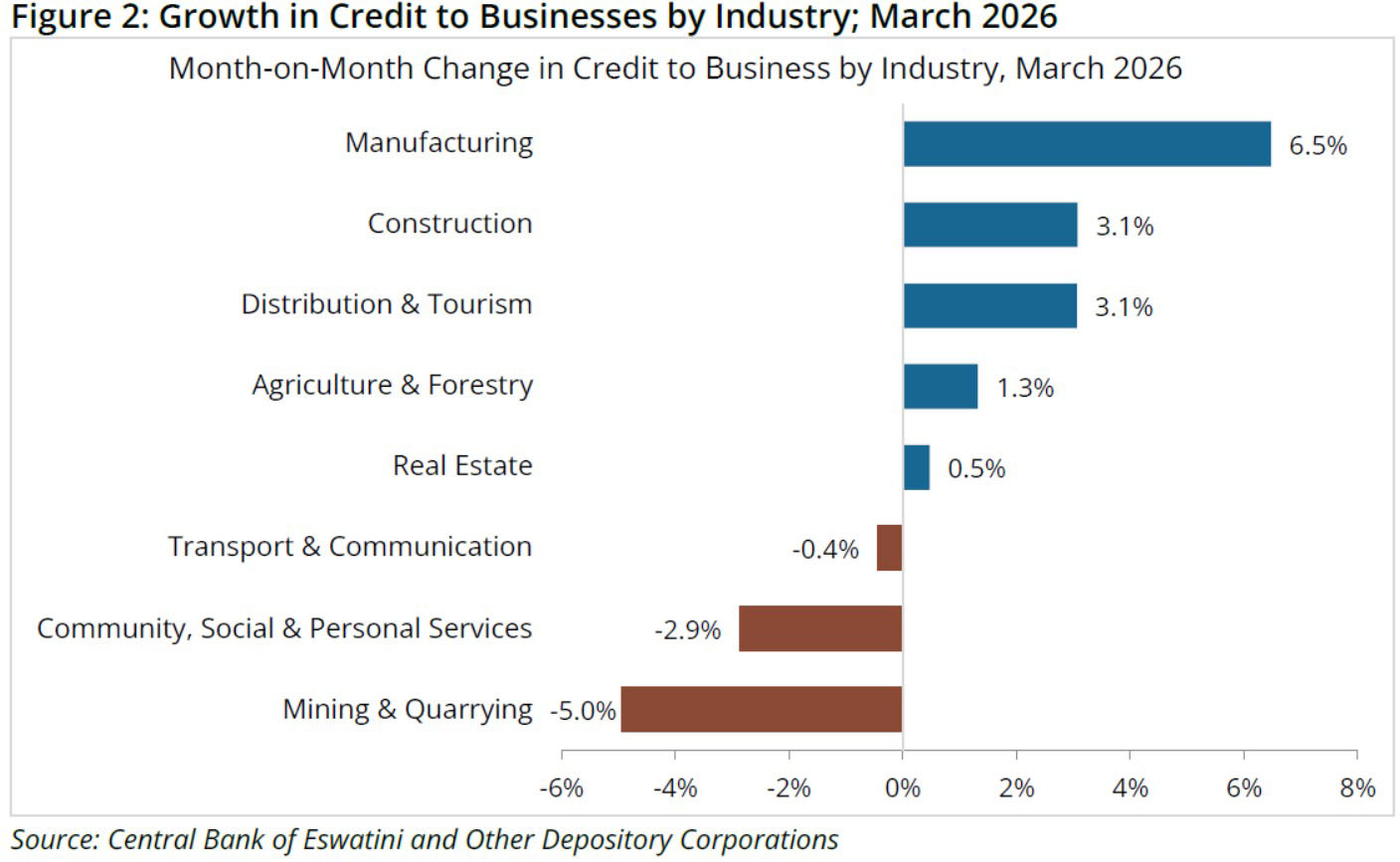
The strongest growth was recorded in manufacturing, which expanded by 6.5 per cent during the review period.
Construction and distribution and tourism industries each recorded growth of 3.1 per cent, while agriculture and forestry increased by 1.3 per cent. The real estate sector also posted modest growth of 0.5 per cent.
The figures suggest that businesses are continuing to position themselves for economic opportunities despite concerns around rising operational costs, geopolitical tensions and softer global demand conditions.
The expansion in manufacturing credit is particularly significant as the sector remains one of the country’s critical pillars for exports, industrialisation and employment creation.
Construction sector growth also reflects ongoing infrastructure activity and private sector investment appetite.
The report further indicates that both large enterprises and small and medium enterprises (SMEs) contributed to the increase in business borrowing. Credit extended to large enterprises, which accounted for 66.3 per cent of total business credit, rose by 1.9 per cent to E8.4 billion.
*Full article available on Pressreader*