MBABANE – Siphofaneni, a once-quiet rural outpost in Eswatini’s Lowveld, is fast becoming one of the country’s most dynamic peri-urban economies.
This is as private capital follows the wake of a large-scale irrigation scheme that has transformed livelihoods and de-risked agriculture.
The catalyst is the E1.2 billion Lower Usuthu Smallholder Irrigation
Project Phase I (LUSIP I), implemented by the Eswatini Water and Agricultural Development Enterprise (EWADE). Since its rollout in 2004, Siphofaneni has seen a steady influx of businesses comprising retailers, banks, fuel operators and wholesalers, positioning the area as a new investment frontier beyond traditional urban centres.
Top-desk research and analysis by the Business Desk indicate that Siphofaneni ranks among the fastest-growing peri-urban locations in the country. Investors cite improved household incomes, reliable agricultural output and a growing consumer base as key drivers behind the surge in business activity.
At the core of this shift is a smallholder-led sugar cane economy that has scaled rapidly. Funded by the Government of Eswatini, the European Union (EU), the European Investment Bank
(EIB), the African Development Bank (AfDB), the Arab Bank for Economic Development in Africa (BADEA) and the Development Bank of Southern Africa (DBSA), LUSIP I has directly transformed the lives of more than 20 000 people across nearly 3 000 homesteads, while catalysing the formation of 60 farmer companies spanning sugar cane and banana production. These entities, with over 3 100 shareholders, collectively employ about 5 100 people, creating a stable income base that underpins local demand. The project area spans chiefdoms including Madlenya, Ngcamphalala, Shongwe, Gundvwini- Lesibovu, Mamba-Mamisa, Bulunga-Mahashulane and Mphumakudze-Mphaphati, regions once associated with chronic poverty prior to the project’s inception in the early 2000s. Today, that narrative has shifted markedly. Major retail chains such as Shoprite, Ackermans, PEP Stores and Build it have established a presence in the area, drawn by rising consumer spending.
Financial institutions including First National Bank, Standard Bank, Nedbank Eswatini, EswatiniBank and FINCORP have also expanded into Siphofaneni, signalling confidence in the area’s long-term growth prospects. Notably, FNB Eswatini has been the latest to open its doors at Siphofaneni Plaza, opening its 13th branch in the kingdom.
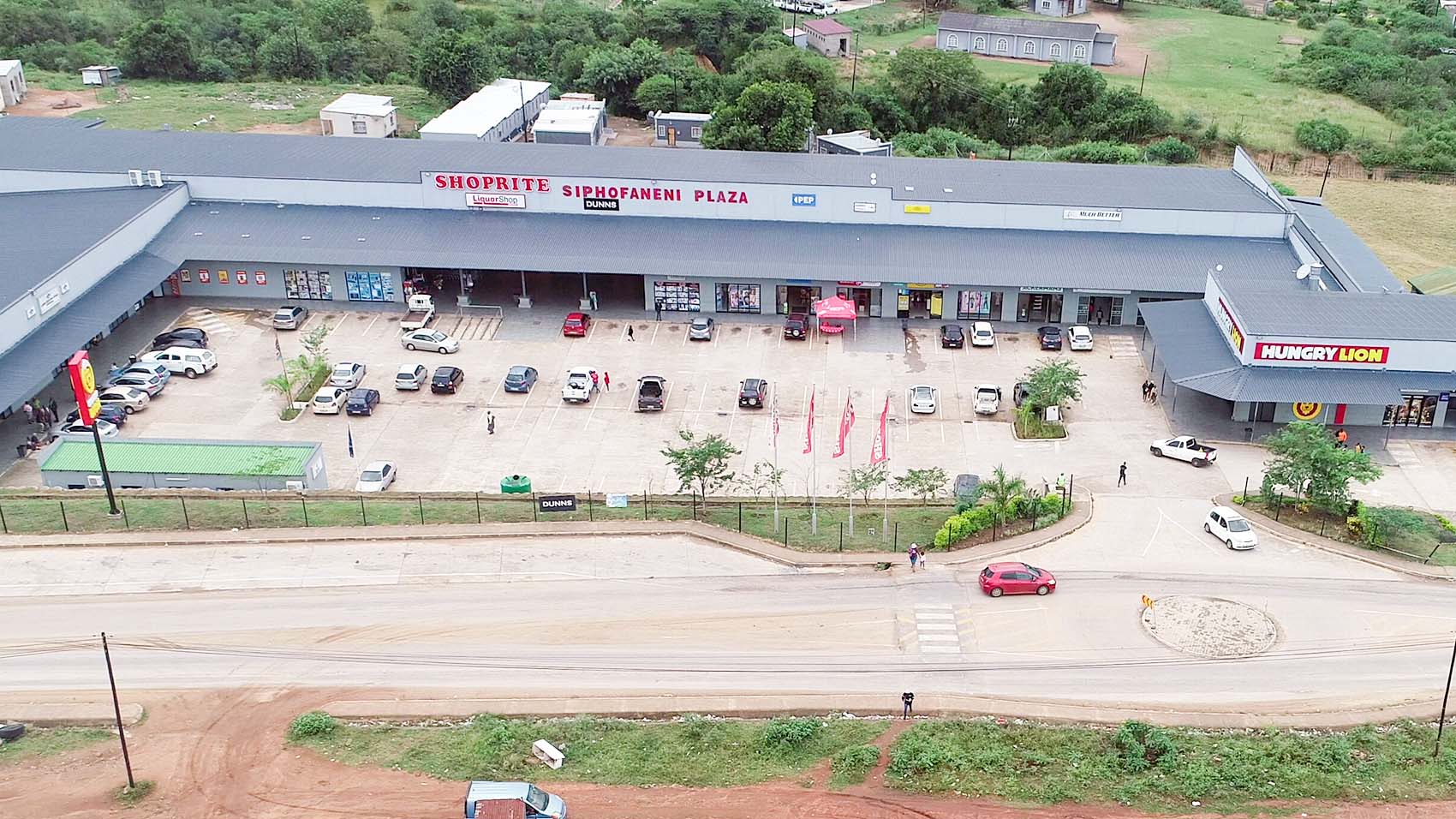
Fuel and energy operators such as TotalEnergies, alongside wholesalers including Ruchi Wholesalers, have followed suit, supporting both consumer and agricultural supply chains. Real estate development is keeping pace. A multi-million Emalangeni retail plaza developed by MA Properties now anchors the town’s commercial activity, housing national retail brands and quick-service restaurants such as Hungry Lion.
EswatiniBank invested E56 million to finance the development of the Siphofaneni Plaza. The project highlights the partnership between EswatiniBank and MA Props, which has also included property developments in Mbabane and Ezulwini. Additionally, MA Props partnered with the Public Service Pensions Fund (PSPF) to manage the operational aspects of the plaza.
*Full article available on Pressreader*
Major retail chains such as Shoprite, Ackermans, PEP Stores and Build it have established a presence at Siphofaneni, drawn by rising consumer spending. (Courtesy pics)