

There’s a special kind of inheritance no lawyer announces.
Not land. Not cattle. Not even that family kettle that whistles like it’s personally offended by poverty. No, I’m talking about responsibility without consent.
The kind where a man passes on and suddenly, you’re promoted from last seen online to CEO of a company you didn’t register, with debts you didn’t approve and employees who don’t believe in salaries, only expectations.
No interview. No induction. Just arrival.
Let’s be honest, masculinity in this economy is not identity. It’s liability management. One day, you’re arguing about data bundles, the next someone calls you bhuti with a tone that says: “We have reviewed your existence and concluded you now owe us stability.” From that moment, your name changes quietly. You are no longer Sibusiso.
You are Sibusiso, who works. And Sibusiso, who works? That man is apparently successful, according to everyone except his bank account, his landlord and his nervous system.
Here’s the contradiction nobody questions out loud. Men are expected to be emotionally silent providers. Silent, but responsible for everything. You must not cry, but you must pay. You must not break down, but you must break your back.
You must not complain, but you must perform miracles on a debit card that is already overdrawn emotionally.
It’s like being told to drown, but do it politely. You’re disturbing the surface tension. When you finally try to speak, society responds with its favourite shutdown phrase: “But you’re a man.” Four words that cancel vulnerability faster than load shedding cancel dinner. As if masculinity is a pension fund for pain. As if strength is just endurance with better branding. Now here’s where reality stops being funny for a second. According to the Royal Eswatini Police Service, over the past nine months, 133 people allegedly died by suicide. Of these, 109 were men and 24 were women. Reported contributing factors include financial challenges, unemployment, domestic abuse, depression, chronic illness and social ostracism. That’s not a statistic. That’s a list of people who stopped participating in a world that kept asking them to ‘hold on’ without ever asking what they were holding. However, we read it like weather updates. One hundred and nine men tapped out. One hundred and nine family members couldn’t take it. These are names. It’s not data. Its absence that used to have a voice.
the strange part is not only what’s in that number, but it’s what surrounds it. Let’s talk about the first salary. That money doesn’t arrive. It reports for duty. Already allocated. Already exhausted. Rent is waiting like a landlord who emotionally spent it last week.
Transport is idling outside like it knows you’re not going anywhere financially.
Groceries are standing there like, ‘We were invited into your future, remember?’ Then the family enters, not as a request, but as an announcement.’ Your brother needs shoes.’ ’Your sister has a trip.’
‘Auntie is not well.’
At this point, your salary is no longer income. It is public infrastructure with emotional toll gates.
Nobody exits the system, but society still demands presentation. You must suffer, but look stable. Struggle, but remain impressive. Drown, but maintain posture. So, men do what the system rewards. Perform survival. Loans become emotional coping mechanisms. Not because they are reckless, but because nothing else buys time. You buy a car you cannot afford to prove you are moving.
You buy clothes that arrive in rooms before you do.
You upgrade a phone so at least something in your life has a future. Just like that, you become a premium version of broke. Luxury stress. Designer anxiety. High-definition depression. Now here’s the part nobody likes to sit with, pressure doesn’t shout. It repeats. At night it sounds like your own thoughts saying:
‘You’re behind.’ Even when you are still running. Maybe the more honest truth is not that men are failing. It’s been enough that they disappeared a long time ago. Expectations don’t have limits anymore. They have appetite, and you are the meal. So, collapse becomes gradual. Not dramatic. Not cinematic. Just small exits from yourself. A missed call. A shorter reply. A laugh that arrives late.
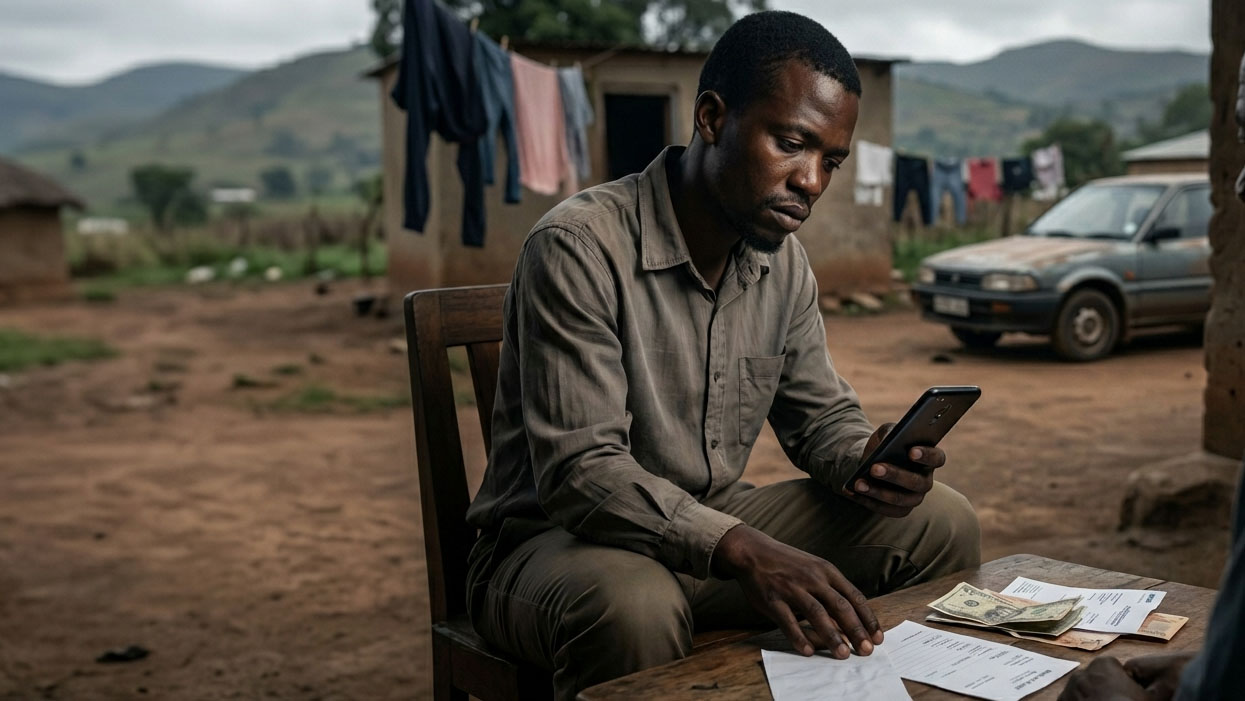
A man staring at his banking app as it owes him emotional compensation. Depression in men rarely looks like sadness. Sometimes it looks like silence that has stopped explaining itself.
Sometimes it looks like anger with no clear target.
Sometimes it looks like presence without participation.
When someone finally says, ‘I’m not okay,’ the response is often automatic: ‘But you’re a man.’As if that sentence is a cure. Let’s be honest. This is where the satire becomes slightly uncomfortable. Some families don’t want sons. They want solutions with salaries.
Some relationships don’t want partners. They want stability with skin. Nobody says it directly. They just behave consistently. Go to any bar.
Men are laughing loudly. Performing confidence like overtime pay depends on it. ‘I bought a car!’ Cheers. No one asks about the instalments. ‘I’m building a house!’
Respect. No one asks about the loan term. ‘I’m fine.’
That one gets the loudest response, because everyone knows it’s the least true. Underneath it all, there is a shared understanding nobody says. We are all tired in different uniforms.
The quiet danger is that a society that only understands men through function eventually stops recognising them as people. He is valuable when he carries weight. Invisible when he drops it. So what follows is not a collapse. It is disappearance with attendance.
Men show up. They pay. They smile. They perform. Slowly, they reduce themselves to something that cannot be burdened. Until one day, they are no longer there. Then the questions begin. What happened? When did it start?
Why didn’t he say anything? However, the harder question is the one nobody wants to sit with: who was supposed to listen before silence became the only option? The system does not break when a man breaks. It replaces him. Another Sibusiso who works is summoned. Another life learns responsibility without consent.



















Leave a comment