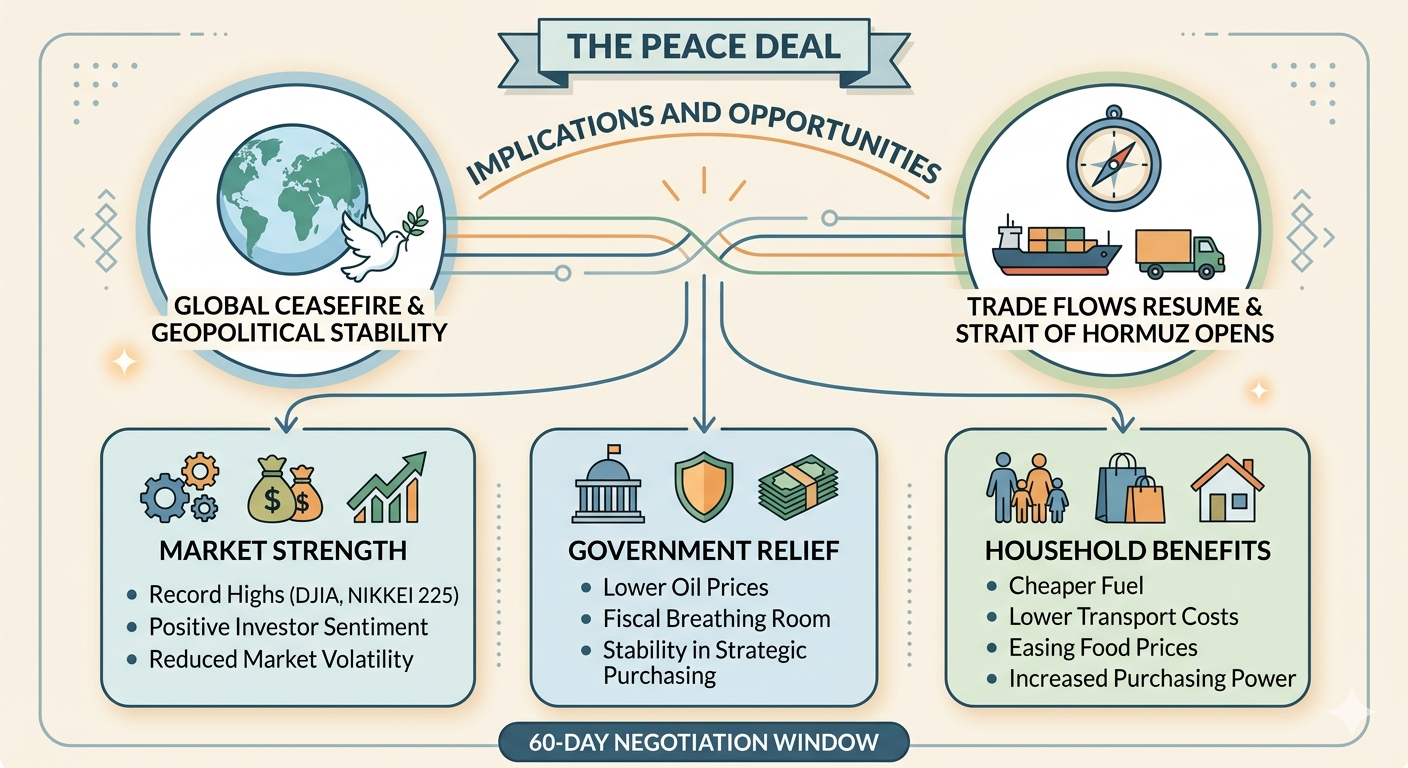
As this week dawned, the world received news from Tehran and Washington: Finally, a peace deal is on the table. Moving the world beyond the cease-fire with a lot of fire bred significant volatility in markets, as this is a major global choke point responsible for 20 per cent of global oil transit and 25-25 per cent of global fertiliser and related inputs into fertiliser production. Hence, the news of a ceasefire is indeed good news that markets are taking in positive stride, as both Japan (NIKKEI 225) and the Dow Jones Industrial Average in the US made record highs on Tuesday trading. As the world moves from uncertainty into a risk-on 60 days, at which point the peace deal will be reviewed, it is imperative that we evaluate what the next 60 days mean for the economy and what life post-those 60 days will look like for the domestic economy and our pockets.
The next 60 days
Albeit, the text on the actual peace deal is not clear, we can infer from the news some elements of the next 60 days. The Strait of Hormuz has already been opened, hostilities suspended, Iran will take the foot off the nuclear enrichment pedal, and there will be some sanctions relief for Iran. Essentially, the next 60 days will function as a negotiation window and a trial run on whether a lasting peace solution is possible. Hence, an adjustment back to the pre-war equilibrium will take a two-fold approach. At present, markets are celebrating the news but based on geopolitical risk sentiment. And then post the 60 days, inshallah, we begin to descend back to pre-war equilibrium and a potential upgrade to global, regional and domestic GDP figures.
Relief for government, policymakers
The Eswatini Government has spent the past months cushioning consumers from soaring fuel costs through subsidies and strategic oil purchases. These measures, while necessary, placed immense strain on fiscal reserves. The reopening of the Strait of Hormuz offers immediate relief: Lower oil prices reduce the burden on the strategic oil purchasing fund and create breathing room for fiscal policy.
Monetary authorities also benefit. With fuel inflation easing, the Central Bank of Eswatini gains space to stabilise prices and support consumer confidence. As inflation in July is expected to ease or decelerate. In May, we saw a 0.7 percentage point increase in inflation; hence, going forward, we shall expect smaller accelerations. A disinflation in fuel and transport categories is expected starting in July and most likely lasting until October. This reprieve allows policymakers to redirect resources towards longterm priorities such as infrastructure, energy diversification and social spending, rather than firefighting the inflationary fallout of global shocks.
Business sector gains
The business community, particularly energyintensive industries, stands to feel relief against the backdrop of improved conditions on the Strait of Hormuz and the rich oil fields of the Middle East. Manufacturing firms, logistics operators and agricultural producers faced months of squeezed margins as fuel and fertiliser costs surged. Lower oil prices now reduce operating expenses, stabilise input costs and improve competitiveness.
Small and medium enterprises (SMEs), the backbone of Eswatini’s economy, stand to benefit most. High transport and packaging costs had eroded profitability, forcing many to scale back operations or pass costs onto consumers. With fuel prices declining, SMEs can recover lost ground, reinvest in growth and restore stability to their supply chains.
The reopening also stabilises global shipping and trade flows. Freight rates, which had spiked during the closure, are expected to normalise, while insurance premiums on shipments through the Gulf decline. For Eswatini’s importers, this means lower costs for goods ranging from food to consumer electronics, easing the pressure on both businesses and households.
Consumers and households
Regarding the ordinary liSwati, the reopening translates into tangible relief. Fuel prices, which had climbed steeply during the closure, are expected to decline gradually, reducing transport costs for commuters and freight operators alike. Lower energy costs ripple through the economy, easing the price of food, manufactured goods and household essentials.
Consumers will feel this relief most acutely in food prices. Fertiliser and transport costs had driven up the cost of staples, straining household budgets. With global energy markets stabilising, food inflation should ease, restoring purchasing power and improving living standards. In other words, the cost-of-living pressures are expected to recede.
Risks and fragility
Yet, while the reopening is a relief, it is not a guarantee of stability. Clearing the backlog of vessels stranded on either side of the Strait will take weeks, delaying full normalisation of trade flows. More importantly, the geopolitical fragility of the Gulf remains unresolved. The ceasefire that enabled the reopening is temporary and renewed conflict could quickly reverse gains. Energy security remains a pressing concern. The country must accelerate efforts to diversify supply chains, invest in renewable energy and build fiscal buffers against future shocks.
The reopening of the Strait of Hormuz is more than a geopolitical headline; it is a lifeline for the global economy, but also comes with lessons for future shock absorption.
As this week dawned, the world received news from Tehran and Washington: Finally, a peace deal is on the table. Moving the world beyond the cease-fire with a lot of fire bred significant volatility in markets.