

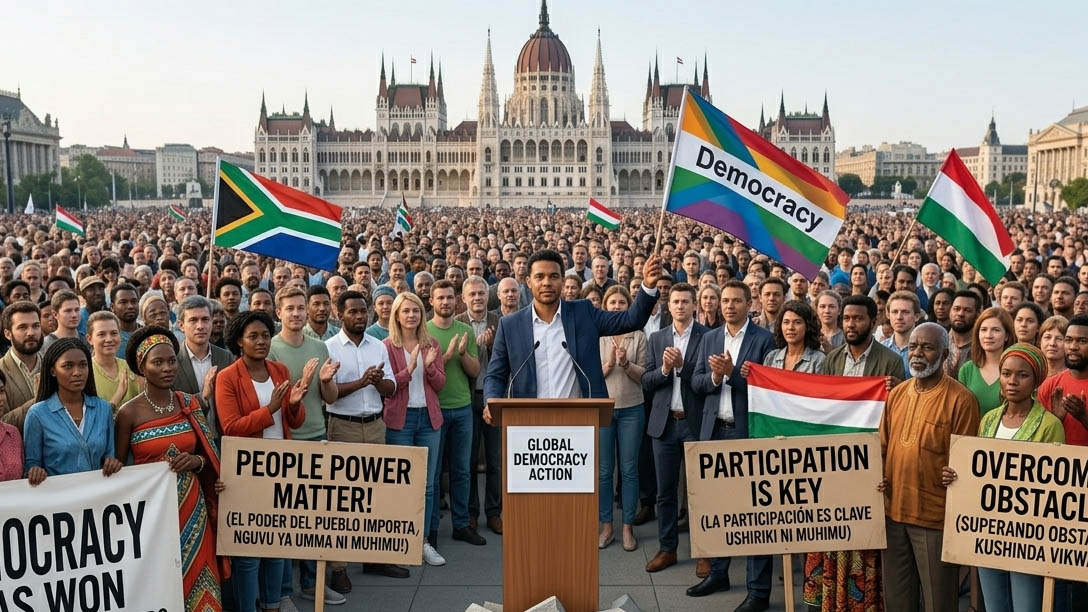
A political tsunami in Hungary’s recent elections on April 12, 2026, has swept away Prime Minister Viktor Orbán and his political class, yet the outgoing prime minister weakened democratic institutions, suppressing opposition and civil society organisations, among other measures. Just when many around the world have lost hope in liberal democracy, the Hungarian elections have demonstrated that elections as an ideal can only succeed when people participate in a democratic process, even when the stakes are against them.
I must state that the democratic project has always been a fascinating subject because it is anchored on the belief that people’s power matters. Hence, the American President Abraham Lincoln described democracy as: ‘‘A government of the people, by the people and for the people.’’ While the first African American President Barack Obama described democracy as: ‘‘A bold experiment requiring continuous work.’’ He meant democracy demands action and participation rather than passive appreciation. The African icon, former President Nelson Mandela, described democracy: ‘‘As an inseparable partnership with human rights, focusing on equality, reconciliation, and active participation of all citizens, regardless of race,’’ the key being people’s participation.
Why are the Hungarian elections of interest to us in Eswatini and Africa in general?
I know that mentioning democracy in Eswatini and among Africans in general tends to invoke various reactions. There are many who regard liberal democracy as unworkable in Africa. April 12, 1973, was indeed a watershed moment in Eswatini when the 1973 Proclamation was announced to the nation, where King Sobhuza stated in Section 2: “And whereas I have given consideration to the serious situation that has now arisen in our country and have come to the following conclusion:
a) That the Constitution has failed to provide machinery for good governance and for maintaining peace and order;
b) That indeed the Constitution is the cause of growing unrest, insecurity, dissatisfaction with the state of affairs in our country and an impediment to free and progressive development in all spheres of life;
c) That the Constitution has imported into our country highly undesirable political practices alien to us and incompatible with the way of life in our society and designed to disrupt and destroy our own peaceful and constructive and essential democratic methods of political activity, increasingly this element engenders hostility, bitterness and unrest in our peaceful society.”
Abrogation
This led to the abrogation of the Constitution where human rights were done away with and political parties were banned, among other things. In fact, this was a period of one-party States in many independent countries in Africa, as independent States felt liberal democracy was unworkable.
In recent times, coups by military officers have shocked the African Union and the world in general. This came about when there was hope that democratic practices were taking root in Africa. In Burkina Faso, the military government has banned political parties.
Zimbabwe is currently undergoing political tremor as government seeks to amend the Constitution, increase term limits for Parliament and the president, which has divided the nation once more. These are some examples that liberal democracy is being rejected by the political class in Africa.
How did the opposition in Hungary win in spite of the obstacles?
The ruling party entrenched electoral advantages by redrawing district boundaries to pack the opposition voters into specific areas, while winner compensation mechanisms favoured the ruling party.
There was media capture and monopoly where the ruling party controlled 80 per cent of the media, creating a hostile environment for the opposition figures, whilst promoting government propaganda. There was systemic media harassment and smear campaigns.
Over the 16-year period, the ruling party loyalists occupied key positions, including the Constitutional Court, which could block legislation from the opposition. There was also in place a Sovereignty Protection Office which was charged with powers to investigate and harass NGOs, independent media and opposition figures under the guise of protecting national sovereignty against foreign influence.
Electoral fraud and voter manipulation were rife in previous elections.
This is said to have included vote buying, intimidation and the abuse of postal voting.
What made the opposition win?
The opposition focussed its message on deep economic stagnation, a weak health system, high inflation and frustration with rampant corruption. The opposition figure Péter Magyar, who was initially part of the ruling party, is appreciated for running a disciplined campaign that united voters disillusioned with the status quo, including the old opposition. Hence, there was record high voter turnout of nearly 80 per cent, which resulted in the two-thirds majority win by the Tisza Party, ending 16 years of Orbán’s rule.
Lessons Eswatini and Africa voters should learn:
Democracy can only succeed when people participate in the democratic process. Even if the obstacles are there in favour of the ruling class, people’s power can turn things around.
















Leave a comment