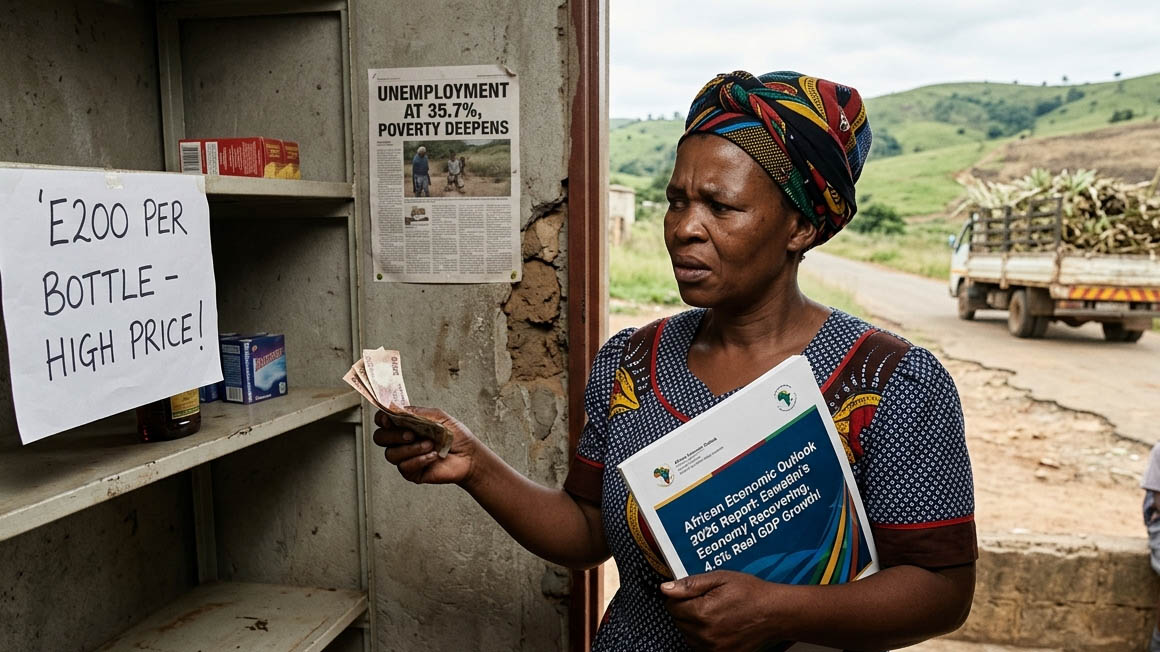
There is a belief that good macroeconomic statistics automatically mean ordinary people are living better lives. They do not.
Eswatini’s economy, we are told, is improving. The African Economic Outlook 2026 Report paints a picture of recovery that government officials understandably welcome. Real GDP growth accelerated from 2.8 per cent in 2024 to an estimated 4.6 per cent in 2025. Inflation eased, infrastructure projects resumed and agriculture partially recovered as rainfall improved and household consumption strengthened. On paper, the kingdom appears to be regaining momentum. However, paper is patient.
Ordinary emaSwati live in the harder world beneath the statistics, where economic growth does not always arrive as relief. They encounter it instead as a contradiction. A trip to the supermarket increasingly feels like a negotiation with humiliation itself. An economy may be expanding, but for many citizens, life remains unbearably expensive. That contradiction should trouble policymakers far more than glossy growth projections reassure them.
The real question confronting Eswatini is no longer whether the economy is growing, but whether that growth has become meaningful to the people carrying the weight of the nation on their backs.
The answer, at least for now, is uncomfortable. A country with unemployment hovering around 35.7 per cent cannot seriously speak of prosperity with complete confidence. Nor can a nation where 34 per cent of the population continues to live in extreme poverty, largely concentrated in rural communities, be too often remembered only during election seasons.
To be fair, the past three years have seen progress. Government deserves recognition for stabilising key sectors amid a difficult regional and global climate. Delayed infrastructure projects are moving again, social grants have expanded and youth and women empowerment programmes signal an awareness that exclusion carries long-term consequences. The Central Bank has also maintained relative monetary stability despite external turbulence.
These are important achievements, but stability is not transformation. Too much of Eswatini’s economic architecture still rests on fragile foundations.
Southern African Customs Union (SACU) revenues remain vulnerable to external shocks.
Furthermore, the country faces an informal economy too large to tax effectively, limited industrial diversification, weak credit transmission, shallow capital markets and a mining sector operating far below its potential.
This is not an economy designed for resilience; it is an economy surviving year-to-year as the seasons become harsher. At the recent SADC Ministers of Foreign Affairs Retreat held in Skukuza, regional leaders warned that geopolitical conflict and climate pressures were driving food and fuel prices beyond the reach of ordinary citizens.
Across Southern Africa, families are paying the price for wars they did not start and markets they do not control. A missile launched in the Middle East eventually finds its way into the price of cooking oil at Ntfonjeni. That is the brutal arithmetic of global instability. Southern African ministers were correct to emphasise regional integration, industrialisation and collective resilience. Small economies can no longer afford the illusion that they will withstand global fragmentation alone. Over-dependence on foreign supply chains and distant markets is becoming economically dangerous.
Eswatini, perhaps more than most, understands this reality. The kingdom’s economy remains deeply exposed to volatility. When global demand weakens, energy prices surge, climate shocks disrupt agriculture or SACU revenues fluctuate, ordinary citizens absorb the pain first, not investors, policy advisers or conference delegates.
This is why regional integration must stop existing merely as ceremonial language repeated at summits; it must become economic doctrine. SADC cannot remain a political bloc issuing communiqués while member States operate like isolated islands. Stronger regional transport systems, coordinated agricultural production, harmonised customs procedures and integrated industrial strategies are no longer optional ambitions. They are survival mechanisms.
Yet, regional integration alone will not solve Eswatini’s deeper structural problems. The country must diversify its economy with urgency. For too long, growth has depended on a narrow set of revenue streams. The result is a nation perpetually reacting instead of strategically planning, where every external shock becomes a national emergency.
Meanwhile, mining continues to remain underdeveloped beneath our soil. Globally, demand for minerals linked to manufacturing, infrastructure and renewable energy transitions continues to rise. Handled properly and managed with discipline, mining could widen the national cash flow pool substantially, generating employment, strengthening exports and financing infrastructure to stimulate broader industrial growth.
Equally urgent is the need for aggressive digital tax reform. Digital systems can widen the tax net fairly, improve compliance and help formalise economic activity that currently operates beyond effective regulation. However, taxation must serve growth, not replace it. A shrinking household cannot indefinitely sustain an expanding State. The ultimate task is structural transformation. Young people need sustainable, productive and dignified jobs. Rural communities need genuine economic participation, small businesses need credit and agriculture needs modernisation.
The economy will likely continue recording moderate growth for some time. The greater danger is a slower, more corrosive shift where official optimism rises while public frustration quietly hardens underneath it. People can endure hardship; what they struggle to endure is the feeling that hardship has become permanent while prosperity remains visible only in reports. Eventually, the statistics stop sounding like hope. They begin sounding like an insult. Eswatini still has an opportunity to change course. Doing so requires economic diversification, deeper regional integration, serious mining development, modern digital taxation and, above all, a commitment to building an economy that ordinary people can feel.
There is a belief that good macroeconomic statistics automatically mean ordinary people are living better lives. They do not.