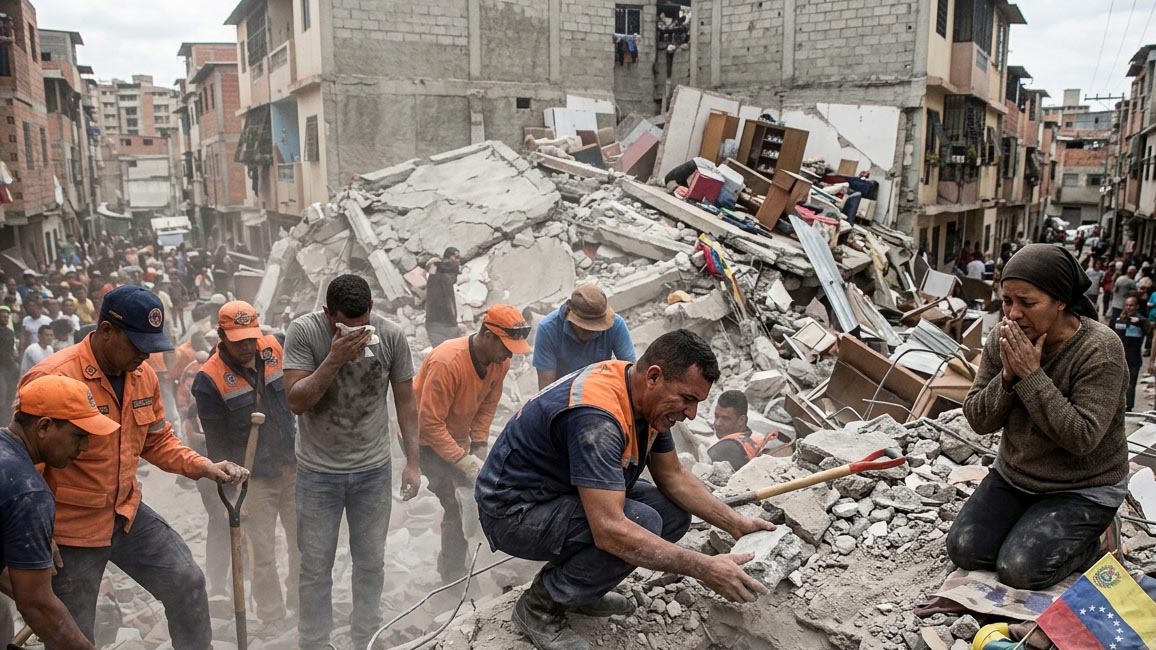
When reading about the tragedy caused by the two earthquakes that occurred in Venezuela last week, one stage beyond the deep empathy we felt for victims and those digging desperately for their loved ones, were the thoughts: Let us count our own blessings; and, there but for the grace of God, go I.
The earthquakes in Venezuela were 7.0 and 7.5, respectively on the Richter magnitude scale. That’s big. At this moment, over 1 500 deaths are reported and caused by the collapse of around 800 buildings. That in itself is a huge disaster, but then came the even more shocking news that many thousands are still missing.
This is not the first natural disaster; and certainly not the last. The deadliest of all on record was the earthquake in 2004 of no less than 9.1 on the Richter scale that fortunately occurred under the Indian Ocean, but still created the devastating ‘tsunami’ where gigantic 40 metres high ocean waves caused between 228 000 and 230 000 deaths along the shores of 15 countries in the Far East.
The Venezuelan disaster is different only because the impact of it is happening right now. As we enjoy peace and security, thousands of Venezuelans are staring in the very deepest anxiety at the ruins before or even beneath them. Where their loved ones and dear ones are buried; and many of them buried but still alive. With the further agony for the survivors through hearing the cries of the victims, below them, turning tragically into groans; and then nothing. We are at this moment on the verge of many hundreds, barely alive under the ruins after more than 100 hours and being about to die from lack of food, water and medical attention. What could be more humanly tragic than that.
These earthquakes occur in parts of the world where there are edges or boundaries to the Earth’s tectonic plates. These massive plates are 15 to 200 kilometres thick and make up the Earth’s crust which, in turn, holds up the continents and the oceans. That, in itself, is mind-boggling. And then you learn that the plates move at the speed of only about 25 millimetres a year, while sliding against each other.
Then, occasionally, the plates get stuck and after about 250 years the stress builds up from that and gives rise to an earthquake. Yes, that’s what’s going on beneath us; kilometres down there. Makes one wonder who worked all that out. The Western Americas, of which Venezuela is part, have fractured plates and the related map records earthquakes of a magnitude of 5.5 and above that runs into more than one hundred.
Each time we are shocked by what our natural world imposes on us. While that suggests the existence of a will to do so, we must acknowledge that our natural world does not work like that. It was created and we developed as ‘homo sapiens’ to take residence in that world. Grateful for it, naturally and especially so when aware of how many fellow occupants have to deal with spending their lives in parts of the world that are continuously vulnerable to earthquakes, hurricanes or cyclones. Imagine having to cope with the thought that the house you’ve built might be in ruins at any time in the coming years. Or worse, that one’s dearly beloved family is similarly vulnerable. The residents of northern Venezuela are in that very situation right now. Every scene in the aftermath of the two earthquakes is emotionally moving and even heart-wrenching. One photograph captured a lady kneeling on ruins that held her son and other very close relatives. She could hear them but could do nothing about it.
As so often happens, the emergency assistance was not what it needed to be, and not up to the standard of the more prosperous countries of the world, most of whom don’t get earthquakes anyway. Hundreds of brave and determined Venezuelans are fighting with picks and shovels to clear debris that demands substantial equipment that is simply not available.
The will and passion of the people is heroically visible; the equipment, sadly, is not. And, in the irony of all ironies, where many groups of individuals have driven frantically to assist the missing and the rescued with food and medical supplies in the devastated areas, this has resulted in the way being blocked for the professional rescue teams themselves. How sad that well-meaning citizens should end up inadvertently delaying the rescue efforts.
An aspect of these natural disasters - and one very often overlooked - is the heroic, self-sacrificing contribution made by the rescuers in areas of such devastation. Especially with earthquakes, those rescuers risk death frequently during their hours of dedicated effort. And occasionally they even lose their lives. They are so frequently in the position of having to make a relatively blind assessment of the degree of difficulty and hazards in an approach to extracting victims from a building hit by an earthquake.
With absolutely no evidence of how dangerous the next step might be. That takes real courage and we shall always be very proud of those fellow human beings.
The earthquakes in Venezuela were 7.0 and 7.5, respectively on the Richter magnitude scale. That’s big. At this moment, over 1 500 deaths are reported and caused by the collapse of around 800 buildings.