

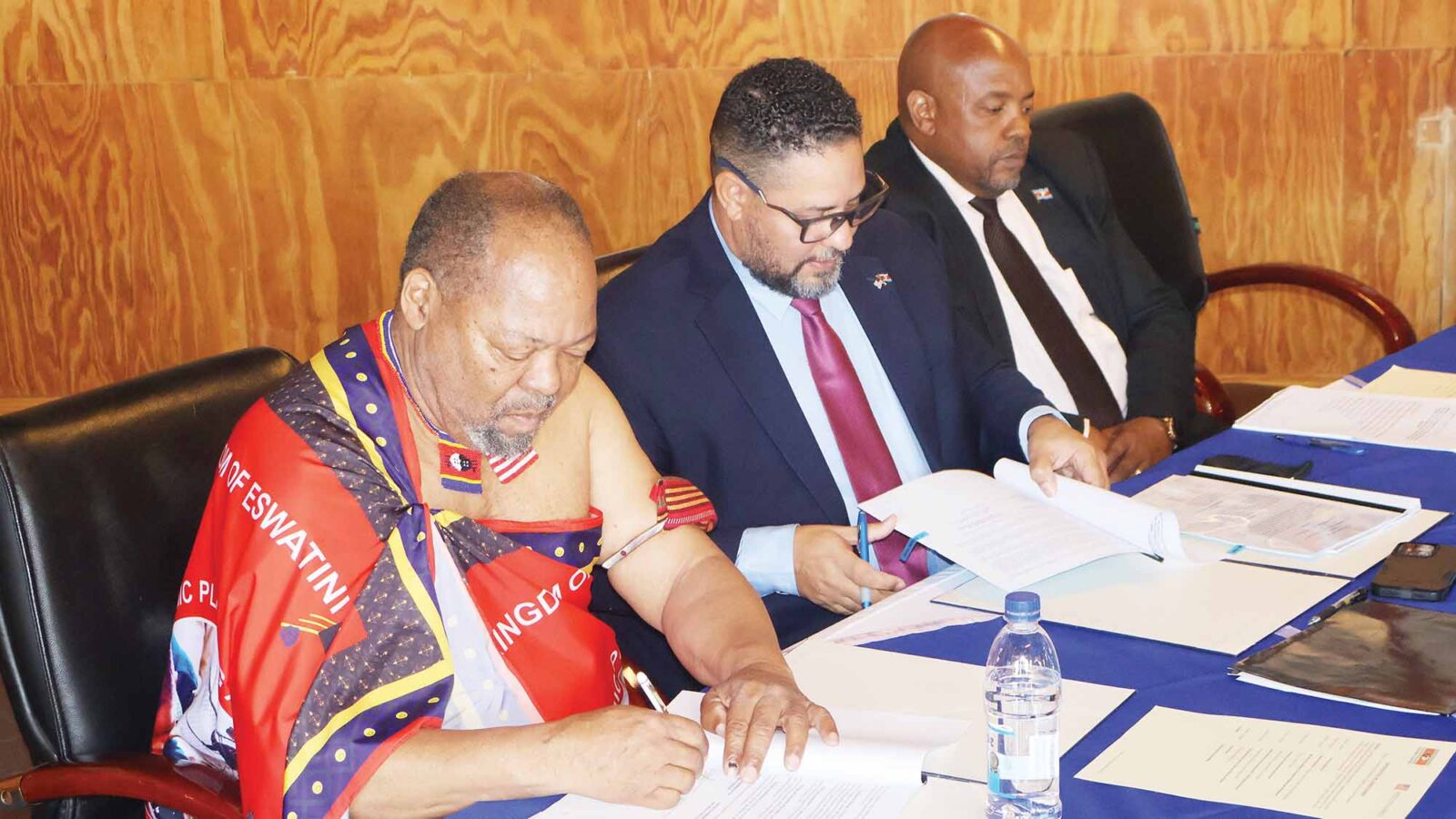
MBABANE -The Government of the Kingdom of Eswatini and the United States (US) Government have entered a new chapter in their two-decade partnership to combat HIV.
This follows the signing of a landmark US$242 million (approximately E4.1 billion) bilateral memorandum of understanding (MoU) at the American Corner in Mbabane.
The agreement, which was formalised in Mbabane, marks what US Embassy Chargé d’Affaires Marc Weinstock described as “a new chapter in our history of cooperation on health—the foundation of security, prosperity and many other goals shared between our nations.”
Speaking during the ceremony, Weinstock shared that the US Government plans to contribute up to US$205 million (approximately E E3.485 billion) over the next five years, while the Government of Eswatini has committed to increasing domestic health spending by US$37 million (approximately E629 million) to progressively take on more financial responsibility as US funding tapers during the MoU period.
Weinstock emphasised that the US remains Eswatini’s largest development partner, both bilaterally and through global institutions.
“I want to assure you that the United States remains Eswatini’s largest partner, both bilaterally and through international multilateral institutions,” he said.
The Chargé d’Affaires highlighted the recent introduction of lenacapavir, a groundbreaking twice-yearly HIV prevention injection.
Describing it as a major scientific advance, he said the American innovation was brought to Eswatini within months of its approval in the US, with government funding access for thousands of emaSwati. Reflecting on the broader partnership, Weinstock stated that over the past 20 years, America’s investment in Eswatini has saved thousands of lives, transformed the local economy and strengthened the health system.
Support for Eswatini’s HIV response alone, he said, has exceeded US$900 million (about E15.3 billion) over the two-decade partnership.
He explained that the newly-signed MoU is designed to directly support Eswatini’s goals for a sustainable HIV response as set out in the National Multisectoral HIV/AIDS Strategic Framework for 2024–2028.
The agreement, he said, is built on co-investment by the two governments and aligns with the America First Global Health Strategy.
He said the strategy aims to shift health assistance from dependency towards efficiency, resilience and partner-country ownership, while safeguarding the health of both nations through strong disease containment mechanisms.
“It simultaneously keeps the United States and Eswatini safe by containing disease threats, strengthening our bilateral partnership and ensuring better health outcomes for both Americans and emaSwati,” Weinstock added.
He provided an overview of the strategic investments outlined in the agreement and it includes full funding for frontline health workers and commodities.
The US Government has committed to covering 100 per cent of frontline healthcare workers and commodities in the next fiscal year. Over the subsequent five years, the two governments will work together to transition these health workers onto Eswatini’s payroll and shift commodity procurement to domestic systems.
It also includes strengthening public health data systems.
For this one, the US will fund improvements to Eswatini’s public health data systems, ensuring accurate tracking and response to HIV trends and disease outbreaks.
Another strategic investment is that of enhancing laboratory and surveillance capacity.
He said continued US support will help maintain high-quality diagnostic and laboratory monitoring, while bolstering Eswatini’s surveillance and outbreak response structures to rapidly detect and respond to emerging health threats.
Furthermore, there will be an investment in the form of support for integrated health services and prevention.
“The MoU includes support to integrate health service delivery and sustain access to antiretroviral treatment. It will also strengthen the scale-up of effective HIV prevention interventions, including the newly-introduced twice-yearly lenacapavir injection,” he said,
In his closing remarks, Weinstock reaffirmed the US’ enduring commitment to the people of Eswatini.
“The United States continues to be a strong supporter of emaSwati. Today’s agreement is more than a document—it is a shared, strategic commitment that reflects our mutual dedication to a healthier, more resilient future for both our nations.” He added that the US looks forward to continued collaboration to save lives, strengthen health systems and promote prosperity for the people of both Eswatini and the United States.
Also speaking at the ceremony was Minister for Health Mduduzi Matsebula, who described the moment as a significant milestone in the partnership between the Government of the Kingdom of Eswatini and the United States Government in the fight against HIV.
He emphasised that the collaboration has long served as a beacon of hope and resilience, demonstrating what can be achieved when nations unite for a common cause.
The minister reflected on the relationship that began in 2005, noting that the US has been a steadfast ally in Eswatini’s battle against HIV and AIDS, a challenge that has affected each and every one at a personal level in the nation.
Over the past 20 years, the minister said, the US Government has contributed nearly US$1 billion (E17 billion) to support Eswatini’s HIV response, including laboratory commodities, human resources, health information systems and strengthened service delivery.
This support, he said, has complemented national investments in antiretroviral medicines, health personnel and infrastructure.
*Full article available in our publication




















Leave a comment