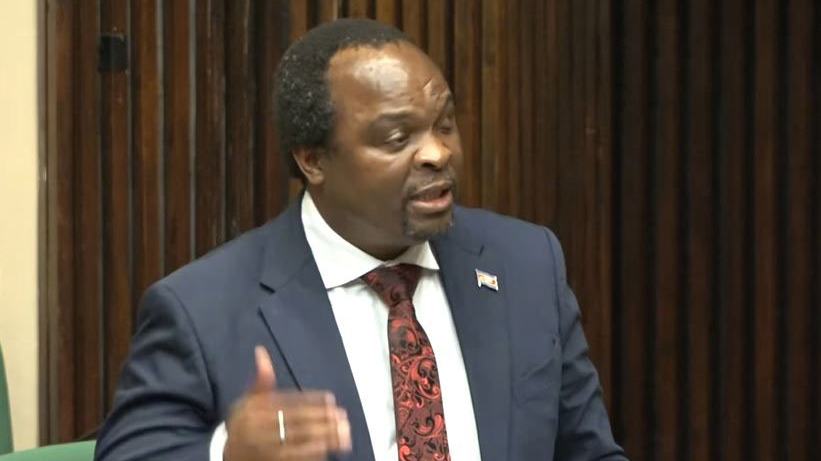
LOBAMBA – Some Members of Parliament (MPs) have questioned the proposed E50-per-day penalty for tax non-compliance, arguing that it could place an unfair burden on taxpayers and businesses.
The concerns were raised during the Committee Stage debate on the Finance Committee's report on the Income Tax (Amendment) Bill, 2026 (Bill No. 7 of 2026).
Mbabane East MP Welcome Dlamini said Parliament had a responsibility to ensure the legislation protects taxpayers, warning that lawmakers should consider the long-term impact of the laws they pass.
He noted that while the proposed amendment before Parliament initially referred to a daily penalty of E25, the committee report now reflected E50, prompting questions about how the figure had changed.
"We need to ask ourselves where the E50 comes from," Dlamini said.
The legislator also challenged the government's position on daily penalties, saying he had received complaints from taxpayers who had accumulated substantial penalties, with some allegedly facing enforcement action over unpaid amounts. He urged authorities to take concerns about the daily penalty seriously, arguing that affected taxpayers should be given an opportunity to present their cases.
Dlamini further sought clarity on the application of capital gains tax, questioning whether expenses such as mortgage interest and bank charges incurred when purchasing a property would be taken into account when calculating the taxable gain. He said the formula should ensure taxpayers are taxed only on the actual profit realised after legitimate costs have been considered.
Lobamba MP Michael Masilela also welcomed an explanation of capital gains tax but said the calculation method should be clearly spelled out in the legislation to avoid confusion.
"I need the formula; it must be clear," Masilela said.
He added that while government had a legitimate interest in collecting revenue, the tax system should be balanced and transparent so taxpayers fully understand how their liabilities are determined.
Meanwhile, Mayiwane MP Sicelo Dlamini urged Parliament to reduce the proposed daily penalty from E50 to E25, arguing that the objective of the legislation should be to improve compliance rather than impose excessive financial pressure on emaSwati.
"Let us cap this tax at E25 because the aim is not to frustrate emaSwati," he said.
Minister for Finance, Nael Rijkenberg was given an opportunity by the Finance Committee to provide more clarity on the amendments.
He explained that the proposed amendments to tax legislation are aimed at tightening the administration of capital gains tax on business assets by closing loopholes that have allowed some companies to avoid paying the tax.
Rijkenberg stressed that the changes do not introduce a new tax but instead provide greater clarity on provisions that already exist in law.
He explained that Eswatini's capital gains tax applies to business assets rather than personal property.
Individuals who sell privately owned assets, such as houses, are not liable for capital gains tax, even if they make a substantial profit. However, companies are required to pay tax on gains realised from the sale of business assets.
Rijkenberg illustrated the distinction by explaining that if a company purchased a factory for E100 000 and later sold it for E1 million, the profit made on the sale would be subject to capital gains tax.
According to the minister, businesses are able to claim deductions for improvements and other capital-related expenses over the life of an asset.
As a result, the government effectively shares in those investment costs through the tax system, making it appropriate for gains on disposal to be taxed.
"The tax already exists," Rijkenberg said. "All we're doing now is putting some clarity into it."
The amendments also seek to clarify that capital gains tax applies to gains derived from the disposal of business assets, excluding trading stock, as well as gains arising from the settlement or cancellation of business debts.
The minister said some companies have structured transactions in ways that create uncertainty over whether tax is payable.
"We're just closing those loopholes," he said.
Another amendment introduces clearer reporting requirements for withholding tax. Under the proposed changes, tax withheld from qualifying transactions must be remitted to the Commissioner General by the 15th day of the month following the transaction.
Rijkenberg said the provision is intended to ensure timely reporting and payment of tax, preventing delays in notifying the revenue authority after business assets have been sold.
"It's just to make sure you let the tax man know when the deal is done," he said.
Mbabane East MP Welcome Dlamini.