 copy.jpg)
MBABANE – Prince Lonkhokhela, the Minister for Natural Resources and Energy, raised serious concerns about local participation in the Strategic Oil Reserve Facility construction project.
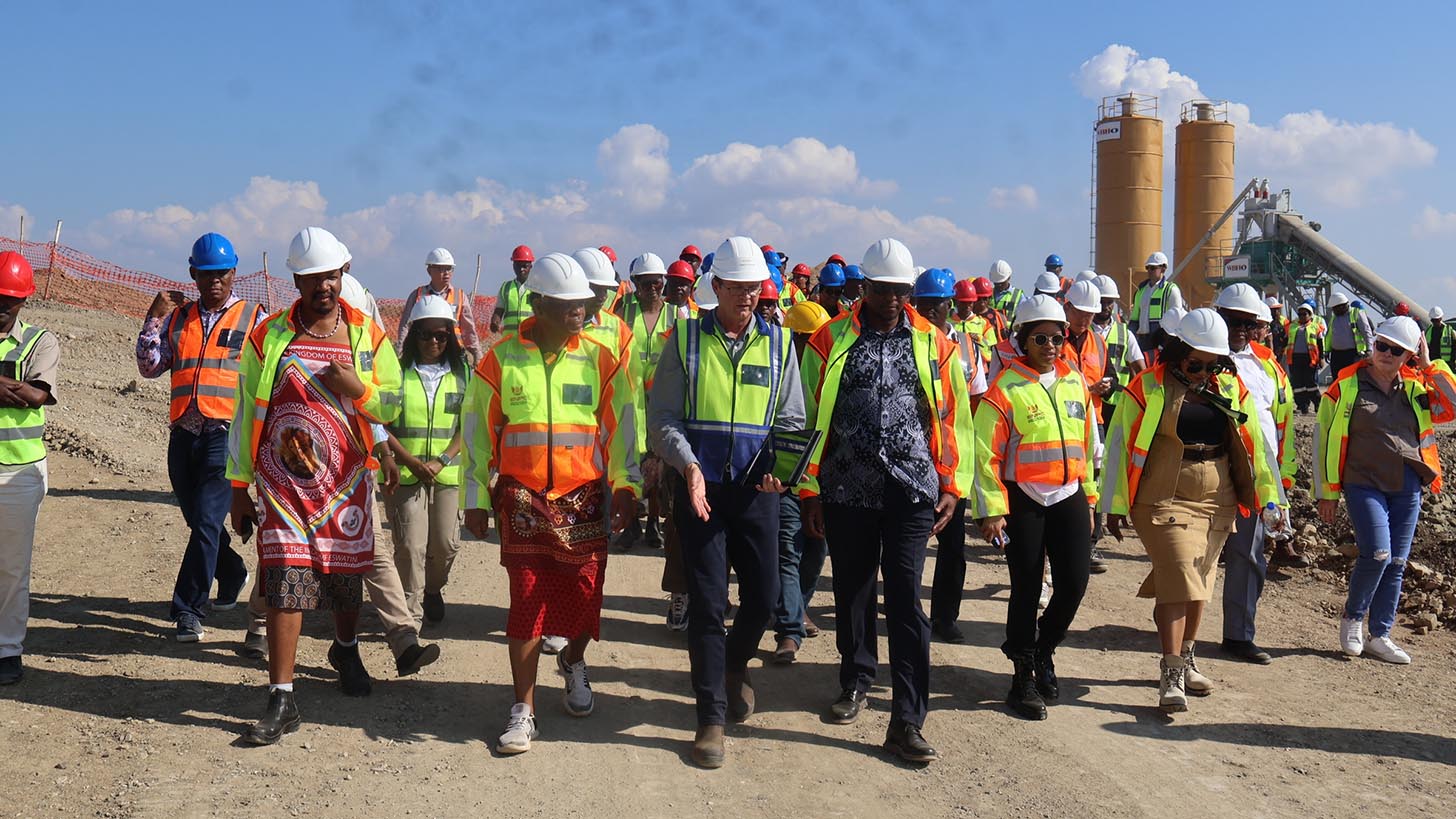
This happened on Friday during the tour of the project site by Prime Minister, Russell Mmiso Dlamini.
Towards the end of the tour, the minister made his intentions clear as he demanded answers from Project Manager Haness Kleymhaus.
This was when the tour team was about to reach the main marquee after having spent over 20 minutes seeing the different sections of the project.
At the end of the tour, this publication sat down with the minister and he registered his concerns.
He said he would raise the issues within the rightful structures.
The minister’s concerns come as calls for meaningful local participation in major construction projects appear to be falling on deaf ears, with foreign companies continuing to secure a significant share of work on large-scale public infrastructure developments.
The latest project to reignite this debate is the construction of the Strategic Oil Reserve Facility (SORF) at Phuzumoya in Siphofaneni, where certain elements of the works have been subcontracted to WBHO Construction.
The reason, it has been gathered, is allegedly that local companies did not have the capacity.
Although WBHO is a South African construction company, it is understood that the work is being undertaken through its local branch, which was appointed by the project’s main contractor.
Despite the company employing a considerable number of emaSwati at the construction site, concerns have emerged that several services, which could have benefitted local businesses, have instead been awarded to foreign companies.
The development comes only weeks after this publication reported on growing concerns surrounding the awarding of major public infrastructure contracts to foreign firms.
According to figures compiled by procurement watchdogs, infrastructure and development projects currently underway or recently awarded are estimated to be worth approximately E18.4 billion, with the overwhelming majority having been allocated to foreign-owned companies.
The involvement of WBHO has further intensified concerns regarding the continued awarding of substantial public contracts to foreign-based construction firms, despite legislative provisions intended to empower indigenous emaSwati through local participation.
Industry stakeholders argue that this trend appears inconsistent with government’s broader objective of building local capacity and promoting citizen-owned enterprises.
Unlike many other infrastructure projects awarded to foreign contractors, the Strategic Oil Reserve Facility agreement contains a specific provision requiring that at least 30 per cent of the project be subcontracted to local suppliers and service providers.
The agreement further requires the project partners to empower emaSwati through employment opportunities and collaboration with local businesses, making it one of the few major infrastructure projects with an explicit localisation target.
In monetary terms, 30 per cent of the E5.2 billion project translates to approximately E1.56 billion worth of opportunities for local companies.
However, reliable sources have informed this publication that WBHO was selected because local companies were deemed not to possess the capacity required to undertake certain specialised components of the project.
This explanation has not eased concerns within the local construction industry.
It has also been alleged that several transport services linked to the project are being provided by South African companies, with trucks bearing South African registration plates regularly seen transporting materials to and from the construction site.
*…
30% local participation target not yet achieved - ENPC admits
MBABANE – The Eswatini National Petroleum Company (ENPC) has acknowledged that the target of ensuring 30 per cent local participation in the construction of the Strategic Oil Reserve Facility has not yet been achieved.
However, the company says it has received a strategy from the main contractor outlining how more emaSwati businesses and workers will be incorporated into the project as construction progresses.
ENPC General Manager for Operations Musa Shongwe explained that the contract was awarded to Overseas Electric Engineering Corporation (OEC), which is responsible for appointing subcontractors.
He said one of the major subcontractors appointed by OEC is WBHO, which is undertaking the civil and structural works.
According to Shongwe, WBHO has, in turn, subcontracted several local companies, including one known as PJM, which is responsible for excavation works.
Shongwe explained that ENPC did not officially announce WBHO because it has no direct contractual relationship with the company.
“WBHO has been subcontracted by the main contractor, which is why we did not announce it officially,” Shongwe said.
He said ENPC’s role was to ensure that the contractual requirement for 30 per cent local participation was communicated clearly to the main contractor, even though it had no authority to determine which subcontractors would ultimately be appointed.
When asked whether the target had been achieved, Shongwe confirmed that it had not.
“For now we have not reached 30 per cent local participation. It is our desire. We are looking at the strategy they have presented to us, as it will give us a clear direction on how many emaSwati will benefit.”
He added that although the target had not yet been realised, a significant number of emaSwati had already secured employment through WBHO and its local subcontractors.
Shongwe further explained that local participation would vary depending on the stage of construction, as different phases required different technical expertise and specialised services.
He said ENPC would continue monitoring implementation of the localisation strategy and submit monthly progress reports to Cabinet.
*Full article available on Pressreader*
 copy.jpg)