

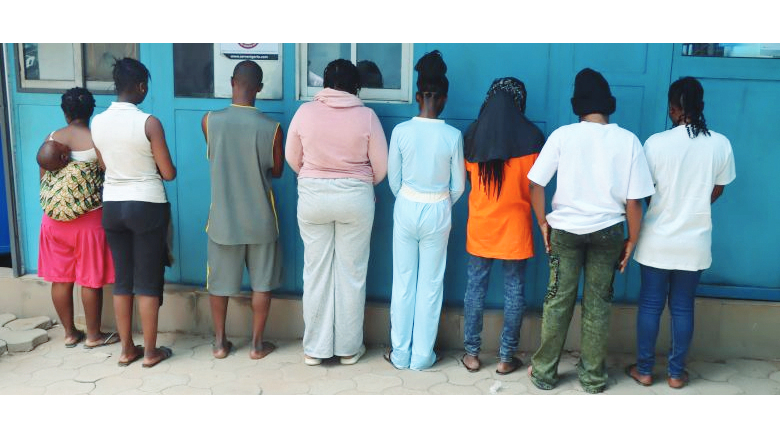
MBABANE – Eswatini will launch investigations with regional partners, including South Africa, into a Russian programme suspected of links to human trafficking across the continent.
This was revealed by Nompumelelo Lukhele, Head of the Prevention of People Trafficking and Smuggling Secretariat in the Prime Minister’s Office. Lukhele was responding to questions about a Russian initiative reportedly targeting young African girls with promises of education and a better life in Russia.
She explained that although there is no confirmed case of a liSwati recruited into the programme, the secretariat will not ignore the matter.
“There also seems to be a pattern in the country where young girls go missing and there are suspicions that their disappearance may be linked to human trafficking. We have not yet found the exact root cause of the current problem, but this has given the task force a responsibility to further probe the issue,” she said.
The Russian initiative, known as the Alabuga Start Programme, has sparked international concern. Reports from South Africa indicate that the Justice, Crime Prevention and Security Cluster is investigating a number of social media influencers who promoted the programme. It allegedly targets girls aged between 18 and 22 years.
Allegations suggest that instead of studying or working with hospitality as promised, recruits end up in factories, including a drone plant believed to be at the centre of Moscow’s war in Ukraine. The programme is run by Alabuga Start, the recruitment arm of Russia’s Alabuga Special Economic Zone, which began expanding its hiring campaign in 2023 to target women from Africa, Latin America and Southeast Asia.
International watchdogs, including the Institute for Science and International Security, allege that women recruited under the scheme are forced into labour at a military drone assembly facility. The plant has been repeatedly bombed by Ukraine.
Satellite imagery shows rapid expansion of the site in southern Russia, with new dormitories and production halls constructed since early 2025. Analists describe the location as Russia’s main drone factory, producing Shahed-type drones used in attacks on Ukrainian cities.
Research further points to teenagers being recruited into both drone assembly and construction at the facility. Alabuga’s Director General, Shagivaleev, has showcased the factory in a state-run television series, signalling its growing role in Russia’s war effort.
According to its official website (https://startworld.alabuga.ru/), the programme presents itself as a ‘unique opportunity for young and talented people’ to build careers in sectors such as road transport, service and hospitality, catering, logistics, installation and tiling. Experts, however, claim that this is a façade hiding its true purpose.
The concern arises at a time when youth unemployment in Eswatini remains high. Statistics indicate that in 2024, the youth unemployment rate was 58.18 per cent, slightly higher than the 58.16 per cent recorded in 2023. The numbers show the persistent struggle faced by young people, many of whom seek opportunities abroad.
Lukhele stressed the importance of vigilance among job seekers.
“The issue of unemployment in the country has seen a number of emaSwati accessing these offers and wanting to handle the processes privately. We have embassies and the Ministry of Foreign Affairs and International Cooperation that can be involved in verifying these opportunities,” she said.
She added that the secretariat often struggles to intervene in time. “We will require some time to investigate the offers as verdicts cannot always be issued immediately. The problem is that applicants usually come to us after signing contracts with potential employers. This does not give us enough time to investigate the offers,” she explained.
Lukhele highlighted that the country has long worked closely with South Africa in the fight against human trafficking.
*…
Human trafficking cases being investigated
MBABANE- The Royal Eswatini Police Service (REPS) and The Prevention of People Trafficking and Smuggling Secretariat continue to investigate human trafficking cases in the country.
According to the secretariat’s Head, Nompumelelo Lukhele, some cases have been concluded, while some are still being tackled by the courts. According to the Private and Cabinet Office’s 2025 First Quarter Peformance Report, the police reported on six cases, that is;
Case 1 – This an enquiry file of a nine-year-old boy of Mozambican origin, who is said to have been smuggled with his mother into South Africa. However, the mother is reported to have left the minor around Oshoek/Ngwenya Border Post on seeing that the smuggling of the child was not possible. The child has been fetched by Mozambican officials in liaison with the Royal Eswatini Police Service.
Case 2 – Male sexual exploitation case – this is a case of suspected trafficking of a liSwati male adult taken to South Africa under the guise of employment only to be subjected to sexual exploitation (sodomy).
Case 3 – Verulam case – This is an alleged case of trafficking involving a South African female adult purported to be involved in a love relationship with a liSwati, who is said to have then trafficked her to Eswatini. The South African female is said to have been subjected to sexual exploitation and assault at the hands of the liSwati.
Case 4 – A male child aged 11 years taken to Mozambique for purported healing at a Mozambican traditional healer’s home. The case is under investigation.
Case 5 – Congolese Case – This case involves six Congolese nationals allegedly smuggled into Eswatini by four possible suspects (a liSwati, Mozambican, Nigerian and South African). The smuggled involve two adults (one male, the other a female) and six children between the ages of five and 11.
Case 6 – A missing in person’s case of 12-year-old was reported. The case is under investigation.
*Full article available in our publication.














Leave a comment