MBABANE – Over the past two years, the Eswatini Electricity Company (EEC) has spent E806 million on administrative costs.
In the 2025 financial year, administrative expenses amounted to E456 764 444, while the company spent E341 354 713 in 2024. It has been learnt that EEC spent a total of E262.34 million (E262 349 820) on employee benefits in 2024 and 2025, respectively.
The parastatal, which is 100 per cent owned by government, also utilised E32 million for staff training and welfare. It must be noted that the company paid E4.2 million in performance bonuses in 2024. Notably, no performance bonuses were paid in 2025.
When combining these employee-related expenses, the company’s total outlay amounted to E298 million, for the past two years. It projected salary increments of 4.65 per cent in 2025 and 5.25 per cent for subsequent years. This was classified as ‘future salary increases’.
Addressing the issue of short-term employee benefits, EEC stated in its 2025 financial report that the cost is recognised during the period in which the employee renders the related service.
It was reported that the provision for employee entitlements to salaries and annual leave represents the amount that the company has a present obligation to pay because of services provided by employees up to the statement of financial position date. EEC said the provision had been calculated at undiscounted amounts based on current salary rates.
On the other hand, the company noted that the implementation plan for its recognition and reward programme commenced through various educational stakeholder engagements. While the formal nominations programme is planned for the 2025/26 financial year, EEC mentioned that it had already introduced the celebration of employee birthdays, which has received positive feedback from staff.
For the year under review, the parastatal introduced what it refers to as ‘Lilangeni per employee’, tailored towards investment in training. Training costs reportedly increased due to the acceleration and strengthening of technical capacity aimed at keeping staff up to date with industry trends and technological advancements that enhance the company’s efficiency and drive innovation.
*…
... CANGO boss questions staff expenses
MBABANE – The Executive Director of the Coordinating Assembly of Non-Governmental Organisations (CANGO), Thembinkosi Dlamini, has questioned the size of the Eswatini Electricity Company’s (EEC) wage bill.
He argued that it appeared disproportionate to the nature of the company’s operations.
In an interview, Dlamini said a review of the company’s structure and functions suggested that EEC’s core business was not engineering or high-technology work but rather the resale and distribution of electricity purchased from external suppliers. He said such an operation was not so complex as to justify the level of expenditure reflected in the company’s staff costs.
He said depending on how the figure of E298 million was determined, the actual human resource costs could be much higher than reported.
*…
Proposed tariffs not for operational costs – EEC
MBABANE – Khaya Mavuso, the Marketing and Corporate Communications Manager at EEC, says the proposed tariff increase is not related to any perceived inefficiency of the utility.
Instead, Mavuso said it is being proposed to cater for import costs for electricity as purchasing contracts have been renewed.
He did not give details on the matter as it is still subject for discussion by the regulator and utility. However, the Times SUNDAY can mention that the South African energy regulator reportedly committed an error in the previous financial year, adjusting tariffs by three per cent and later discovering that it should have been eight per cent.
When EEC asked for the adjustment sometime back, it was based on the three per cent, but the seller, Eskom, imposed eight per cent after the error had been rectified, resulting in the parastatal incurring the loss over a long period of time. This is the money that must be recovered as the parastatal operated at a huge loss, according to insiders.
On another note, it has also been learnt that EEC employees are no longer entitled to free electricity and overtime. To cut down on costs, the parastatal, it has been established, is now reportedly losing its experienced and trained staff to the private sector, mainly the sugar-belt companies.
Investigations have unearthed that the Eswatini Energy Regulatory Authority (ESERA) advised the company to cut down on personnel costs, mainly salaries. Seeing that it is illegal to reduce an employee’s salary, EEC cancelled overtime allowances. Workers are understood to be reluctant to work overtime for no pay.
The staff intake has not changed from 700 for many years. This intake includes support staff. It is now understood that one technician attends to 1 000 customers.
EEC has applied to ESERA seeking an average electricity tariff increase of 20.67 per cent for the 2026/27 financial year. This proposal has prompted ESERA to convene stakeholder consultations to deliberate on the matter. The stakeholder consultations are now complete. The consumer is waiting for an outcome of the deliberations.
*Full article available on Pressreader*
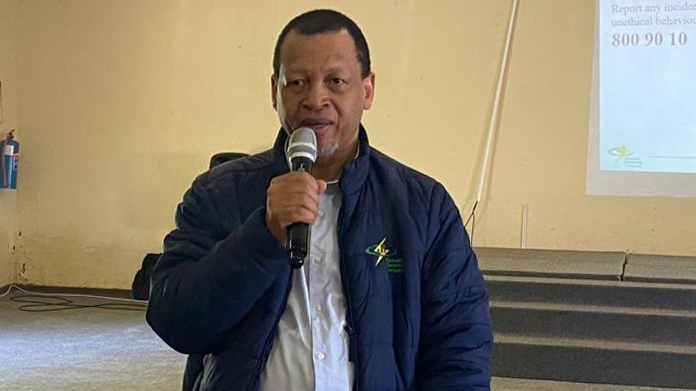
EEC Managing Director, Ernest Mkhonta making his presenatation. (Pics: Sabelo Majola)
 copy.jpg) Advertisement
Advertisement