Madam,
The issue regarding the recent decision by the Ministry of Education and Training to uphold its earlier correspondence to 39 head teachers who are accused of unlawfully charging top-up fees in public primary schools, is interesting to say the least. This firm stance, rather than retracting the letters, is both justified and necessary to uphold the rule of law, protect the constitutional right to free education and protect the interests of learners and parents across the country.
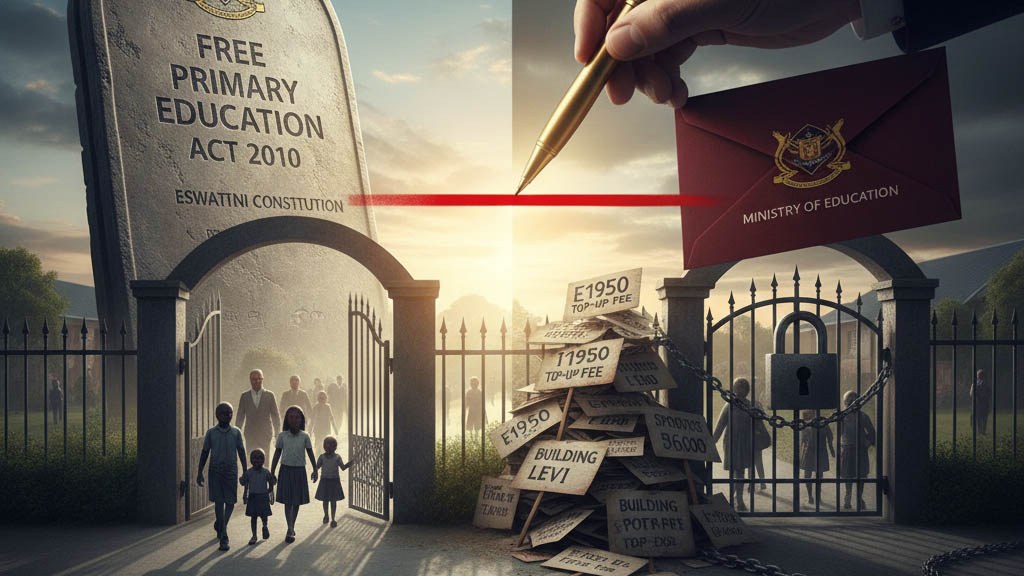
Public education in Eswatini is enshrined in the Constitution and reinforced by the Free Primary Education (FPE) Act of 2010, which guarantees free access to schooling for learners from Grade I to Grade VII. Schools may only collect additional levies with the explicit approval of the Ministry of Education following a transparent process that involves school committees and parent consultation.
The independent investigation, conducted by this very newspaper, brought these practices to light, revealing that out of 50 schools found charging top-up fees, only 11 had applied for authorisation. The remaining 39 charged parents without legal sanction.
It is precisely because these head teachers acted contrary to established policy and the law that the ministry’s insistence on maintaining the letters is a principled and necessary step.
To withdraw them now would send a troubling signal that regulatory frameworks governing public education can be disregarded with impunity. Upholding the rule of law is fundamental to the functioning of a fair society, particularly where children’s rights are at stake.
Critics might argue that many schools are under-resourced and that top-up fees are a way to address infrastructural and operational needs. While resource constraints are a genuine concern, unlawful fees are not the appropriate remedy. Schools must pursue funding needs through lawful channels, such as approved requests for additional resources or community-led fundraising that does not impose unapproved charges on parents.
Allowing schools to bypass statutory requirements would weaken the very foundation of free education and create inequality among learners.
Moreover, the ministry’s decision protects vulnerable families who already struggle to meet basic financial demands. When top-up fees vary widely – in some cases reaching amounts that many parents cannot afford – there is a risk that learners from poorer backgrounds will be unfairly excluded or pressured. Some schools were reportedly demanding as much as E1 950, while others charged far lower amounts. Such inconsistency undermines equitable access and places undue strain on low-income families.
The ministry’s firm approach also aligns with its earlier warnings that head teachers demanding unauthorised top-up fees or turning pupils away could face disciplinary action and be charged with theft.
This position not only reinforces legal compliance but also affirms the State’s commitment to upholding the principle that government already funds free primary education through public resources.
Parents and guardians deserve assurance that their children’s education will be free, fair and protected by clear rules. Upholding the letters issued to the 39 head teachers sets a precedent that public officials are accountable to the same laws that govern every citizen. In doing so, the Ministry of Education and Training has upheld its duty to defend the rights of learners and strengthen trust in the education system.
Public education in Eswatini is enshrined in the Constitution and reinforced by the Free Primary Education (FPE) Act of 2010.