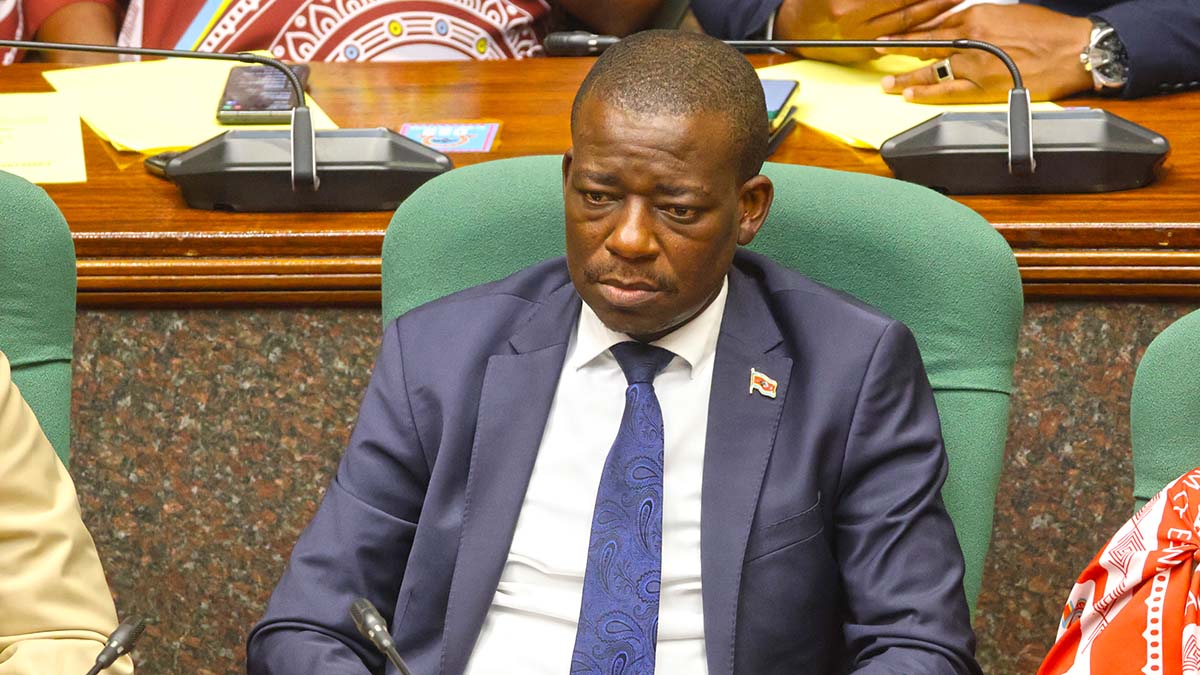
The atmosphere in the House of Assembly this past Friday was one of cautious optimism as Minister for Finance Neal Rijkenberg tabled the budget estimates for the next financial year (2026/27).
For some in the sporting fraternity, the figures initially looked like a victory. The Eswatini Sport and Recreation Council (ESRC) saw its allocation leap from E19.4 million to E30.5 million, which is a staggering E11 million increase. On paper, it is a triumph for Minister for Sports, Culture and Youth Affairs Bongani Nzima.
However, as the dust settles and we look at the cold, hard logistics of modern international competition, we must be honest with ourselves: This is not enough.
While ESRC Chief Executive Officer (CEO) Darius Dlomo is right to laud the move as a step towards professionalisation, we are currently trying to build a skyscraper with the budget of a three-bedroom house. If we are serious about the ‘professionalisation’ mentioned by Minister Nzima, we need to stop thinking in increments of E10 million and start thinking in hundreds. To truly transform Eswatini from a participant to a powerhouse, a minimum budget of E100 million is required.
The single greatest hurdle facing our athletes today is not just a lack of talent; it is the sheer cost of movement. Recent safety mandates have effectively ended the era of cramped, overnight midi-bus trips to regional competitions. The ban on road and night travel for athletes, while necessary for the safety and dignity of our sportsmen and women, has fundamentally altered the financial landscape of Eswatini sports.
In years past, an association could scrape together a few thousand Emalangeni to send a team to South Africa or Botswana by road. Today, that is no longer an option. Professionalism demands air travel. Air travel demands foreign currency, high-cost ticketing and sophisticated logistics. When you consider that the ESRC must provide grants for over 30 sporting associations, the E30.5 million begins to look incredibly thin.
A lion’s share of a revised E100 million budget must be ring-fenced specifically for international participation. We cannot expect our athletes, or our swimmers to compete against the best in the world when they arrive at venues exhausted from logistical nightmares—or worse, fail to show up at all because the ESRC coffers are dry by mid-year.
Minister Nzima and CEO Darius Dlomo have spoken extensively about the Sport Bill and the move towards high-performance centres and scholarships. These are noble goals. The transition from amateurism to a professional industry is the only way to ensure that sports contribute to the gross domestic product (GDP) and provide viable careers for our youth.
However, professionalisation is an expensive venture.
If we dilute the current E30.5 million across 30 associations, while also trying to fund these high-level programmes, we run the risk of doing everything poorly instead of doing a few things excellently.
Perhaps the most glaring oversight in our current sporting framework is the Ministry’s Incentives Policy. Currently, the policy is designed with a narrow lens: It rewards athletes who secure podium finishes on the international stage. While rewarding medallists is vital, this criteria is dangerously outdated and fails to recognise the diverse ways emaSwati are conquering the world stage.
Look no further than Letticia Viana. The latter recently made history with her officiating at the Africa Cup of Nations (AFCON). As a Video Match Official (VMO), she did not just represent herself; she carried the flag of Eswatini into the highest echelons of global football broadcasting and decision-making. Her performance was a podium finish in terms of professional merit.
Yet, under the current rigid policy, an official of her calibre—someone who has reached the absolute pinnacle of her profession—often finds herself outside the bracket for state incentives because she did not win a race or score a goal.
This is an insult to the hard work of our officials. Whether it is referees, judges or administrators, these individuals are our ambassadors. The Incentives Policy must be reviewed immediately to accommodate outstanding officials on international assignments.
When Letticia Viana makes history at AFCON, the state should be the first to reward that excellence, ensuring she has the financial backing to continue her professional development.
The E11 million increase is a polite nod of acknowledgement from Minister Rijkenberg, but it is not a solution. It is a band-aid on a gaping wound of underfunding. We are grateful for the progress, but we cannot be silent about the shortfall.
The Sport Bill has given us the legal framework to dream big. Minister Nzima has shown he has the political will to fight for the sector. Now, we need the financial muscle to back it up. We cannot talk about ‘professional sport’ while our associations are begging for crumbs to buy plane tickets.
We must move away from the mindset that sport is a hobby. It is an industry. It is a diplomatic tool. It is a source of national pride. Above all, it is an investment that requires capital. Until we hit that E100 million mark, we are merely spinning our wheels in the sand.
It is time to pay the price for the success we claim to want. Let us start by fixing the travel budget and ensuring that heroes like Viana are given the flowers and incentives they so richly deserve.
Moneni ‘finally back in business’
There is a distinct rhythm returning to the heart of Moneni.
It is the steady, rhythmic pulse of the drum and the unmistakable roar of one of the most passionate fanbases in the league. For too long, the Moneni ‘Buccaneers’ seemed adrift, looking more like relegation fodder than the powerhouse their history demands. However, the narrative has shifted dramatically. What we are witnessing is not just a run of good form, it is a total cultural and competitive recharge.
The statistics tell a story of a team transformed. After securing four consecutive league victories for the first time this season, Pirates have officially shed their ‘underdog’ tag. This resurgence is punctuated by a gritty 2-1 victory over their perennial hoodoo side, Sisonkhe, proving that the mental blocks of the past have been dismantled. With 11 games remaining, the ‘Buccaneers’ sit a mere five points off second place. In a league where momentum is everything, they have become the side that nobody wants to face.
The catalyst for this revival is undoubtedly the arrival of Mozambican tactician Mathews ‘Chaka Chaka’ Mandlazi. His appointment appears to be exactly what the doctor ordered. Under his stewardship, the team has cultivated a steely resolve, remaining unbeaten in 10 straight league matches. This newfound self-belief was most evident in their recent victory over Buffaloes; by avoiding defeat against them for the first time in over four years, Pirates sent a clear signal that they are no longer anyone’s stepping stone.
However, with great success comes the danger of hubris. The Ingwenyama Cup quarter-finals beckon, and the league podium is within touching distance, but the club must keep its eyes on the ball. History reminds us that the closest Pirates came to the summit in recent years was a fourth-place finish in the 2019/20 season, which was a campaign cut short by the COVID-19 pandemic after just 18 games. To surpass that milestone, the club must manage expectations.
While the ‘vibe’ in the stands is back and the atmosphere is electric, the leadership must set realistic goals to avoid the crushing weight of unnecessary pressure. Securing a top-three league finish and reaching the Ingwenyama Cup final would represent a monumental achievement for a side that, only months ago, was looking over its shoulder at the drop zone.
Moneni Pirates are an undeniable asset to the league. When the ‘Buccaneers’ are firing, the entire domestic game feels more vibrant. If they can maintain this discipline and avoid being carried away by the hype, the 2025/26 season would not just be remembered for a mid-season turnaround; it will be remembered as the year the giants of Moneni truly found their compass again.
Minister for Sports, Culture and Youth Affairs Bongani Nzima. (File pic)