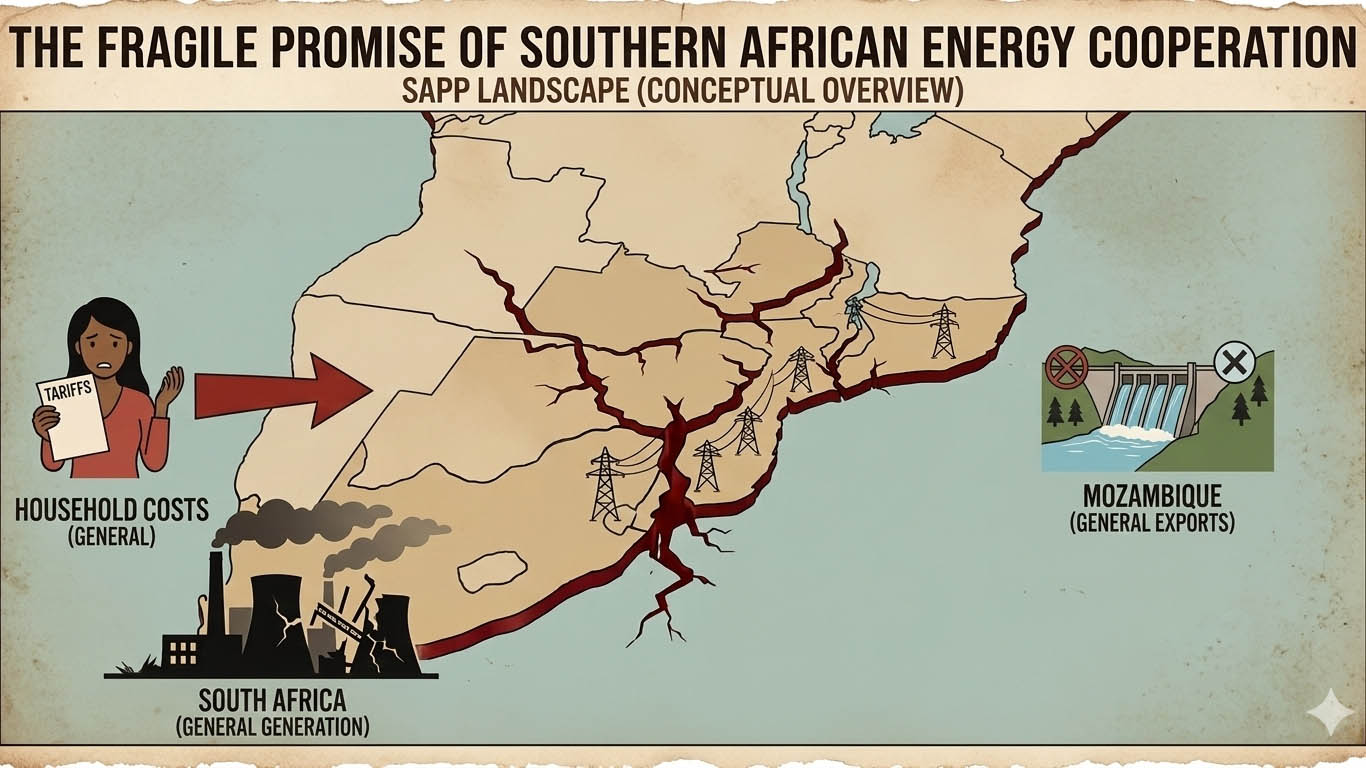
Energy cooperation has long been presented as one of the most practical pillars of the Southern African Development Community. The establishment of the Southern African Power Pool (SAPP) in 1995 was meant to knit together national grids, promote cross-border electricity trade and reduce vulnerability to domestic shocks. Three decades later, the region’s energy landscape presents a mixed picture: Progress in interconnection and market design sits alongside recurring supply crises, financial fragility and uneven investment. In Eswatini, the recent approval of an electricity tariff increase has made the regional energy question more than pertinent, linking household costs directly to decisions taken within and outside national borders.
The Southern African Power Pool, coordinated from Harare, links utilities across 12 member States. Its short-term energy market and day-ahead market have created a platform for competitive trading, allowing countries with surplus generation to sell into deficit markets. On paper, the model mirrors arrangements seen in other regional blocs, pooling risk and improving efficiency through diversification of energy sources.
However, implementation has exposed structural weaknesses. South Africa, historically the region’s dominant generator, illustrates the paradox. Through Eskom, the country once exported surplus power to neighbours. Chronic plant failures, ageing coal infrastructure and governance failures turned the country into a net importer during peak shortages. As rolling blackouts gripped the domestic economy, cross-border supply became erratic. The episode underlined a core vulnerability: when the largest economy falters, the entire pool absorbs the shock. For Eswatini, which imports a large share of its electricity from South Africa and Mozambique, developments within Eskom directly affect domestic tariffs. The recent tariff adjustment, approved by the national regulator, reflects rising input costs and constrained regional supply. It illustrates that regional energy security is not an abstract diplomatic agenda but a matter with immediate consequences for businesses and consumers. When neighbouring systems face strain, smaller economies encounter rising procurement costs and difficult regulatory decisions.
Mozambique presents a different dynamic. The Hidroelectrica de Cahora Bassa has for decades exported hydropower from the Cahora Bassa dam to South Africa and other markets. Hydroelectric generation offered the promise of cleaner, relatively low-cost supply. However, insurgency in Cabo Delgado and climate variability have complicated expansion plans. Transmission infrastructure remains vulnerable, while drought cycles have affected output across the Zambezi basin. Mozambique’s case shows how energy security in the region is tied not only to technical coordination, but to political stability and climate resilience.
Zambia provides a third example. Reliant on hydropower for the bulk of its electricity, the country experienced acute shortages during periods of low rainfall. Reduced water levels at Kariba Dam curtailed generation, forcing load-shedding and increased imports through the SAPP platform. While the power pool enabled emergency purchases, constrained regional supply limited relief. Zambia’s vulnerability highlights the need for diversified generation portfolios across member States, rather than concentration in single-source systems.
The policy architecture underpinning regional cooperation is ambitious. The SADC Protocol on Energy commits members to harmonisation of regulatory frameworks, development of interconnectors and promotion of renewable energy. Transmission projects such as the Zambia–Tanzania–Kenya interconnector and expansions within the Southern African grid aim to widen trade corridors. In theory, a denser network reduces dependence on any one supplier and allows surplus renewable energy to flow where needed.
Financing remains uneven. Utilities across the region struggle with cost-reflective tariffs, debt burdens and limited capital expenditure. Investors weigh sovereign risk and currency volatility when considering large-scale projects. Without stronger regulatory alignment and credible financial reforms, cross-border trade mechanisms cannot fully substitute for domestic reform. Regional leaders have often framed energy cooperation as an economic imperative. “Energy is the lifeblood of our economies and the foundation of industrialisation,” former South African President Thabo Mbeki observed during discussions on continental infrastructure. The statement captures a widely accepted premise: Without reliable electricity, ambitions for manufacturing growth and regional value chains stall.
For his part, Hage Geingob, who served as both President of Namibia and Chairperson of SADC during his tenure, consistently argued that regional integration was not optional, but strategic. He maintained that energy interconnection should form the backbone of industrial expansion, warning that fragmented national planning would perpetuate shortages and raise costs. In one regional address, he stated that ‘no country in our region can achieve sustainable development in isolation,’ framing shared infrastructure as a practical necessity rather than a political aspiration. His position reflected a long-standing view within SADC leadership that coordinated planning and pooled resources offer greater resilience than isolated national systems.
One constraint lies in energy nationalism. Governments, facing domestic political pressure during shortages, prioritise national demand over contractual exports. While understandable, such actions weaken trust in the trading system. The credibility of the SAPP depends on adherence to agreed dispatch rules and timely settlement of payments. Delays in remittances have occasionally strained relations between utilities, raising concerns about counterparty risk.
Climate change introduces another layer of complexity. Southern Africa is among the regions most vulnerable to extreme weather variability. Droughts reduce hydropower output, while cyclones threaten transmission lines and generation assets. The shift towards renewable energy, particularly solar and wind, offers diversification but demands grid upgrades and storage capacity. Regional coordination could facilitate integration of intermittent supply, smoothing fluctuations across a wider geographic area.
Encouragingly, there have been incremental improvements. The SAPP competitive market platform has expanded participation, and some countries have unbundled generation and transmission entities to attract private investment. Independent power producers are entering markets once monopolised by State utilities. South Africa’s renewable energy procurement programme, though nationally driven, has stimulated new capacity that may eventually contribute to regional trade. Disparities, however, remain stark. Countries with relatively strong institutions and larger markets can mobilise investment more readily than smaller economies. This asymmetry shapes bargaining power within the pool. For landlocked States dependent on imports, diversification options are narrower, reinforcing vulnerability to regional shocks.
Energy cooperation has long been presented as one of the most practical pillars of the Southern African Development Community.