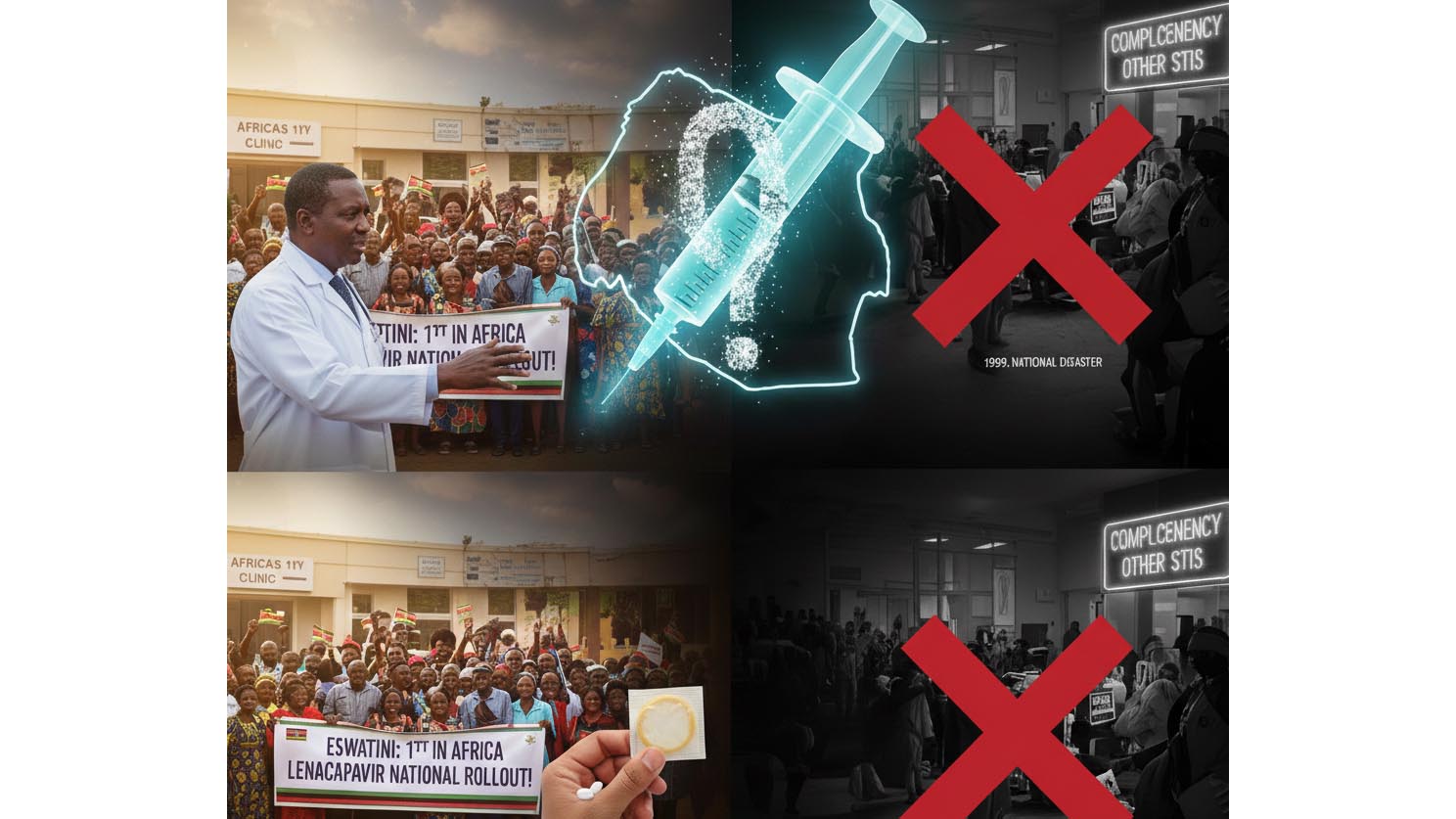
Can being the first to receive the groundbreaking HIV/AIDS prevention drug send us back to being the worst in the fight against HIV and AIDS?
This is the monumental question that unsettled the mind when His Majesty the King issued a stern warning against the potential reckless sexual behaviour, following the country’s landmark acquisition of what some describe as the ‘invisible condom’.
Eswatini has been the first African country to receive the new twice-yearly injection for HIV and AIDS prevention and the King has called for a national rollout to ensure it is accessible to all citizens. The Ministry of Health has swiftly responded, pledging to swiftly implement the directive, with the speed of ‘nkwe’!
The injection, lenacapavir, created by Gilead Sciences, is anticipated to revolutionise the status quo of HIV prevention in a country that had one of the highest HIV prevalences in the world.
Nonetheless, as His Majesty King Mswati III wisely warned in his speech when dispersing regiments at the close of the Incwala Ceremony on Saturday, this innovation cannot breed complacency or recklessness.
In short, it can easily negate all the gains the country has achieved in the health sector, particularly because it does not prevent the contraction of other sexually transmitted diseases.
The warning essentially underscores the prolonged and challenging nature of Eswatini’s battle against HIV and AIDS. It was declared a national disaster by the King in 1999 and two years later, he told a special session of the United Nations General Assembly: ‘My people are dying. They are dying before their time, leaving behind their children as orphans and a nation in a continuous state of mourning. A quarter of all emaSwati are already infected with the virus that causes AIDS and we cannot avoid an escalating tragedy of truly frightening proportions.’
HIV-related deaths reached a peak of roughly 10 000 in 2005, followed by 14 000 new infections in 2010, which highlighted the need for urgent intervention. Driven by a political will, the Ministry of Health, in collaboration with the World Health Organization, UNAIDS and PEPFAR, has managed to turn the corner in Eswatini.
Key interventions included the introduction of antiretroviral therapy in 2003, delivery of WHO recommendations for treatment optimisation and task allocation strategies that decentralised services to reach greater numbers of people.
At the heart of this success has been Eswatini’s milestone attainment of the targets for UNAIDS 95-95-95, a decade before the 2030 global deadline. As of 2020, 94 per cent of adults living with HIV knew their status, while 97 per cent of those aware were on antiretroviral therapy, and 96 per cent of those on treatment achieved viral suppression.
Now we open a new chapter following the introduction of lenacapavir injectables. Eswatini has become the first African country to receive this twice-yearly HIV prevention injection, a feat that has set off excitement from the Global Fund to fight AIDS, tuberculosis and malaria.
The Global Fund’s Executive Director, Peter Sands, has called the delivery of the injection in Eswatini ‘a turning point’ for a nation that has known the very worst of the epidemic and has fought tirelessly to reverse it.
Sands emphasised the injection’s enormous liberating potential, especially in countering stigma and abuse. In an opinion piece on the Global Fund Facebook page, he notes how in Eswatini, as in many places, people have to conceal daily oral prevention pills, which could leave them open to judgment or risk of harm.
Sands highlights its empowering influence for young women, who lack a voice in intimate relationships, to achieve a private way to protect their health without fear of recrimination or exposure. However, Sands warns that the success of this initiative requires more than science. ‘Success is based not just on funding; it is based on trust. You should have the trust to provide stigma-free care for people in your clinics and trust health workers to facilitate medicines. Trust in global partners to maintain the momentum,’ he says.
On Saturday, the King commended the injection’s promise, saying he had great confidence in it and that it would enable the country to eradicate the disease, helping people to live healthy lives.
Most importantly, he was firm in his caution against carelessness: ‘Let us not become careless in our conduct,’ he warned. Indeed, this injection is not an invisible condom that should give rise to wanton sexual behaviour.
To think like that would undo decades of progress, risking the reemergence of infections and eroding the trust Sands believes is central.
Responsible practice is still critical and this includes consistent use of condoms where safe to do so, fidelity in relationships, testing and having open conversations regarding sexual health.
The King’s warning serves as a candid reminder that medicine can only bring about great progress when there is a good society that respects the values of discipline both for its members and for everyone else. We really cannot afford to move from being the world’s best and Africa’s first, to being the worst globally (once again) through a lack of moral restraint.
Eswatini has been the first African country to receive the new twice-yearly injection for HIV and AIDS prevention and the King has called for a national rollout to ensure it is accessible to all citizens.