Time is the only currency that cannot be recovered once spent.
Today, as we mark exactly 58 days before Sihlangu Semnikati’s first and arguably most critical match of 2026, the silence emanating from the Eswatini Football Association (EFA) headquarters is not just deafening—it is dangerous.
Since the sacking of Croatian ‘part-timer’ Zdravko Logarusic late last year, the national team has been left in a state of tactical limbo. Despite the expiry of that chapter months ago, the EFA has neither named a successor nor even bothered to formally advertise the vacancy. This lack of urgency raises a familiar, stinging question: What exactly are the priorities of our football authorities?
The EFA continues to operate under the persistent, flawed delusion that a national team can be assembled overnight like a marquee for a Sunday fete. It is time to face the cold, hard facts: Sihlangu are a long-term project. It requires a visionary at the helm who is not merely looking at the next 90 minutes, but at the next 90 months.
When will a new coach start monitoring the players in the Premier League games and beyond? How can we expect the first squad of the year to be a true reflection of the talent at our country’s disposal when there is no one tasked with the scouting? These are not just ‘media questions’; these are the concerns of a soccer-loving nation that feels it is being taken for a ride.
The current excuse—that the coaching issue will be tabled during the EFA retreat starting this Thursday—is, quite frankly, unacceptable.
To wait until late January to discuss a vacancy that opened at the end of November is a failure of administrative duty. By the time the retreat concludes, we will be staring down the barrel of March with no technical blueprint. It is already too late for discussion. We need a decision.
From March 25, Sihlangu face a two-legged tie in the 2027 Africa Cup of Nations (AFCON) Preliminary Round. Our opponent is Eritrea. On paper, some might see a team returning from a six-year hiatus as an easy draw. That is a trap.
The ‘Red Sea Camels’ are officially making their comeback to international football in March 2026. This is their first competitive outing since 2020, and they are hungry to re-establish themselves on the continental stage. Do not be fooled by their absence; Eritrea boasts a significant number of players in the Diaspora, refined in professional environments abroad. They will not be pushovers.
The winner of this tie advances to the group stages of the qualifiers. The loser vanishes from the AFCON map for years. For Eswatini, a nation that prides itself on its footballing identity, falling at the first hurdle to a team that has not played a competitive match in over half a decade would be an unmitigated disaster.
Why does this matter so much? Because a national football team is more than just 11 men chasing a ball; it is the heartbeat of a nation’s pride. Sihlangu represent our collective hopes, our resilience and our presence on the global stage. When the national anthem plays, it is not the EFA being judged—it is Eswatini.
A successful national team drives grassroots interest, boosts the local economy through domestic leagues and serves as a primary tool for international diplomacy. By neglecting the technical leadership of Sihlangu, the EFA is neglecting the very image of the country.
To move forward and avoid repeating the same mistakes while expecting different results, the EFA must undergo a radical shift in its operational DNA. If the EFA is to be taken seriously going forward, they must appoint a caretaker coach this week.
This individual can begin the essential work of player selection and fitness monitoring while the formal, transparent search for a permanent head coach continues.
The EFA needs to move away from ‘manual’ administration. A centralised database of all eligible players—both domestic and overseas—should be maintained so that any incoming coach has a ‘handover’ pack ready on day one.
The ‘Logarusic saga’ proved that the EFA’s vetting and contract management are porous. Future contracts must include strict clauses regarding ‘part-time’ work and mandatory presence at local league games.
The EFA is at a crossroads. They can continue with this culture of ‘last-minute’ management and watch as Sihlangu fall further down the International Federation of Association Football (FIFA) rankings, or they can act with the decisiveness that the fans deserve.
The Eritrea match is not around the corner; it is on our doorstep. Appoint the caretaker. Open the applications. Stop the excuses. Our national pride is not a part-time interest.
Protect next generation of fans
The image of a parent clutching a wailing child while fleeing for safety, should haunt every stakeholder in Eswatini football.
This scene, captured amid the chaos at Mavuso Sports Centre this past Sunday, is a damning indictment of the state of our game. What should have been a standard league clash between Manzini Wanderers and Rangers descended into a war zone, proving once again that for some, a referee’s decision is worth more than a human life.
The flashpoint was a disallowed goal—a moment of sporting friction that occurs every weekend across the globe. Wanderers fans, convinced they were robbed of a legitimate score, chose to vent their frustrations through violence. While passion is the lifeblood of the sport, there is no justification for turning a stadium into a site of trauma for the young and the vulnerable.
This was not an isolated incident. Just days prior, we witnessed the harrowing sight of Mbabane Highlanders Coach Ernest Mavuso, being whisked away by police. His crime? Overseeing a match where the ‘Black Bull’ surrendered a 2-0 lead to draw 2-all against Green Mamba. When a coach requires a police escort to survive a stalemate, the ‘beautiful game’ has turned ugly.
We must be pragmatic. In a landscape where resources are scarce, gate receipts remain the primary lifeline for our clubs. By fostering an environment of fear, clubs are effectively sabotaging their own bank accounts.
Parents will not bring their children—the next generation of fans—to a venue where tear gas and flying missiles are the norm.
No reputable brand wants its logo associated with bloodied faces and riot police. The damage to facilities like Mavuso Sports Centre diverts funds that should be spent on player development and infrastructure. We have reached the point where condemning violence in print is no longer enough. Ink and paper have been exhausted; what we lack is the steel to follow through with consequences.
To save Eswatini football, we must move beyond mere fines, which are often poorly enforced or delayed. We need a structural shift. Financial penalties are often absorbed by clubs or ignored. We again call for immediate points deductions for teams whose fans incite violence. When a title race or relegation battle is at stake, the fans may finally self-police.
Working with local law enforcement, clubs must identify repeat offenders through stadium footage and ban them for life.
Relying solely on police can sometimes escalate tension. We need professionally trained, club-affiliated stewards who are integrated into the fan bases to de-escalate situations before they turn violent.
We should leverage this community spirit to launch ‘Family-First’ campaigns, reminding supporters that the person sitting next to them—perhaps a child—is more important than the scoreboard.
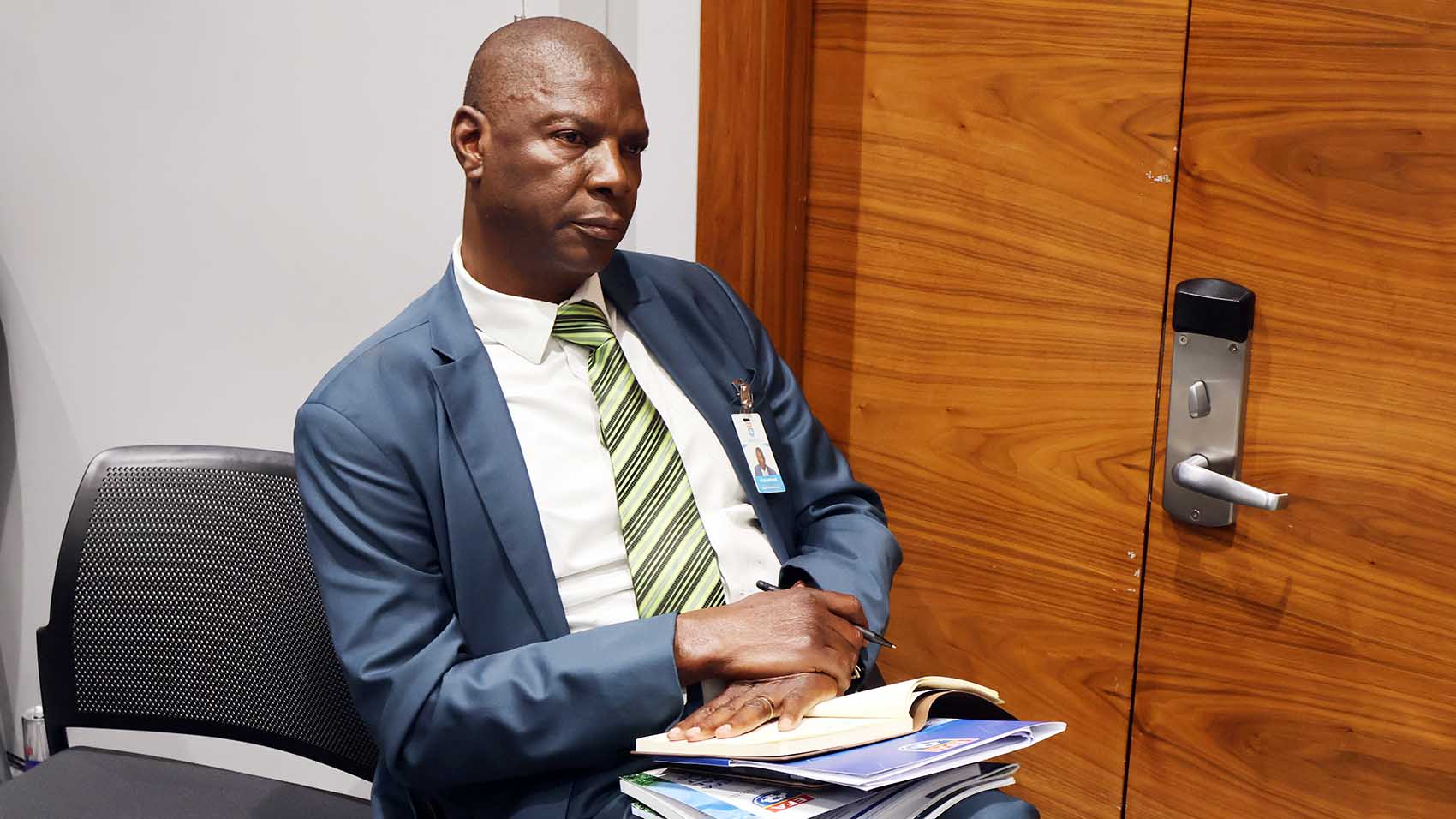
EFA President Peter ‘Samora’ Simelane. Since the sacking of Croatian ‘part-timer’ Zdravko Logarusic late last year, the national team has been left in a state of tactical limbo. (File pic)