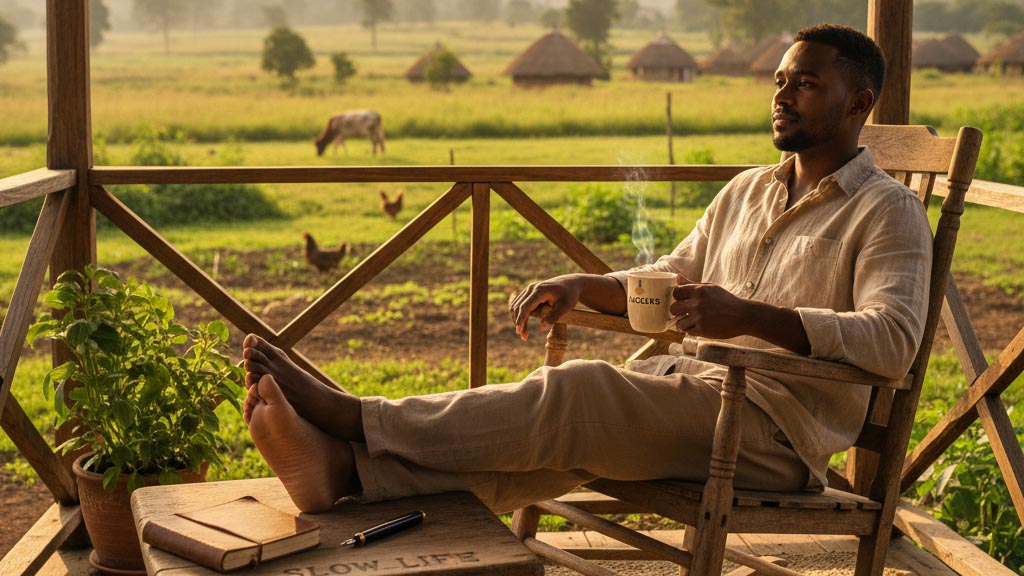
While sitting on the verandah of my father’s house, enjoying a cup of Jacobs coffee and listening to the cacophony of farm animal sounds, a thought came to my mind. There is a rebellion taking place in the world, more so among the millennials. It is not a protest. It does not involve signs. It is not a trending topic, like the trending topics of outrage. It is a subtle thing.
A personal thing. Almost invisible. People are deciding to slow down.The truth is, we are tired. After years of burnout, pandemic-induced reflection and economic uncertainty, people are beginning to understand that there is a cost to perpetual acceleration.Whether you are coming from an emerging economy (Eswatini) or a ‘mega economic powerhouse’ (USA), from urban to rural areas, there is an amazing global movement emerging in opposition to the culture of perpetual acceleration. The ‘slow living’ movement, which was previously considered a niche or indulgent lifestyle choice, is now influencing the way that people think about mental health, sustainability, productivity, and purpose. What if slowing down is not laziness but rather wisdom and moving towards an elevated frequency or a higher level of consciousness?
Hear me out. Our cellphone notifications start buzzing before sunrise, our deadlines stretch well into the evenings, and having a side hustle is not only praised but considered a necessity. Having a single income simply is not enough for the average liSwati. Young people feel pressure to succeed quickly, visibly and publicly; success must be photographed, and rest must be well earned. Somewhere along the way, we began to equate speed with progress.
Yet, if we have an honest look at ourselves, we are tired. Our conversations are rushed. Our meals are hurried. Our weekends are filled with errands and obligations.
Globally, this exhaustion has triggered a reckoning. In parts of the world, slow-food movements have revived traditional cooking and local agriculture, and in others, such as Scandinavia, work-life balance is treated as policy, not privilege. Across social media platforms, younger generations are rejecting hustle culture in favour of prioritising mental health and boundaries.
For many, slowing down has become less of a luxury and more of a survival strategy.
In Eswatini, there is an added layer. As a developing country, we are often told that time is money and that we cannot afford to slow down. Development discourse rarely includes rest. We are urged to grow the economy, increase productivity, attract investment, build faster, produce more.
The slow life is not about doing nothing. It is about doing things intentionally. It is about depth instead of constant motion. Perhaps speed is not the solution we thought it was.
Slowing down might look like saying no to an extra commitment to protect family time. It might mean walking instead of driving when possible, reading instead of scrolling and listening instead of interrupting.
For a country like Eswatini, where unemployment is high and economic pressures are real, the slow life might even offer unexpected economic benefits. Supporting local farmers instead of imported goods. Buying handmade products instead of mass-produced ones. Investing in community enterprises instead of distant corporations. Slower choices can strengthen local systems and build resilience.What I am learning during this period of my life is that there is a certain amount of bravery that comes from taking the time to pause and reflect before making the next move in your life.
Imagine a version of Eswatini where growth is balanced with well-being. Where workplaces respect rest.
Where young people are encouraged not only to dream big but to live gently. My fellow emaSwati, let us decide to live differently, and in doing so, we may discover that slowing down is not falling behind. It is finally arriving.
While sitting on the verandah of my father’s house, enjoying a cup of Jacobs coffee and listening to the cacophony of farm animal sounds, a thought came to my mind.