We often view war through a lens of human tragedy and shifting maps, but beneath the smoke and rhetoric lies a colder, more mechanical reality: war is a violent disruption of the marketplace. It shatters supply chains, diverts scarce money from schools and hospitals into ammunition and triggers widespread panic across global markets. More often than not, we view war as a threat when it is right on our doorstep or within the vicinity of our natural borders. However, the current US-Israel-Iran war has amplified lessons from the Russia-Ukraine war.
Even the lay person on the streets, who has no background in political science or war studies, has felt the impacts of war miles away from the African shores and the borders of Eswatini. The current US-Israel- Iran War is one that is fought by Iran through what we call asymmetric warfare.
Iran understands that it cannot win on the battlefield, but through direct influence on the Strait of Hormuz it can pressure the global economy, thereby causing global powers to pressure the US for a quick resolution. the one element that has not been given much attention is the other wild card, which Iran can choke through its proxies in Yemen. That is chocking the Bab al-Mandab Strait, that narrow path between Yemen and Djibouti. Also, Iran can go directly for energy infrastructure in the Persian Gulf region and potentially drag the whole region into war. All this I contend, is against the backdrop of an understanding that Iran has learnt that even though it is inferior in the battlefield, it remains strategically placed to cause a stalemate in the war, through these economic levers.
Macroeconomics of conflict
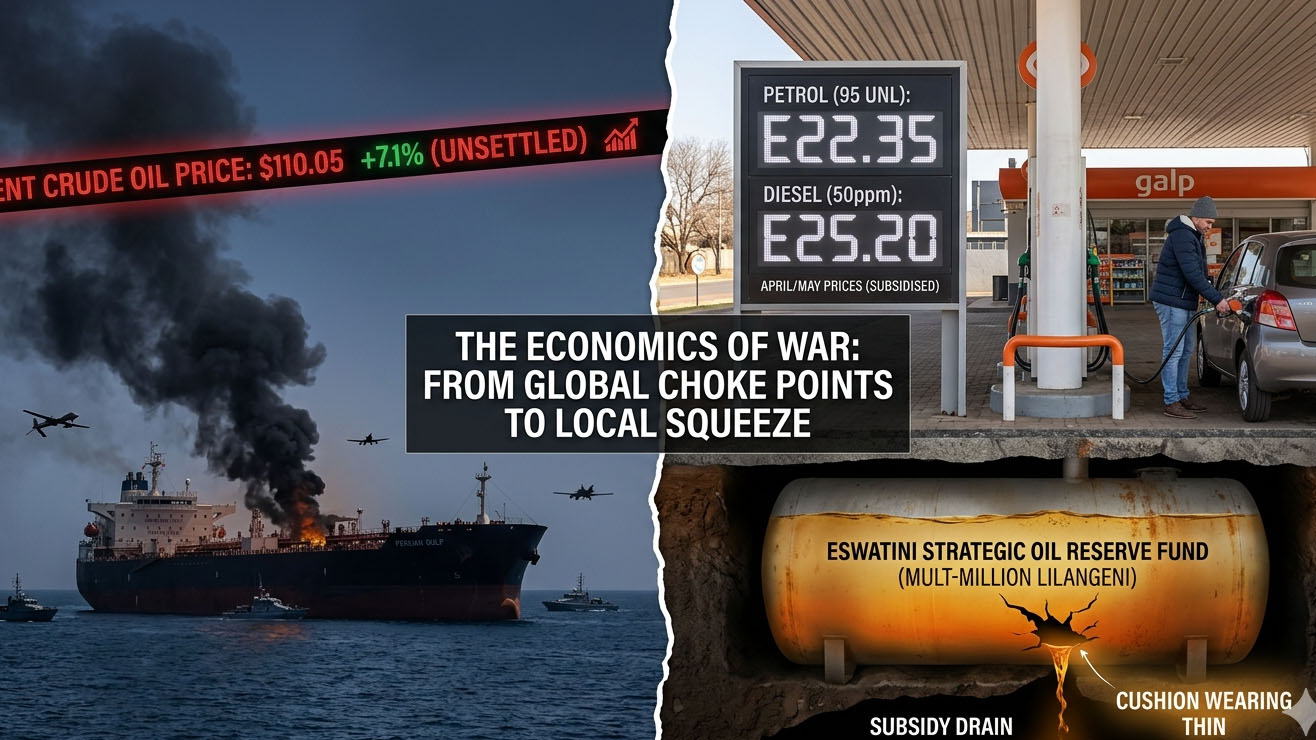
At its core, the economics of war is defined by sudden scarcity. When a major resource-producing region plunges into conflict, or when vital shipping lanes are bottlenecked by naval blockades and drone strikes, the global supply of goods shrinks overnight. Scarcity in the markets is usually corrected and distributed through price mechanisms. When a resource is scarce, the price shoots up. This is what we are seeing in the price of oil. On Monday’s trade, the price of oil crossed the US$110 mark as the stalemate in the negotiations became visible. This is the direct impact on the price of oil and on the price of fertiliser. About 25-35 per cent of global fertiliser and related inputs into the production of fertiliser pass through the Strait of Hormuz. Also, because of the tensions on the seas, maritime shipping costs have also increased, and all commodities being transported by fossil fuel-powered modes will also increase. This is the indirect effect.
Local impacts
In the domestic economy, we have already seen pump prices increase for the months of April and May. Also, it is expected that these prices will increase in June. Also, overall CPI readings show a sharp 0.33 percentage point increase in the index from 1.6 in March to settle on 2.0 per cent. Although we are still within the inflation target range of three per cent, with a one percentage point diversion in both directions. However, the rapid rate of increase observed in April is expected to carry through to May and June. Also, July and August are not certain, we might actually be running into a situation of rapid price increases driven primarily by the price of fuel. As we enter the winter cropping season, the problem may accelerate as fertiliser prices will also be on the rise.
A cushion wearing thin
Over the last few months, global benchmark Brent crude oil has surged, averaging over US$104 per barrel as geopolitical anxieties refuse to ease. In Mbabane and Manzini, the Ministry of Natural Resources and Energy has fought hard to shield citizens from the worst of these global spikes. Recently, pump prices adjusted upward to E22.35 per litre for Unleaded Petrol (95) and E25.20 per litre for Diesel (50ppm). Yet, these numbers hide a harsher truth: They are heavily subsidised. The Eswatini Government has been quietly drawing from its Strategic Oil Reserve Fund to absorb a massive multi-million Lilangeni deficit, keeping prices artificially lower than what the market actually demands.
This looming hike will act as a quiet tax on the entire nation. Higher diesel prices directly increase the cost of public transport, grid-reliant manufacturing and daily commutes. More critically, because Eswatini imports the vast majority of its consumer goods via road freight from South Africa, elevated fuel costs will quickly manifest as higher shelf prices for basic groceries and clothing.
Navigating the headwinds
The economics of war prove that a nation does not need to fire a single shot to suffer the consequences of a conflict. For the kingdom, the next three months will require navigating a deeply challenging economic landscape. As global conflicts continue to disrupt energy and commodity markets, the kingdom faces a dual challenge: Rising costs at the fuel pump and a severe financial squeeze in the agricultural fields. It is imperative that we remain prudent with our spending to survive the road ahead.
We often view war through a lens of human tragedy and shifting maps, but beneath the smoke and rhetoric lies a colder, more mechanical reality: war is a violent disruption of the marketplace. It shatters supply chains, diverts scarce money from schools and hospitals into ammunition and triggers widespread panic across global markets.