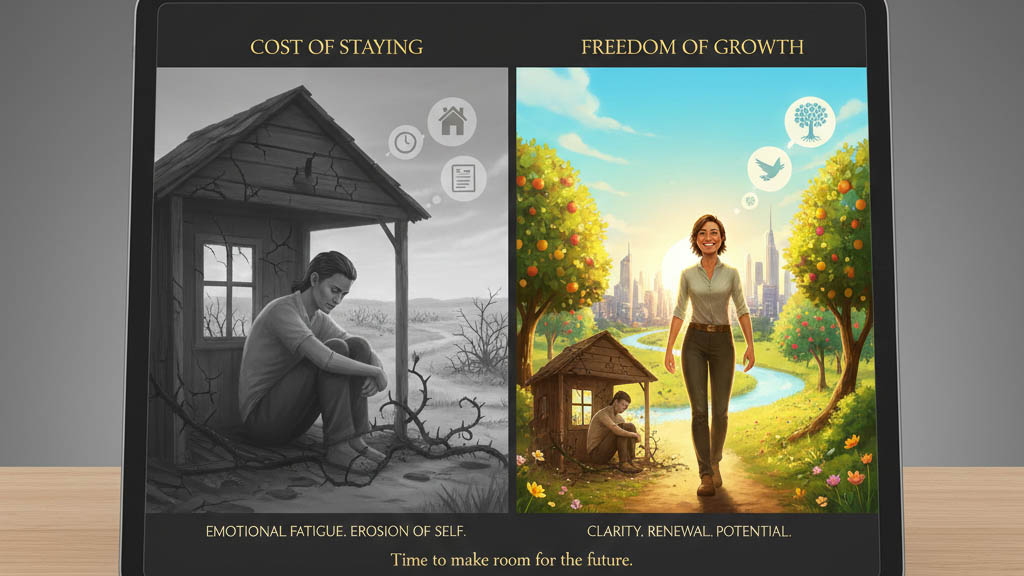
Growth is often celebrated but what we talk about less is the discomfort that comes with it. Outgrowing a place, a relationship, a role or even a version of yourself is rarely dramatic. It does not always arrive with conflict or crisis. Sometimes, it shows up quietly as restlessness, emotional fatigue or the sense that you are shrinking to fit spaces that once felt expansive.
Yet, many people stay long after they have outgrown where they are, and the cost of doing so is higher than it appears. One of the greatest costs of staying where you have outgrown is the slow erosion of self.
When you remain in environments that no longer align with who you are becoming, you begin to suppress parts of yourself to maintain comfort or familiarity. You speak less, dream smaller and silence ideas that no longer fit the room. Over time, this self-editing becomes habitual. You may still function well on the surface, but internally, you feel disconnected from your own potential.
Familiarity is often mistaken for safety. Staying feels easier than leaving because it avoids disruption, uncertainty and judgment. There is comfort in what is known, even when it no longer serves us. Many people stay in unfulfilling jobs, stagnant friendships, or limiting routines not because they are happy, but because leaving would require courage and clarity they don’t yet feel ready to claim.
However, comfort without growth eventually turns into stagnation, and stagnation quietly drains motivation and joy. Emotionally, staying where you have outgrown can lead to resentment towards others and towards yourself.
You may begin to feel frustrated with people who are not changing, even though they are not obligated to. You may also feel disappointed in yourself for staying despite knowing better. This internal conflict creates emotional heaviness. Instead of directing energy towards growth, it is spent managing dissatisfaction and self-blame.
There is also a cost to ambition and creativity. Growth requires challenge, exposure and the freedom to experiment. When you stay in spaces that no longer challenge you, your ideas become repetitive and your passion fades. You may find yourself going through the motions, performing competence rather than experiencing fulfillment. Over time, this dulls curiosity and makes progress feel exhausting rather than exciting.
Relationships are especially affected by outgrowing. When growth is uneven, it can create distance that is difficult to name. Conversations feel shallow, shared values shift and emotional intimacy declines. Staying out of loyalty or guilt can feel noble, but it often leads to emotional loneliness. Relationships are meant to evolve, but when one person grows and the other resists change, staying can mean denying both people the opportunity to form connections that better reflect who they are.
Fear plays a powerful role in why people stay. Fear of starting over. Fear of being misunderstood. Fear of regret. Yet what is often overlooked is the fear of staying, the quiet fear that life will pass without expansion, that potential will remain unrealised.
While leaving carries risk, staying where you have outgrown carries certainty: the certainty of limitation. Outgrowing does not mean that what came before was wrong or wasted. It simply means that it served its purpose for a season. Growth is not betrayal. Change is not failure. Many people struggle to leave because they associate departure with ingratitude. In reality, honouring growth is one of the deepest forms of self-respect. You can appreciate what something gave you while acknowledging that it can no longer give you what you need.
The cost of staying where you’ve outgrown is also paid in time. Time spent in the wrong place is time not spent discovering what is possible elsewhere. Time is the one resource that cannot be recovered, and prolonged hesitation often leads to regret. Looking back, many people do not regret leaving too early; they regret leaving too late.
Choosing to move on does not always require dramatic exits or burned bridges. Sometimes it begins internally; with honesty. It starts by admitting that you have changed and allowing yourself permission to seek alignment. Growth asks for bravery, but it also rewards it with clarity, renewal and self-trust.
Ultimately, staying where you have outgrown may feel safe in the moment, but it is costly in the long run. Growth requires space, and when you deny yourself that space, you deny yourself the chance to fully become who you are meant to be. Letting go is not about abandoning the past; it is about making room for the future. At times, the most responsible choice you can make is to leave what no longer fits, even when it once felt like home.
Growth is often celebrated but what we talk about less is the discomfort that comes with it. Outgrowing a place, a relationship, a role or even a version of yourself is rarely dramatic.