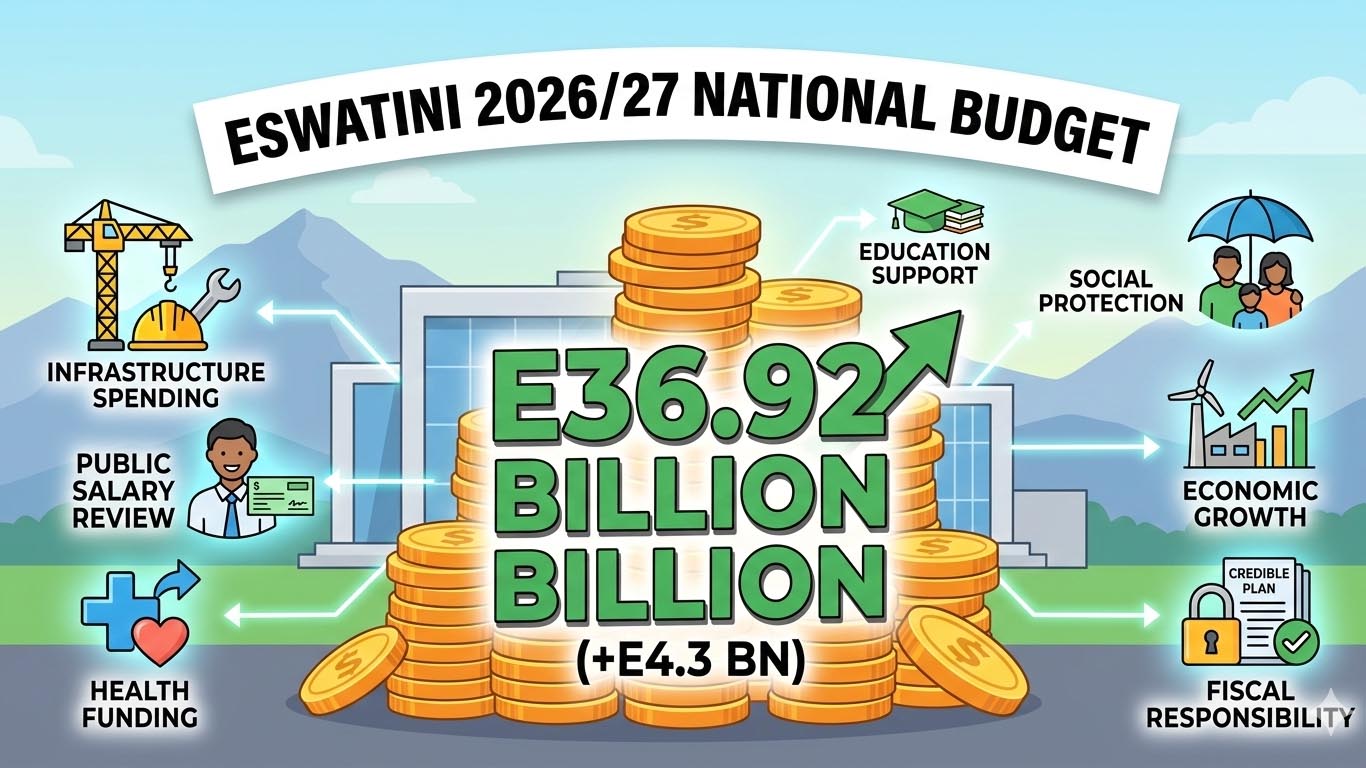
The Finance Ministry tabled the country’s 2026/27 national budget amounting to E36.92 billion, marking the largest fiscal expansion in the kingdom’s history. This represents an increase of E4.3 billion from the previous year’s allocation of E32.6 billion. A significant portion of the increase stems from the public service salary review and ambitious infrastructure spending.
Social spending remains a cornerstone of the budget, with allocations directed towards health, education and social protection. The transformation of the Central Medical Stores and increased funding for hospitals and clinics signal government’s intent to strengthen health-care delivery. Education also receives notable support, with resources earmarked for curriculum reforms and teacher training. However, rising healthcare costs, coupled with the burden of communicable and non-communicable diseases, demand more than incremental increases. Similarly, while education spending is commendable, challenges persist which require more targeted increases to transform the education sector. Social protection programmes, though expanded, remain insufficient to cushion vulnerable households against poverty and inequality, there were no cost-of-living adjustments on grants leaving the elderly and vulnerable exposed to inflationary pressures. Thus, while the budget demonstrates commitment, the scale of social needs suggests that allocations may still fall short of achieving universal adequacy.
Capital expenditure is positioned as a driver of long-term growth. The budget prioritises infrastructure projects such as the completion of the International Convention Centre, road networks and energy investments. These projects are expected to stimulate tourism, trade and industrial activity. Additionally, investments in digital infrastructure, including the Integrated Financial Management and Information System, aim to modernise public finance management and improve transparency. Yet, the balance between recurrent and capital spending remains delicate. The salary review has significantly expanded recurrent costs, potentially crowding out CAPEX. To achieve sustained growth, capital investments must not only be protected.
The budget acknowledges the growing fiscal deficit, driven by higher recurrent expenditure and ambitious capital projects. Debt servicing continues to consume a substantial share of resources, raising concerns about long-term sustainability. While the country’s debt-to-GDP ratio remains moderate compared to regional peers, the trajectory is worrying. The expansionary stance of the budget risks widening the deficit further, especially if revenue mobilisation does not keep pace. Dependence on SACU receipts remains a vulnerability, as fluctuations in regional trade can destabilise fiscal planning. Without careful management, the combination of rising debt and persistent deficits could erode fiscal space and limit future policy flexibility.
The country stands at a critical juncture where fiscal expansion must be carefully balanced with long-term sustainability. The projected deficit, while reflective of pressing developmental and social priorities, can only be sustained if it is anchored on a credible medium-term fiscal framework. A sustainable deficit-financed path does not imply eliminating borrowing altogether; rather, it requires ensuring that borrowing finances growth-enhancing investments, strengthens revenue capacity and keeps debt at manageable levels relative to GDP. For Eswatini, this means aligning fiscal policy with realistic growth assumptions, strengthening domestic resource mobilisation and improving expenditure quality so that every Lilangeni spent yields measurable economic and social returns.
Revenue mobilisation must form the backbone of deficit sustainability. The country’s continued vulnerability to volatile transfers from the Southern African Customs Union (SACU) underscores the urgency of expanding domestic revenue sources. Broadening the tax base through formalisation of the informal sector, enhanced compliance monitoring and deployment of digital tax systems can significantly improve collections without necessarily increasing tax rates. Strengthening VAT administration, improving data matching across government systems and leveraging technology to reduce leakages will also enhance efficiency.
Over time, a more diversified and predictable revenue base will reduce fiscal shocks and stabilise deficit financing needs. On the expenditure side, rationalising recurrent spending, particularly the public wage bill remains essential. While safeguarding social protection and essential services, government must prioritise expenditure reviews that identify inefficiencies and reallocate resources toward high-impact capital projects. Infrastructure investments in energy, transport and ICT should be rigorously appraised to ensure they stimulate private sector activity and broaden the productive base. Improved public financial management systems, performance-based budgeting and stronger procurement oversight will ensure that fiscal deficits translate into tangible development outcomes rather than structural imbalances.
Prudent debt management is equally critical. Borrowing should prioritise concessional financing and lengthened maturities to reduce refinancing risks and interest burdens. Strengthening the institutional capacity of debt management units, maintaining transparent reporting and adhering to a clear debt anchor, such as a sustainable debt-to-GDP ratio will reinforce market confidence. At the same time, promoting economic diversification into agro-processing, tourism, manufacturing and renewable energy will expand the growth base and improve the denominator of the debt ratio. Carefully structured public-private partnerships can further ease fiscal pressures by mobilising private capital for infrastructure without overburdening public finances. If deficits are strategically directed towards productivity-enhancing investments while strengthening revenue systems and containing recurrent costs, the country can maintain macroeconomic stability, protect social spending and place public finances on a resilient and sustainable trajectory.
Social spending remains a cornerstone of the budget, with allocations directed towards health, education and social protection.