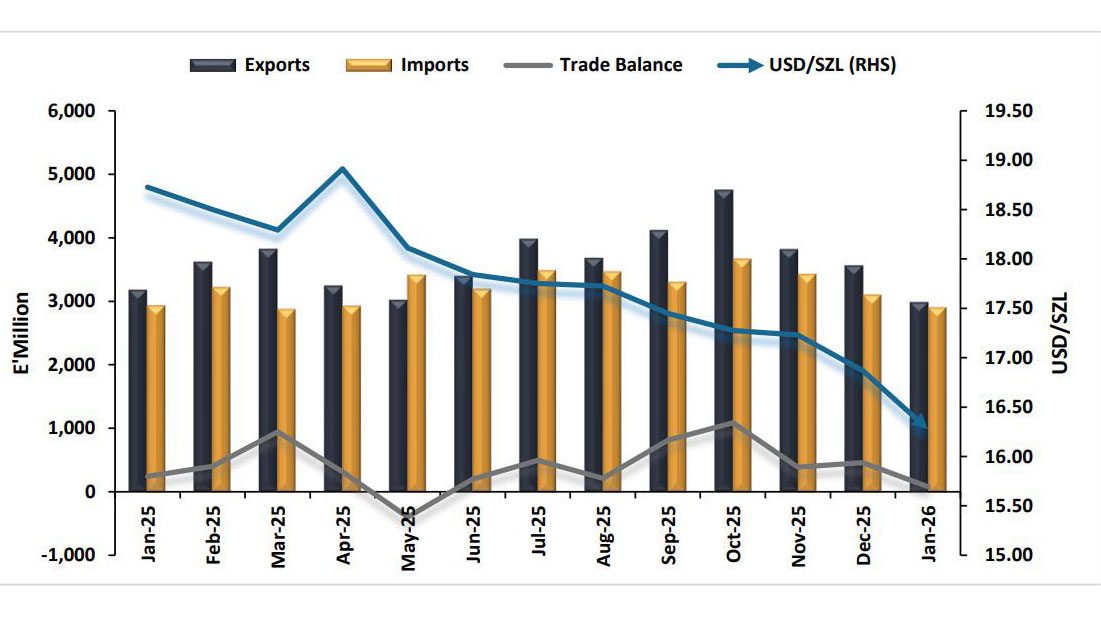
MBABANE - Eswatini’s trade surplus narrowed sharply to E80.8 million in January 2026, down from E459.4 million in December 2025, reflecting a steeper contraction in exports relative to imports.
According to the latest Recent Economic Development (RED) report for December 2025 and January 2026 by the Central Bank of Eswatini (CBE), export earnings declined by 16.2 per cent month-on-month to E3.0 billion, weighed down by weaker shipments of sugar and soft drink concentrates.
Despite the monthly decline, exports remained 6.1 per cent higher year-on-year, signalling that the external sector maintained a firmer footing compared to January 2025.
Imports totalled E2.9 billion, declining by 6.4 per cent month-on-month, mainly due to reduced electricity and food imports. Year-on-year, imports eased by 1.0 per cent, reflecting softer domestic demand pressures at the start of the year.
On a seasonally adjusted basis, exports were estimated at E3.6 billion and imports at E3.3 billion, translating into a stronger adjusted trade surplus of E369.4 million.
Trade direction analysis showed that South Africa remained Eswatini’s dominant trading partner, accounting for 70.7 per cent of exports and 68.9 per cent of imports.
Other export destinations included Nigeria, Kenya, Mozambique, Zimbabwe and Tanzania, which together absorbed 18.9 per cent of exports.
*…
GDP growth accelerates on broad-based recovery
MBABANE – Turning to domestic output, real gross domestic product expanded by 5.8 per cent year-on-year (seasonally adjusted) in the third quarter of 2025.
The economy accelerated from the revised 4.3 per cent growth recorded in the previous quarter. Growth was broad-based across all three sectors of the economy, underpinned by a strong rebound in the primary sector and sustained momentum in both the secondary and tertiary sectors.
On a quarter-on-quarter basis, GDP expanded by 2.1 per cent, slightly lower than the 2.6 per cent growth observed in the previous quarter, pointing to continued, albeit moderating, momentum in domestic activity.
The primary sector exited its slump, recording 11.8 per cent year-on-year growth, contributing 0.9 percentage points to overall economic expansion. This rebound was driven largely by a sharp turnaround in mining and quarrying, which grew by 65.3 per cent, following a 22.7 per cent contraction in the previous quarter.
The recovery reflects easing demand-side disruptions and renewed extraction activity within the domestic coal industry. Agriculture and forestry also returned to positive growth, expanding by 1.7 per cent, with forestry rebounding strongly by 13.4 per cent, supported by firmer external demand for forestry products.
The secondary sector, which accounts for 37.7 per cent of total industries, expanded by 9.9 per cent year-on-year, up from 6.8 per cent in the previous quarter. Manufacturing grew by 10.0 per cent, reflecting stabilisation in external demand for non-food export-oriented commodities.
*Full article available on Pressreader*
Merchandise Trade; January 2025 – January 2026.