MBABANE – Eswatini’s inflation outlook for the next three years has been revised slightly downwards.
This comes as the Central Bank of Eswatini (CBE) projects a continued period of price stability supported by lower food costs, subdued global oil prices and a stronger Rand.
Updated forecasts for 2025 to 2027 show marginal downward adjustments in the short-term before inflation gradually rises in the medium-term, driven partly by domestic cost pressures.
The latest inflation update, released by the Bank’s Research Department, shows that headline inflation for 2025 is now expected to average 3.20 per cent, slightly lower than the 3.24 per cent projected during the September 2025 Monetary Policy Meeting.
The revision comes on the back of a lower-than-anticipated inflation outturn for the third quarter, where actual inflation registered 2.74 per cent compared to the previously forecast 2.85 per cent. This softer outcome shifted the inflation trajectory for the remainder of the year.
Global factors continue to act in Eswatini’s favour. The bank notes that international oil prices remain stable below the US$70 mark, due mainly to increased output from OPEC members.
This stability in global energy markets limits the risk of domestic transport and food price shocks – two categories that traditionally carry significant weight in Eswatini’s inflation basket.
The Rand, to which the Lilangeni is pegged, has also strengthened against the US Dollar. Analysts attribute this to improved economic fundamentals in South Africa, favourable commodity prices and a generally weaker US Dollar globally.
Additionally, expectations that the US Federal Reserve will loosen its monetary policy stance further may support the Rand’s competitiveness in the months ahead.
A stronger Rand allows Eswatini to import goods at relatively lower costs, exerting downward pressure on domestic inflation. The bank believes this will remain a key stabilising factor heading into early 2026.
While South Africa’s headline inflation has been revised upwards, Eswatini is expected to feel the spillover effects mainly in the first quarter of 2026, rather than this year. As a result, the CBE marginally revised its fourth-quarter 2025 inflation forecast downwards – from 3.04 per cent to 2.98 per cent. Quarterly data also shows a downward trend through the year.
This pattern underscores the sustained moderation in domestic price pressures, particularly food inflation, which has played a major role in keeping inflation under control.
Core inflation – excluding volatile categories such as food, fuel and energy – remains closely aligned with headline inflation. The bank reported that the third quarter of 2025 core inflation came in exactly as forecast at 3.3 per cent.
However, core inflation has been revised marginally upwards as the bank anticipates a rebound in certain services-related inflation components, including education, recreation and accommodation services. The fourth-quarter 2025 core inflation forecast has been revised to 3.18 per cent, from the earlier 3.03 per cent.
*Full article available in our publication
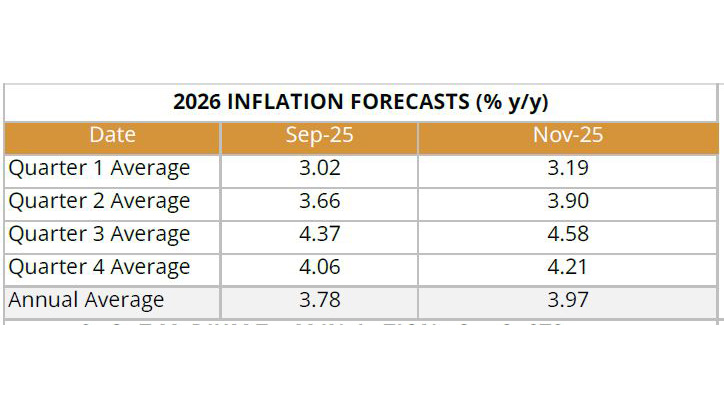
2026 inflation forecast (%y/y).