copy.jpg)
MBABANE – Local financial watchdogs have been called to strengthen oversight, improve data quality and expand surveillance as the financial sector grows increasingly complex.
The International Monetary Fund (IMF) has called for far-reaching reforms to Eswatini’s financial sector oversight, warning that stronger regulation, improved reporting standards and closer collaboration between regulators are becoming increasingly important as non-bank financial institutions continue to dominate the country’s financial system.
In its latest Technical Assistance Report released last Friday, following a mission conducted in May 2025, the IMF outlined an extensive roadmap aimed at strengthening financial sector surveillance, improving monetary policy analysis and enabling authorities to better detect emerging financial risks before they threaten economic stability.
Unlike previous assessments that concentrated largely on commercial banks, the IMF argues that Eswatini’s rapidly expanding pension funds, insurance companies, credit providers, collective investment schemes and savings and credit co-operatives now warrant significantly greater regulatory attention because together they account for the majority of financial sector assets.
According to the report, other financial corporations now account for approximately 66.2 per cent of the country’s financial sector assets, excluding the Central Bank of Eswatini (CBE), while commercial banks account for just 27.9 per cent, signalling a structural shift in the country’s financial landscape.
The IMF noted that while Eswatini’s banking sector remains stable, policymakers require much more comprehensive information from the broader financial sector to accurately assess vulnerabilities, liquidity conditions and systemic risks.
Non-bank institutions dominate
MBABANE - The report highlights pension funds as the single largest component of the financial system.
Pension funds alone represent nearly 70 per cent of all assets within the non-bank financial sector, with the Public Service Pensions Fund (PSPF) accounting for roughly three-quarters of the pension market.
Insurance companies, collective investment schemes, SACCOs and credit providers have also grown significantly in recent years, making them increasingly important channels, through which savings are mobilised and credit is extended across the economy.
Despite their growing importance, the IMF found that information collected from these institutions remains incomplete in several critical areas.
The fund, therefore, recommends that the Central Bank of Eswatini and the Financial Services Regulatory Authority (FSRA) substantially improve reporting requirements so authorities can better understand how money moves throughout the financial system.
Calls for pension sector reforms
MBABANE - The International Monetary Fund (IMF) also identified weaknesses in the reporting framework governing pension funds.
While pension funds regularly submit information on their investment assets, reporting on liabilities remains inconsistent because existing legislation requires actuarial valuations only once every three years.
The IMF argues that this creates significant information gaps regarding the financial position of pension schemes.
It recommends updating the regulatory framework so pension funds provide more frequent actuarially based liability reporting, allowing regulators to obtain a more accurate and timely picture of their financial health.
Improved liability reporting would also strengthen oversight of one of the country’s largest pools of long-term savings.
Meanwhile, insurance companies are also expected to provide much more detailed financial information under the IMF recommendations.
The report found that some insurance assets currently combine different financial instruments into broad categories, making accurate analysis difficult.
The IMF recommends revising reporting templates so loans, debt securities and other financial assets are clearly distinguished while improving explanatory guidance to ensure institutions report data consistently.
Greater transparency, the report says, would improve financial surveillance while allowing regulators to better assess exchange rate exposure and sectoral risks.
… need for modernising investment fund oversight
MBABANE - Collective investment schemes, whose assets exceed E8.9 billion, are another area targeted for reform.
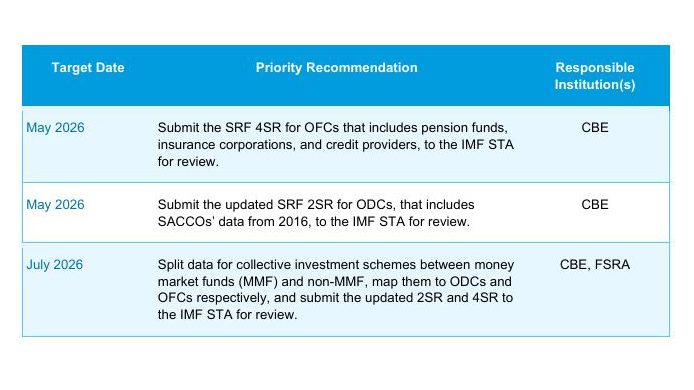
The International Monetary Fund (IMF) recommends separating money market funds from other investment funds because each plays a different role within the financial system.
Money market funds behave similarly to deposit-taking institutions and therefore influence liquidity conditions and monetary policy transmission.
Non-money market funds, meanwhile, serve longer-term investment functions.
Separating the two would improve the quality of monetary statistics while strengthening macroprudential oversight. The fund also recommends that investment fund managers provide greater detail regarding the types of investors they serve and the assets they hold.
The IMF similarly called for enhanced reporting by credit providers, noting that balance sheet information remains highly summarised.
Although credit providers collectively manage more than E6.4 billion in assets, the report found that financial instruments require greater classification to distinguish loans, securities and other liabilities more accurately.
Improved reporting, the IMF says, would strengthen financial sector analysis while allowing authorities to monitor credit risks more effectively. Savings and Credit Co-operative Organisations (SACCOs) also feature prominently in the reform agenda. Although there are 47 licensed SACCOs, the IMF notes that only 23 consistently report financial information. The fund recommends closer monitoring of reporting institutions, improved consistency in submitted data and more detailed classification of loans and deposits by institutional sector.
It also proposes permanently incorporating SACCO data into national monetary statistics, expanding coverage of the country’s financial system.