

MBABANE – Eswatini’s merchandise trade performance moderated in November 2025, with both exports and imports declining on a year-on-year basis.
This resulted in a narrower trade surplus compared to the same period last year, according to the latest monthly merchandise trade statistics by the Eswatini Revenue Service (ERS).
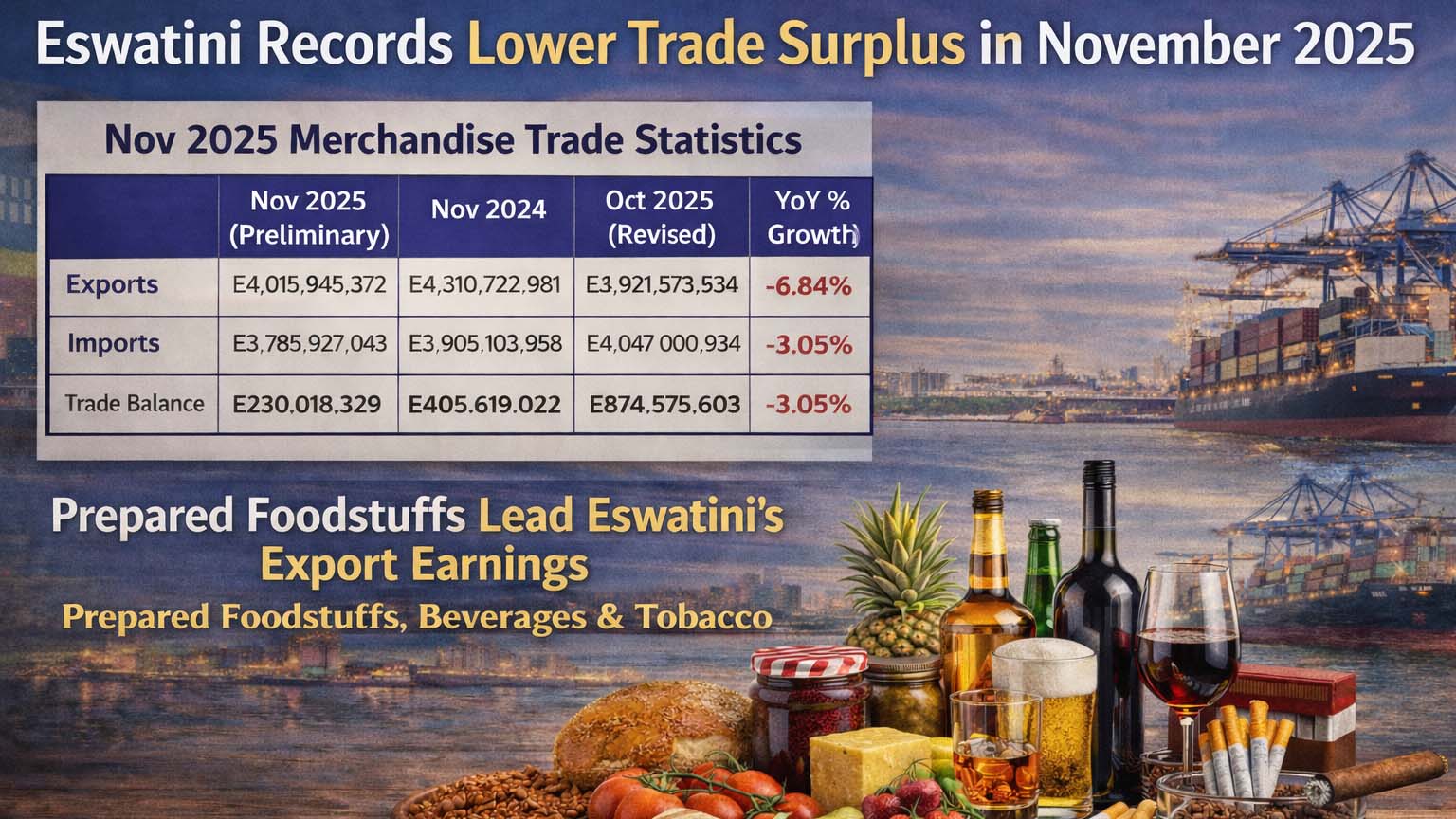
The data shows that total exports stood at E4.02 billion in November 2025, down 6.84 per cent from E4.31 billion recorded in November 2024. Imports also declined, falling by 3.05 per cent to E3.79 billion, compared to E3.91 billion a year earlier.
As a result, the country recorded a trade surplus of E230 million, significantly lower than the E406 million surplus registered in November 2024.
Compared to October 2025, when exports amounted to E4.92 billion and imports stood at E4.05 billion, November figures indicate a notable slowdown in trade activity.
October had yielded a substantially larger trade surplus of E874.6 million, highlighting the volatility in monthly trade flows and the impact of changing export destinations and product composition.
Despite the softer November performance, Eswatini’s cumulative merchandise trade position for the April–November 2025/26 fiscal period remained positive.
Total exports reached E26.94 billion, reflecting a 3.61 per cent increase from E26.00 billion recorded during the corresponding period in 2024/25. Imports rose by 4.22 per cent to E25.55 billion, up from E24.52 billion.
The cumulative trade balance stood at E1.39 billion, slightly lower than the E1.48 billion surplus recorded in the previous fiscal year period, indicating that while trade volumes expanded, import growth marginally outpaced export growth.
*…
Prepared foodstuffs lead export earnings
MBABANE – Prepared foodstuffs, beverages, spirits, vinegar, tobacco and manufactured tobacco substitutes remained Eswatini’s single largest merchandise export category in November 2025.
Exports under this section were valued at E1.15 billion during the month, maintaining the category’s position as the top contributor to total export earnings.
However, the figure represented a 30.48 per cent decrease from the E1.65 billion recorded in November 2024, reflecting lower shipments compared to the same period last year.
The category accounted for a substantial share of Eswatini’s total exports of E4.02 billion in November 2025, underscoring its continued importance to the country’s export structure, even amid short-term fluctuations.
Exports of prepared foodstuffs to SACU markets remained particularly strong. Data show that shipments to SACU under this category amounted to E859.2 million in November 2025, representing a 13.30 per cent increase from E758.4 million in November 2024.
This growth indicates sustained regional demand, particularly within neighbouring markets, which continue to absorb a notable portion of Eswatini’s processed food and beverage products.
In contrast, exports of prepared foodstuffs to non-SACU markets experienced a notable contraction, contributing to the overall year-on-year decline observed at the global level.
On a cumulative basis, the importance of prepared foodstuffs to Eswatini’s export performance remains evident.
Between April and November 2025, exports under this HS section amounted to E8.08 billion, although this was 5.88 per cent lower than the E8.59 billion recorded during the corresponding period in the 2024/25 fiscal year.
Despite the decline, prepared foodstuffs continued to rank among the top export categories over the fiscal year to date, reflecting the scale and consistency of output from Eswatini’s agro-processing and manufacturing sectors.
*…
… exports to SACU up 9.79%
MBABANE – Trade within the Southern African Customs Union (SACU) continues to play a critical role in Eswatini’s merchandise trade.
In November 2025, exports to SACU markets amounted to E2.96 billion, representing a 9.79 per cent increase from the previous year. Imports from SACU declined by 2.97 per cent to E2.83 billion, resulting in a trade surplus with SACU partners.
Prepared foodstuffs, chemicals, textiles and wood products remained the leading export categories to SACU markets. Conversely, imports from SACU were dominated by mineral products, machinery, prepared foods and vehicles, though several of these categories recorded year-on-year declines.
For the April–November 2025/26 period, cumulative export growth was driven by strong performance in vegetable products, animal fats and oils, optical and medical instruments, and miscellaneous manufactured articles. However, exports of mineral products and machinery declined slightly, offsetting gains in other categories.
*…
… imports from African markets amount to E2.90bn
MBABANE – Africa continued to dominate Eswatini’s trade flows in November 2025.
Imports from African markets amounted to E2.90 billion, accounting for the largest share of total imports, although this represented a 3.68 per cent decline year-on-year.
Asia was the only major source region to record growth, with imports rising sharply by 18.81 per cent to E634.1 million, reflecting increased sourcing of goods from Asian markets.
Imports from Europe declined substantially by 33.64 per cent to E193.5 million, while North America and Oceania also
*Full article available in our publication



















Leave a comment