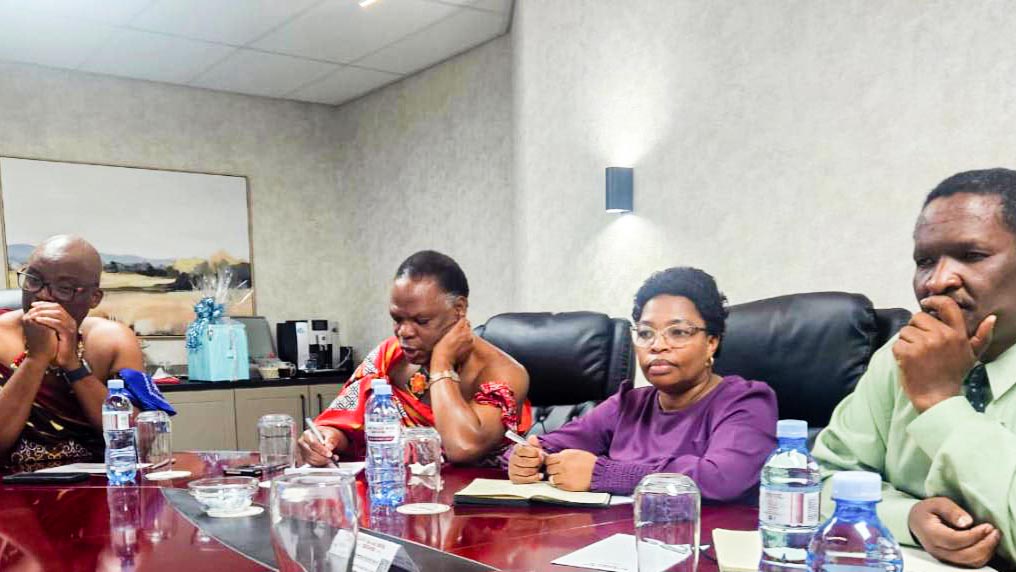
MBABANE – The Minister for Natural Resources and Energy, Prince Lonkhokhela, has met with Eswatini Ambassador to Malaysia, Menzie Dlamini, to advance discussions on strategies for the country to access technical and funding opportunities.
The opportunities to be explored are available through the Tokyo International Conference on African Development (TICAD) and Korea–Africa relations programmes, with a particular focus on the energy sector.
The meeting, which took place on Wednesday, follows the TICAD 9, which was co-hosted by the Government of Japan, the United Nations, the United Nations Development Programme (UNDP), the World Bank and the African Union Commission.
TICAD 9 took place in Yokohama, Japan, from August 20 to 22, 2025.
The TICAD 9 conference promotes African ownership and international partnership, bringing together heads of state, development partners, private sector leaders and civil society organisations to drive sustainable development across the African continent. The conference focuses on co-creating innovative solutions under three key pillars: economy, society, and peace and stability.
In a press statement, the Ministry of Natural Resources and Energy said the meeting between the minister and the ambassador concluded with the establishment of a committee chaired by the Director of Energy, Thabile Nkosi.
Other committee members are drawn from various entities, including the Ministry of Foreign Affairs and International Cooperation, the Eswatini Electricity Company (EEC), and the Ministry of Economic Planning and Development. The statement further noted that the committee, with the support of both the minister and the ambassador, will assess available support programmes offered through TICAD and Korea.
It will also prepare relevant proposals for Eswatini’s submission to these programmes. The committee is expected to meet regularly as it develops the proposals and will provide progress reports to the minister.
According to Business Media, South Korea is intensifying its economic and investment relations with Africa, marking a significant shift in its foreign policy and economic strategy. This growing partnership was prominently showcased during the inaugural Korea–Africa Summit held in June 2024, where leaders from 48 African nations convened in Seoul to discuss avenues for mutual growth and cooperation.
In terms of strategic economic engagement, Business Media reports that historically, South Korea’s trade with Africa has been minimal, accounting for less than two per cent of its total trade volume.
However, recognising Africa’s vast potential, South Korea is now actively seeking to deepen economic ties through substantial investments and strategic partnerships.
During the 2024 summit, it was reported that South Korea announced a commitment of US$10 billion in official development assistance (ODA) to Africa by 2030, alongside US$14 billion in export financing aimed at supporting South Korean companies operating on the continent.
These financial commitments are designed to facilitate infrastructure development, enhance trade, and promote sustainable growth across various African countries.
*…
TICAD broadly aligned to Africa’s priorities
MBABANE – The Government of Eswatini’s plan to leverage the Tokyo International Conference on African Development (TICAD) and Korea–Africa relations programmes appears to be a step in the right direction.
This is because TICAD has been cited by experts as an institution that aligns well with the development priorities of the African continent. According to the Africa Centre for Strategic Studies, TICAD was launched in 1993 and has been held every three years in alternating Japanese and African venues, making it the longest-running mechanism of its kind.
Co-organised by Japan, the African Union (AU), the United Nations Development Programme (UNDP) and the World Bank, policy alignment was an explicit feature of the Yokohama Declaration, which stated that “TICAD 9 is broadly aligned to Africa’s development priorities”.
The Africa Centre for Strategic Studies further notes that, to demonstrate the growing importance of Africa to Japan, the Japan International Cooperation Agency (JICA) designated four Japanese cities as official “hometowns” for residents of four African countries in order to promote closer ties.
These include Nagai in the northern Yamagata Prefecture, paired with Tanzania; Kisarazu in Chiba Prefecture near Tokyo, assigned to Nigeria; Sanjo in Niigata Prefecture, linked with Ghana; and Imabari in the western Ehime Prefecture, aligned with Mozambique. Each of these cities has long-standing historical ties with its respective African partner country.
It is also highlighted that TICAD’s creation reflected a convergence of Japanese and African interests. “Concerned about the continent’s marginalisation following the Cold War, TICAD was established to foster ongoing mechanisms of engagement and a joint commitment to peace, development, solidarity and the banishment of tyranny. In doing so, Japan pioneered the tradition of Africa-focused summitry,” notes the Africa Centre for Strategic Studies.
From its inception, the TICAD process has revolved around three pillars: economy, society, and peace and stability. Commitments under these pillars, as outlined in the Yokohama Declaration, include the following:
*Full article available in our publication
Minister for Natural Resources and Enegry, Prince Lonkhokhela and teh stakeholders during the meeting with Ambassador to Malaysia, Menzie Dlamini (in traditional regalia). (Courtesy pics)