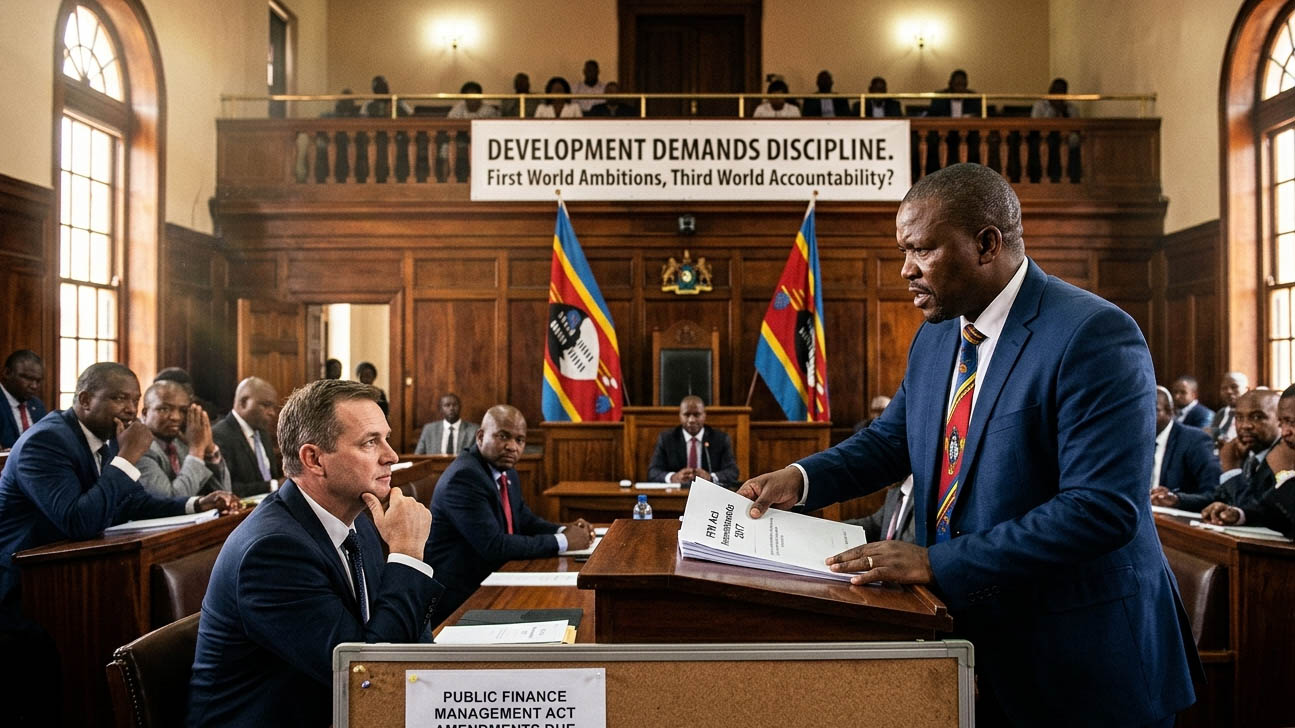
To observe the latest confrontation in the House of Assembly is to see, with unusual clarity, the contradiction at the centre of Eswatini. Parliament, through a motion spearheaded by Sandile Nxumalo and seconded by Mazwi Zwane, seeks to compel Finance Minister Neal Rijkenberg to table amendments to the Public Finance Management Act of 2017 within 21 days. The procedural details matter less than what they reveal. For beneath the parliamentary manoeuvring lies the defining political question confronting the country.
Can a country credibly pursue First World ambitions while tolerating Third World standards of accountability? That question has hovered over the kingdom for years, surfacing each time the auditor general releases another report documenting wasteful expenditure, procurement irregularities and public funds that evaporate without consequence. The findings rarely shock anymore. They accumulate and, in their accumulation, lies the real danger.
Corruption becomes normal not when laws fail to exist, but when violations cease to surprise.
The proposed amendments to the PFM Act are, therefore, not merely administrative reforms. They are an overdue acknowledgment that the State’s financial architecture has become dangerously permissive. The current framework lacks punitive force. It allows controlling officers to preside over irregular expenditure with little fear beyond temporary embarrassment and ritual condemnation before parliamentary committees.
In serious States, accountability mechanisms are designed to create fear, not theatrical outrage, but institutional fear. Fear of dismissal, personal liability, prosecution and that public office carries obligations rather than immunity. Eswatini has too often substituted this discipline with performance. Now, this is where Parliament itself must now confront scrutiny. This legislative push cannot become another exercise in gallery politics masquerading as reform. The temptation will be obvious as it entails deliver of fiery speeches, dominating headlines, denouncing corruption in the language of moral emergency and quietly retreating once the political moment passes. The approach may generate applause. It may even generate votes in 2028; but it will not generate functioning institutions. A serious Parliament treats accountability as governance while an unserious one treats it as choreography. This distinction matters because corruption is not an abstraction discussed in committee rooms and audit tables. It is a practical assault on national development. Every inflated tender narrows the State’s ability to build infrastructure.
Every unauthorised expenditure weakens already fragile public services. Every procurement process manipulated for political or personal convenience transfers resources away from national priorities and towards private accumulation. In Eswatini, public money rarely disappears mysteriously. It merely changes address, from the national ledger to private comfort, from collective need to individual privilege. The consequences are visible everywhere. Rural clinics struggle with shortages. Young people enter an economy incapable of absorbing their ambitions. Meanwhile, reports detailing financial irregularities arrive with the depressing regularity of seasonal weather. No nation modernises under those conditions.
This is the uncomfortable truth often obscured by official rhetoric. Developed countries are not distinguished merely by skyscrapers, conferences or investment summits. They are distinguished by institutional culture. Rules matter. Consequences matter. Delivery matters. States that succeed cultivate public sectors built around competence, urgency and collective discipline. They elevate individuals capable of producing results rather than explanations. They reward efficiency instead of proximity to power. Most importantly, they understand that corruption is not simply immoral; it is economically destructive. A government consumed by leakage eventually loses the capacity to govern at all. Minister Rijkenberg has frequently pointed to technological reforms, particularly the rollout of the Integrated Financial Management Information System (IFMIS), as evidence that government is modernising financial oversight. Technology is certainly necessary. Modern States cannot operate efficiently on fragmented systems and bureaucratic improvisation.
However, software does not create integrity. A digitised system administered by weak institutions merely digitises weakness. An electronic ledger can record misconduct with remarkable efficiency while remaining powerless to prevent it. Technology may expose leakage faster; it cannot substitute for political seriousness.
What matters is whether consequences follow.
If Parliament intends these amendments to mean anything, the legislation must contain unmistakable penalties. Personal liability for controlling officers, mandatory surcharge provisions, automatic criminal referrals in cases involving severe irregularities and legally enforceable implementation of the auditor general recommendations. Public officials entrusted with national resources must understand a simple principle, that negligence carries a price.
Anything less would amount to legislative cosmetics, reform designed to sound impressive while leaving the underlying culture untouched. Too many parts of the State continue to operate through inertia rather than performance. Systems persist because they are familiar, not because they are effective. No country drifts into modernity through institutional habit. And no State achieves the vision of the head of State by normalising mediocrity within its governing structures. This is ultimately the test facing Parliament. The upcoming debate will reveal whether lawmakers possess the seriousness required to strengthen institutions or whether accountability will once again become seasonal rhetoric deployed between election cycles.
For the path to national development is neither mysterious nor ideological. It is administrative. It is procedural. It is built on the often-unglamorous disciplines of enforcement, competence and accountability. Countries rise when institutions function predictably, when laws are applied consistently and when public office ceases to operate as shelter from consequence. That is the choice before Eswatini now.
Not whether corruption should be condemned, every politician already condemns it, but whether the State is finally prepared to make corruption dangerous to those who benefit from it.
The answer will determine whether the kingdom’s developmental ambitions are genuine national objectives or merely elegant slogans repeated between audit scandals.
To observe the latest confrontation in the House of Assembly is to see, with unusual clarity, the contradiction at the centre of Eswatini.