MBABANE – The first court challenge to emerge since the implementation of the recent civil servants’ salary review exercise has landed in the Industrial Court.
Prosecutors have accused government of unlawfully downgrading them and cutting their pay by at least 17 per cent without consultation.
The case is expected to test how the salary review has been applied across the public service, particularly amid growing complaints from civil servants who say the exercise resulted in unexplained downgrades.
In recent weeks, the Times of Eswatini reported that several civil servants had raised concerns over being downgraded following the salary review, prompting calls for affected employees to submit formal complaints so that anomalies could be corrected.
It is against this background that the prosecutors have now turned to the courts, arguing that the implementation of the salary review has crossed from administrative adjustment into unlawful labour practice.
The aggrieved prosecutors have approached the Industrial Court on an urgent basis, challenging what they describe as an unlawful and unilateral demotion that has seen their salaries downgraded following the recent government salary review.
In papers filed in the Industrial Court, the applicants argue that the downgrade amounts to an illegal demotion carried out without consultation, without due process and in violation of their contracts of employment and the country’s labour laws.
The prosecutors include among others, Khanyisile Magagula, Zinhle Magagula, Absalom Shabangu and Ntombifuthi Manyatsi. They have filed an urgent application against the chairperson of the Civil Service Commission (CSC), the accountant general and the attorney general, seeking to have their downgrade from Grade E2 to Grade D5 declared unlawful and set aside.
Crown prosecutors occupy an important position in the criminal justice system. They are officials mandated to prosecute criminal cases on behalf of the State, ensuring that offenders are brought before the courts and that justice is served in accordance with the law.
Prosecutors are also responsible for evaluating police dockets, deciding whether there is sufficient evidence to institute criminal proceedings, drafting charges, presenting cases in court, examining and cross-examining witnesses and making submissions on conviction and sentence.
In serious matters, prosecutors deal with offences ranging from murder, rape and armed robbery to fraud, corruption and other complex crimes.
Many Crown prosecutors are admitted attorneys of the High Court, meaning they are legally qualified professionals capable of appearing not only in the magistrates’ courts, but also in the superior courts of the country.
*…
... slams selective downgrades as discriminatory
MBABANE – The prosecutors have alleged that the colleagues in the capital city were not affected by the downgrade.
They submitted that Mbabane-based prosecutors who hold the same qualifications and perform the same duties, were not affected.
“This differential treatment appears discriminatory and defeats logic,” they submitted.
They also argued that it made no sense for prosecutors with identical qualifications and responsibilities to be treated differently simply because of their station of posting.
In their court papers, the applicants relied heavily on the principle that an employer may not unilaterally change the terms and conditions of employment to the detriment of an employee.
They argue that their grade forms part of their written particulars of employment, which are protected under the Employment Act. Any adverse change to those particulars, they say, requires consultation, justification and compliance with statutory procedures.
By downgrading them from E2 to D5 without notice or consultation, the applicants contend that the Civil Service Commission breached both their contracts of employment and the law.
They further argue that demotion is only permissible, where it is justified by factors such as poor performance, incapacity or misconduct, none of which apply in their case.
At no point, they insist, were they told that they lacked the requisite skills to continue occupying Grade E2.
The prosecutors have approached the court on an urgent basis, arguing that they cannot be adequately compensated later if the matter proceeds in the ordinary course.
They say the downgrade has already resulted in financial prejudice, including reduced salaries and the loss of benefits associated with professional grading.
With December salaries due to be processed, the applicants argue that urgent intervention is necessary to prevent the continued implementation of what they describe as an unlawful act.
*Full article available in our publication
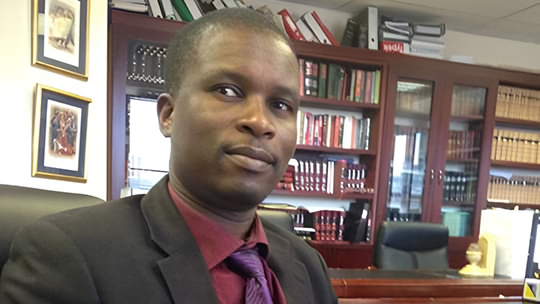
Human Rights Lawyer Sipho Gumedze represents the prosecutors, who are challenging their downgrading after the salary review exercise. (File pic)