

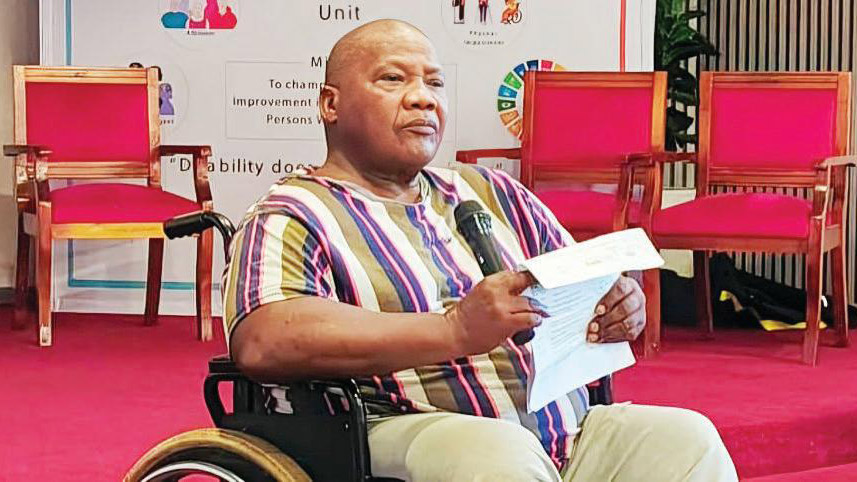
MBABANE – For years, Eswatini’s commitment to inclusive education has largely existed in policy documents, international conventions and ministerial speeches promising that no child would be left behind.
However, inside classrooms across the country, a far harsher reality continues to unfold quietly.
A newly-published study by the University of Eswatini (UNESWA) Associate Professor and Dean of Education, Professor S’lungile Thwala, has revealed deep cracks within the country’s education system. The research shows that more than half of emaSwati with disabilities have no formal education, despite years of reforms aimed at promoting inclusion. The study, published on 16 February this year, paints a picture of exclusion, inaccessible schools, underprepared teachers and persistent social stigma that continues to keep thousands of children with disabilities out of classrooms.
According to disability statistics cited in the research and supported by national education reports, persons with disabilities constitute between 13 and 16 per cent of Eswatini’s population.
Using the 2017 Population and Housing Census estimates, this translates to between 146 000 and 176 000 people.
Of these, approximately 52 per cent reportedly have no formal education. In practical terms, this means more than 70 000 emaSwati with disabilities may never have meaningfully entered the country’s education system.
These figures contrast sharply with the country’s commitment to Sustainable Development Goal Four (SDG 4), which promotes equitable and quality education for all.
Thwala’s study, titled ‘From Policy to Practice: Eswatini Perspective on the Implementation of Inclusive Education Policy’, examined policy documents, ministry reports and local research spanning more than two decades.
The research concluded that inclusive education in Eswatini remains largely aspirational, with a widening gap between government policy and classroom realities. Children with disabilities continue to be excluded from schools, hidden from public life or pushed through an education system that is neither designed nor adequately prepared to accommodate them.
At the centre of the problem, Thwala identified what she described as a ‘policy–practice gap’. Although the Ministry of Education and Training adopted the Education Sector Policy and the Special Education Policy in 2018 to guarantee equal educational opportunities, implementation remains weak.
*Full article available on Pressreader*





Leave a comment