

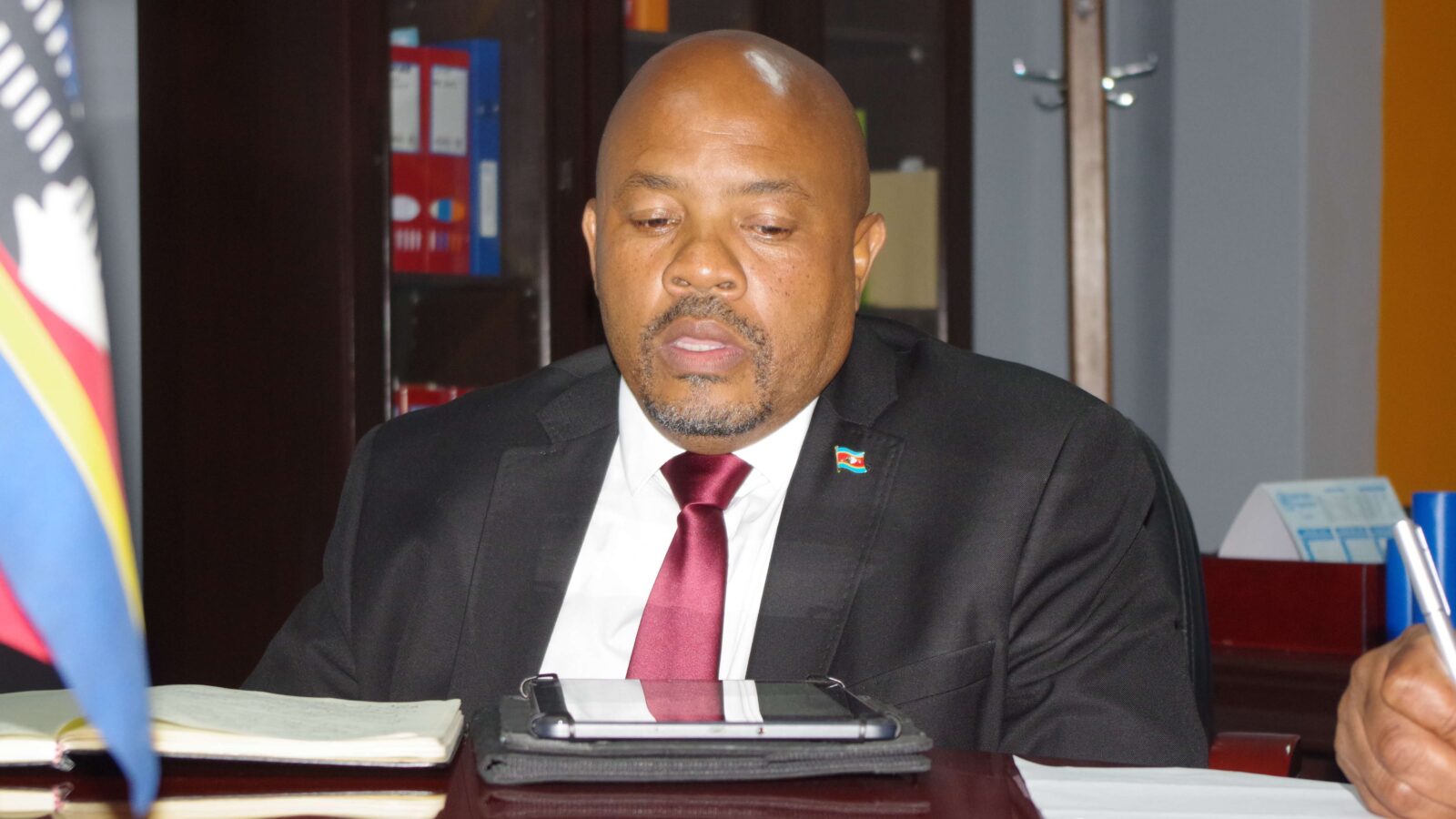
MBABANE – Minister for Health Mduduzi Matsebula, has outlined 10 challenges currently undermining Eswatini’s health system.
Most of these, he explains, stem from management flaws, an incoherent funding model and inadequate human resources.
He also decries old and decrepit infrastructure and facilities, which slow the work.
He asserts that government, of which he is a part, must take deliberate action to resolve both human resource and infrastructure deficits.
The minister, fresh from averting an imminent shutdown of the country’s largest referral hospital, Mbabane Government Hospital, is currently compiling a concise report for the House of Assembly, detailing the necessary steps to revitalise the public health sector.
Speaking candidly in an interview, Matsebula revealed that the Ministry of Health had requested approval to fill all vacant posts in January of this year.
However, due to budget constraints and competing government priorities, only a limited number of recruitments were sanctioned.
“The hiring freeze from Circular No. 3 of 2018 contributed significantly to the backlog. Health should have been exempted,” he stated.
The minister further noted that the situation has been exacerbated by the construction of new health facilities, such as the Mbabane Government Hospital’s emergency wing and other additional units, all of which require more staff. “We must create new posts, especially for specialists.
Utilising referrals outside the country is costly. For instance, with a limited number of specialists such as cardiologists in the country, we end up using the Phalala Fund when that money could be circulating locally,” he explained.
On the issue of poor emergency transportation, Matsebula said the ministry had acquired 70 vehicles, mostly ambulances, in the last 18 months. Nevertheless, several vehicles and ambulances purchased in earlier years remain parked due to mechanical issues and poor fleet management.
“We are doing our best, but most vehicles are not operational, which hampers emergency response and outreach programmes,” he noted.
Matsebula lamented the poor state of health facilities, many of which were built decades ago. “These facilities should give hope, not worsen patients’ health conditions. Renovations are ongoing at a snail’s pace due to budgetary constraints in facilities such as Pigg’s Peak, Hlatikhulu, Mbabane and others,” he said.
While new facilities like Ndunayithini at Sigwe and Mfishane have been completed, a number of maternity wards in clinics remain non-operational due to staff shortages.
“The aim is to bring services closer to the communities, but we need more personnel,” he concluded.
The 10 challenges
- The hiring freeze from Circular No. 3 of 2018 has seen most public healthcare facilities understaffed.
- Vehicles and ambulances bought in earlier years were parked due to mechanical issues and poor fleet management.
- Most clinics and hospital structures are not well maintained as they were built decades ago.
- Poor tools and equipment in public health facilities.
- Overcrowding in some facilities. The Manzini Psychiatric Centre houses 100 patients in a space meant for 70.
- Lack of decentralisation of services, forcing patients to travel from outlying areas such as Lavumisa to Mbabane for services such as CT scans.
- The hospitals have grown beyond the capacity of the current management structure, which is outdated and inefficient.
- Poor customer service in some health facilities.
- Overreliance on regional and international agencies to track and test medical drugs.
- The need to transform health funding.
Old equipment, overcrowding hamper services
MBABANE – The state of tools and equipment in public health facilities has been described as one of the Ministry of Health’s major challenges.
Health Minister Mduduzi Matsebula highlighted that much of the equipment in hospitals is outdated and no longer fit for purpose, citing the Pigg’s Peak Mortuary as a prime example of ageing infrastructure that is now malfunctioning.
“The problem is that most of our equipment has surpassed its lifespan. As government, we must start applying the principle of depreciation and replace machinery before it completely breaks down.
“In health, you can’t stop treating patients because the machines aren’t working. A mortuary, for example, is not optional. When someone passes on, they must be taken there, there’s no alternative.”
He warned that maintaining obsolete equipment often costs more than purchasing new equipment.
“Sometimes, the money used to repair old machines could have been used to buy new ones. Equipment must be replaced on time,” he added.
The minister said government, with the support of international partners, is gradually addressing the situation. He specifically acknowledged the Taiwanese Embassy, which recently donated six eye treatment machines and a CT scan.
“Previously, we only had one CT scan in the country. Today, we have two more. We’ve installed one more in Mbabane and the other one will be installed in Manzini. This is a big step, but more still needs to be done,” Matsebula stated.
Matsebula also revealed that conditions at the Manzini Psychiatric Centre are dire, with 100 patients housed in a space meant for 70. Despite budget constraints, he said the ministry managed to renovate another ward to ease the overcrowding.
“Even small issues like a lack of hair clippers in psychiatric wards can affect patient dignity. We are fixing these as we go,” he noted.
When the minister assumed office in November 2023, he says he found three non-functioning theatres at Mbabane Government Hospital. Today, three new theatres are operational in the emergency wing. While efforts to replace old equipment are ongoing, he admitted that the backlog is too extensive to resolve quickly.
“We’ve made deliveries across the country, but it’s still not enough. The gaps are too wide to be filled in just 18 months since I’ve been in office,” he said.
To address accessibility, the ministry aims to decentralise services so that patients in outlying areas such as Lavumisa do not have to travel to Mbabane for services such as CT scans.
“Government is making progress, but we are asking for patience. We have had only one financial year in office, and while we’re aware of the needs, it’s unrealistic to expect that all will be resolved in less than two years,” Matsebula remarked.
Health financing system needs urgent review – minister
MBABANE – The current health financing model needs to be reviewed because it is no longer sustainable, Minister for Health Mduduzi Matsebula, says.
The minister commended government’s efforts in providing affordable healthcare, noting that patients currently pay only E10 for medical attention. However, he questioned whether this minimal fee was sufficient to sustain the health services. “We used to have private wards in our hospitals, but most have been shut down. This is a missed opportunity for generating revenue, especially since there are people who can afford to pay more, including those on medical aid,” he said.
He cited the high cost of treating kidney patients as one of the major financial burdens.
“We have more than 200 patients undergoing dialysis with treatment costs averaging E20 000 per person each month, depending on the number of sessions.
“Government provides this service almost for free, yet not all patients are financially constrained. This is why we need to revisit and upgrade our health financing system,” Matsebula explained.
The minister also stressed the importance of better coordination of donor funding.
“There is a need to streamline the involvement of donors and development partners to ensure that critical national health needs are addressed more efficiently,” he said.
In addition, Matsebula highlighted the urgent need to strengthen Eswatini’s medical laboratories, especially in drug quality assessment. “We need a local facility to track and test medical drugs instead of relying on regional and international agencies. We have proposed a memorandum of understanding with the Medicine Regulatory Authorities of Zimbabwe and South Africa to assist us in the interim. Strengthening our laboratories is a national priority,” he concluded.
Corruption also major problem – SWADNU
MBABANE – The Swaziland Democratic Nurses Union (SWADNU) says corruption is also a major undoing of the current health crisis.
SWADNU Secretary General Mayibongwe Masangane, said government has neglected implementing forensic audit reports that outlined clearly where the problems of the country’s health institutions lie.
“We had a meeting with the minister last Friday where we discussed the challenges affecting the health sector. The ones he has mentioned were also deliberated on.
“However, we want corruption to be also be uprooted in as far as service delivery is concerned,” he said.
He also supported the move to transform the funding model of health institutions, saying the current position was not enabling to service delivery.
“However, if you change it, you need to explain how corruption will be avoided, so that we don’t find ourselves back to the very problem we were trying to resolve,” he said.
He also concurred that government structures are too old and need to be revamped.
Without the move to implement the forensic reports, he said he sees no political will to end the health crisis.
















Leave a comment