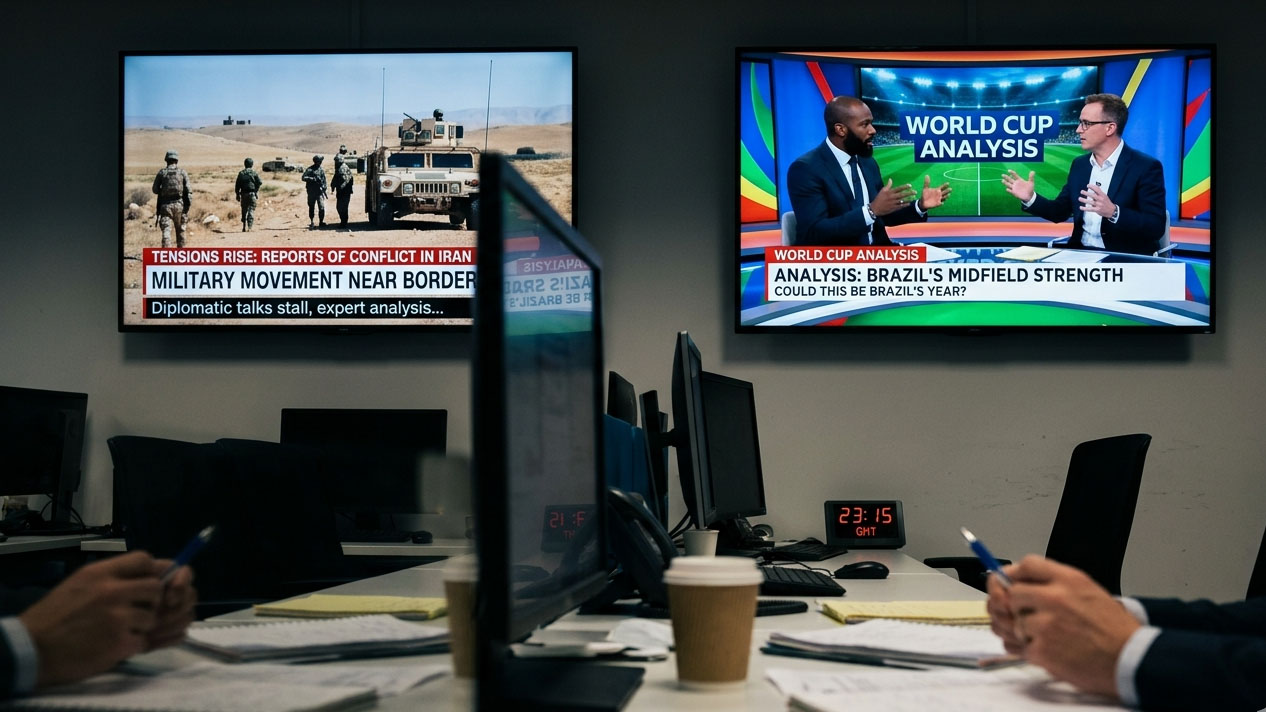
I realised this while sitting in the newsroom last week, watching one screen showing reports about tensions involving Iran and another showing analysis for the World Cup.
On one screen, experts were discussing whether the world was moving closer to another conflict. On the other, two grown men were arguing about whether Brazil’s midfield is strong enough to win the World Cup. The funny thing is, the football argument seemed far more emotional. That is when it hit me. The world has terrible timing.
Humanity is busy doing what humanity does best. Fighting, threatening, deporting, arguing, violating rights and generally behaving like a family reunion where nobody likes each other, but everybody insists on attending.
All this is happening right before the World Cup. Right before the World Cup. It’s disrespectful because if there is one event humanity should approach with a clear mind, it is the World Cup. Every four years, football gives us a rare opportunity to stop pretending we have our lives together. Doctors become coaches. Lawyers become referees. Journalists become tactical analysts and people who haven’t exercised since secondary school suddenly develop strong opinions about fitness levels. The World Cup is one of the few occasions where the entire planet confidently speaks about things it barely understands. Which, now that I think about it, is exactly how social media works. The world has terrible timing. Take the United States. For months, conversations have been dominated by immigration crackdowns, deportations and debates around human rights. Families are worried. Communities are anxious. Lawyers are working overtime. Politicians are doing what politicians do best: Blaming others.
Everybody has an opinion. Everybody has facts and everybody else’s facts are apparently wrong. Then the World Cup arrives. Suddenly, the same people who were debating immigration policy are debating whether the United States should start with two holding midfielders. The same passion. The same volume. The same certainty. Human beings are remarkable. We can move from constitutional law to corner kicks in under three minutes. Then there is Iran. Every week, there seems to be another headline. Military threats. Diplomatic warnings. Strategic responses.
Experts appear on television armed with maps and arrows. I don’t know who manufactures those arrows, but business must be booming.
Yet give it a few weeks and those same experts will be explaining why Argentina’s defence is vulnerable against high pressing teams. With the same confidence. Humanity’s greatest natural resource is confidence. Not oil. Not gold. Confidence. The world has terrible timing. What’s even more fascinating is how easily human rights have become negotiable. Some governments bend them. Others ignore them. And supporters on every side somehow find a way to justify it. These days, some people only believe in human rights when the rights belong to people they already agree with. That’s not a principle. That’s a fan club. Imagine applying football rules the same way. That sounds ridiculous. Yet somehow that’s how many serious debates now unfold. Perhaps that’s why the World Cup matters. Not because football solves problems. It doesn’t. The final cannot stop a war. A penalty shootout cannot lower inflation. And no striker in the world can fix politics. Trust me, if footballers could fix politics, half of them wouldn’t even be able to explain the offside rule; but football does something else.
It interrupts the noise. For a few weeks, the world becomes one giant conversation. A businessman in London. A taxi driver in Mbabane. A teacher in Siteki. A student in Cairo. A farmer in Brazil. A banker in New York. People who have absolutely nothing in common suddenly start discussing the same thing. “Did you watch the match?” Not: “What is your political affiliation?” Not: “What are your views on immigration?” Not: “Where do you stand on international relations?” Just: “Did you see that goal?” I find that beautiful and strange. Mostly strange because football achieves in one evening what politicians have failed to achieve in generations. Temporary unity. Very temporary. Let’s not exaggerate. The same people hugging each other after a goal will be arguing on Facebook three weeks later, but for a moment, the walls come down. The world has terrible timing and football has perfect timing.
That is why every World Cup feels like a global ceasefire. Not because the problems disappear. The wars don’t disappear. The deportations don’t disappear. Human rights don’t suddenly become universally respected. Politicians don’t wake up honest. The problems simply wait outside while humanity attends football. What a gathering it becomes. In a few weeks’ time, somebody in Nhlangano, somebody in Pigg’s Peak, somebody in Toronto and somebody in Mexico City will all wake up thinking about the same thing. A football match. Not inflation. Not conflict. Not geopolitics. A football match. Humanity is strange like that.
And England supporters... May God continue to strengthen England supporters. Every World Cup follows the same cycle. “This is our year.”
Then a draw. Then optimism. Then the calculations. Then disappointment. Then a documentary. Then another declaration that next time will definitely be their year. It is less a football campaign and more a religious tradition, but perhaps that’s what makes the World Cup special. For a few weeks, the world becomes smaller. People who disagree on everything suddenly agree on line-ups. People who cannot speak the same language somehow understand each other through football. People who will never meet share the same joy, the same frustration and the same heartbreak. The wars won’t stop.
The deportations won’t stop. The politicians won’t suddenly become saints. The problems will still be waiting for us after the final whistle, but for a little while, humanity will remember something social media keeps trying to make us forget. We actually have more in common than we think. Of course, being human, we’ll still find something to argue about. And that is where the referee comes in, because every World Cup eventually produces a moment so controversial that it unites the entire planet. Not in peace. Not in diplomacy. Not in love. In outrage. A billionaire in New York. A farmer at Vuvulane. A student in Cairo. A taxi driver in Taipei. A journalist sitting in a newsroom. All shouting exactly the same thing at exactly the same time. ‘The referee is blind!’ Perhaps that is the closest thing humanity has ever produced to world peace.
On one screen, experts were discussing whether the world was moving closer to another conflict. On the other, two grown men were arguing about whether Brazil’s midfield is strong enough to win the World Cup.