

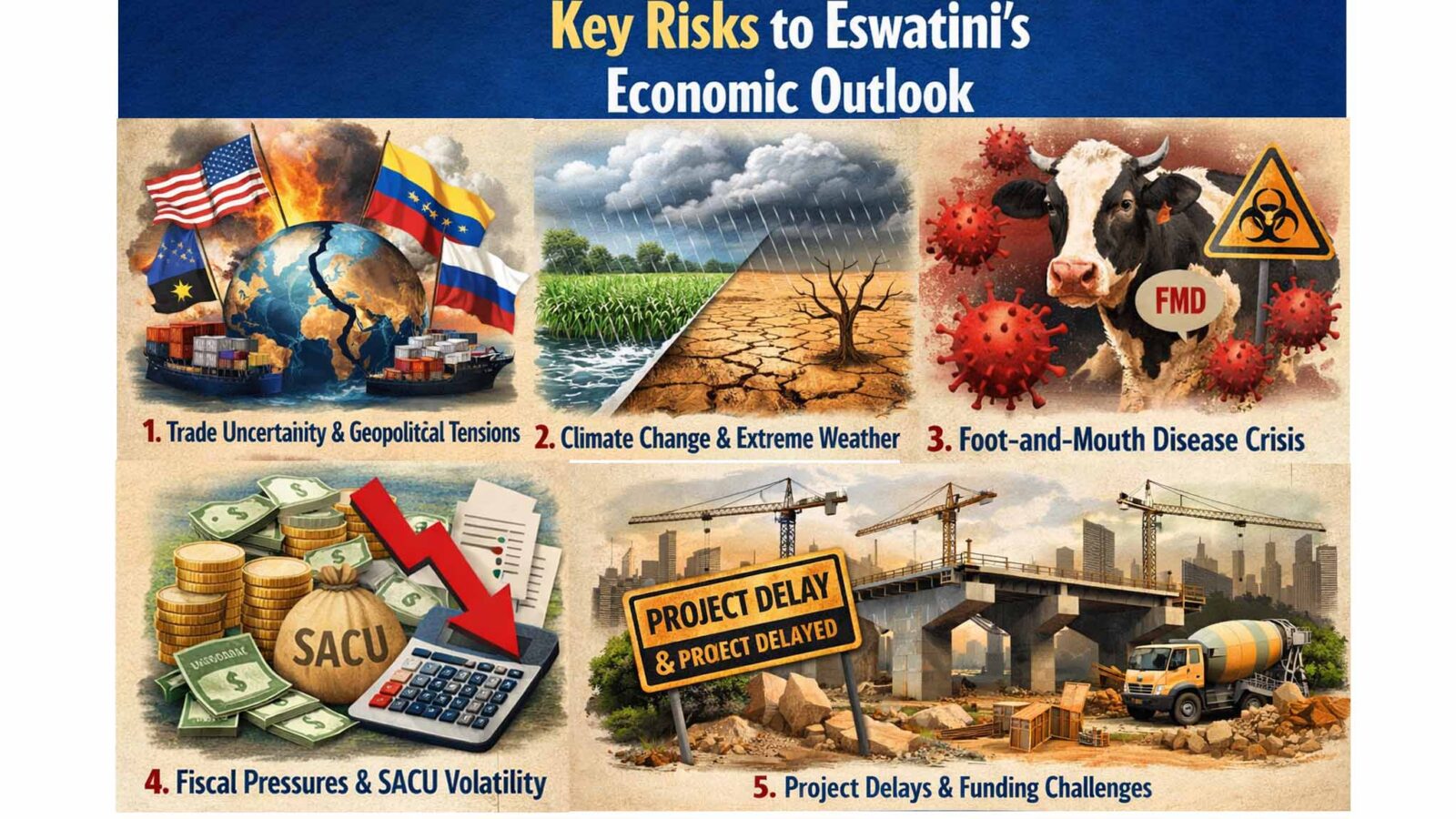
MBABANE – Despite an improved growth trajectory in the coming years, Eswatini’s medium-term economic outlook remains exposed to five clearly defined downside risks, arising from both global and domestic pressures.
According to the Eswatini Medium-Term Economic Growth Forecasts (2025–2030) released in January 2026, international trade uncertainty has emerged as a significant concern.
Heightened geopolitical tensions, including strained relations involving the United States and Venezuela, alongside the prolonged Russia–Ukraine conflict, continue to dampen global confidence and disrupt supply chains. For a small, open economy like Eswatini, such disruptions are transmitted quickly through trade, investment flows and commodity prices, raising vulnerability to external shocks.
International trade uncertainty and geopolitical tensions: International trade uncertainty remains a major external risk.
Heightened geopolitical tensions, notably those involving the United States and Venezuela, alongside the protracted Russia–Ukraine conflict, continue to dampen global confidence and disrupt supply chains.
For Eswatini, a small and open economy heavily reliant on external markets, such disruptions heighten exposure to volatile commodity prices, weaker export demand, and unpredictable capital flows, potentially constraining medium-term growth.
Climate-related vulnerabilities and erratic weather: Climate-related risks further weaken the outlook. Increasingly erratic weather patterns, characterised by excessive rainfall and periodic droughts, pose serious threats to agriculture and agro-processing.
These sectors are vital to food security, rural livelihoods and export earnings. Weather shocks also delay infrastructure projects and raise construction costs, compounding growth challenges.
Foot-and-mouth disease impact on livestock and exports: The ongoing foot-and-mouth disease outbreak represents a significant sector-specific risk. The crisis has already undermined livestock production and threatens access to key export markets. Given the importance of animal production to rural incomes and foreign exchange earnings, prolonged containment challenges could have lasting economic consequences.
Domestic fiscal pressures and SACU revenue volatility
Domestic fiscal pressures remain elevated, largely due to volatility in Southern African Customs Union (SACU) receipts.
As SACU revenues constitute a substantial share of government income, fluctuations pose risks to fiscal sustainability, capital investment planning, and service delivery. Any sharp decline could force difficult fiscal adjustments.
Project funding constraints and implementation challenges: Finally, delays in external funding and persistent weaknesses in public-sector project implementation threaten growth prospects. Funding uncertainties could stall major capital projects – particularly in construction – while inefficiencies in procurement and execution may dilute the growth impact of public investment.
*…
Outlook for 2027 and the outer years
MBABANE – Economic growth for 2027 has been revised sharply upward to 3.9 per cent from a previous projection of 1.6 per cent.
Over the 2028–2030 period, average growth is now expected at 3.8 per cent, compared to an earlier estimate of 3.3 per cent.
These improvements largely reflect the deferral of construction activity into later years and the inclusion of new medium-term initiatives not previously incorporated into forecasts.
*…
Secondary sector growth revised slightly downward
MBABANE – Growth in the secondary sector has been revised slightly downward, with output now projected to expand by 4.4 per cent in 2025 and 5.7 per cent in 2026, compared to earlier forecasts of 5.7 per cent and 7.7 per cent.
The weaker outlook for 2025 reflects lower-than-expected construction activity, driven by excessive rainfall and logistical challenges that delayed the commencement of several major building and road projects in the last quarter of the year.
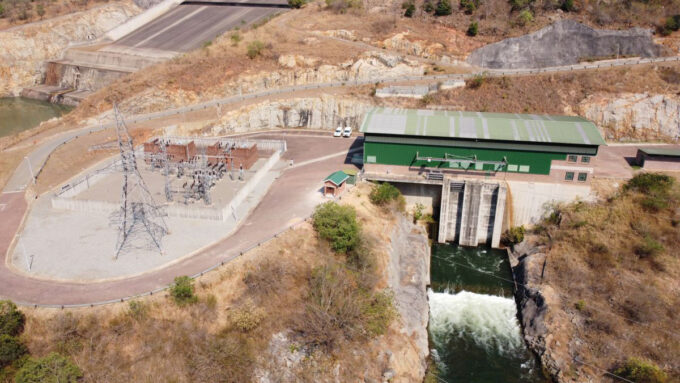
Despite these challenges, there were positive developments within the sector. Higher rainfall supported dam levels, boosting hydropower generation.
Electricity supply is, therefore, expected to increase by 10.6 per cent in 2025 and by a further 3.4 per cent in 2026.
Manufacturing performance was also revised upward, benefitting from improved output in key industries aligned with strengthening external demand. Export-oriented subsectors such as sugar, textiles, forestry and wood products recorded improved performance, although exchange rate movements may weigh on export receipts in the short-term.
*Full article available on Pressreader*


















Leave a comment